
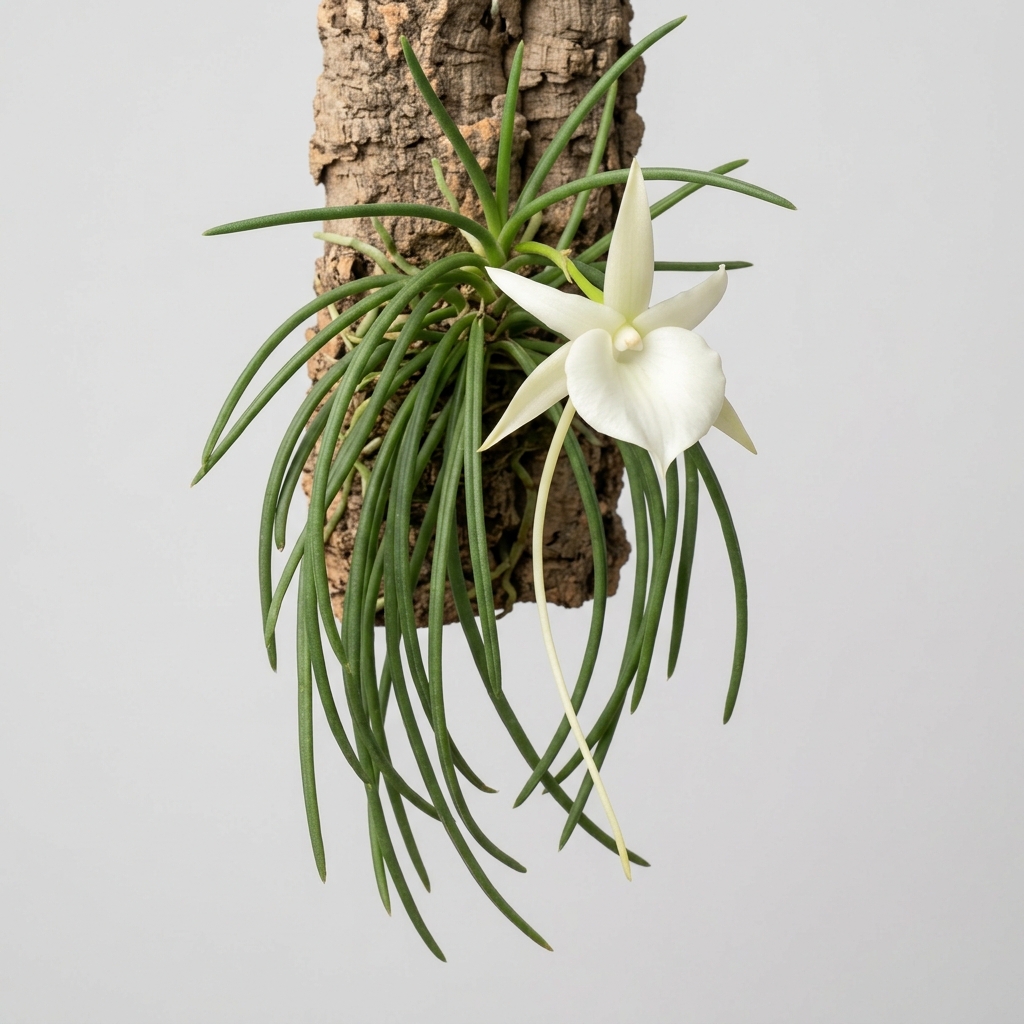
Angraecum Scottianum is a highly prized orchid species native to the Comoro Islands, celebrated for its distinctive growth habit and striking, long-spurred flowers. Belonging to the subtribe Angraecinae, this epiphytic orchid stands out with its slender, terete leaves that resemble pine needles, presenting a stark contrast to the broad-leaved foliage of most other angraecoid orchids. Growers value this species not only for its unique vegetative appearance but also for its elegant, pristine white blooms that seem to float gracefully in the air.
In cultivation, Angraecum Scottianum is appreciated for its relatively compact size and its willingness to bloom when provided with consistent, high-humidity conditions. The flowers exhibit a fascinating non-resupinate presentation, meaning the lip is positioned at the top of the bloom rather than the bottom, trailing a remarkably long nectary spur behind it. This species is an exceptional choice for orchid enthusiasts looking to add a touch of architectural elegance and nocturnal fragrance to their indoor or greenhouse collections.
💡 Did You Know?
The exceptionally long spur of Angraecum Scottianum is a classic example of coevolution. In its native Comoro Islands, this orchid relies on specific species of nocturnal hawkmoths with extraordinarily long tongues to reach the nectar at the bottom of the spur, pollinating the flower in the process.
🌿 Botanical Overview
Angraecum Scottianum is an epiphytic orchid that naturally grows on trees in the humid forests of the Comoro Islands, situated off the southeastern coast of Africa. Unlike many of its larger relatives in the genus Angraecum, this species features a more delicate, pendulous to semi-erect growth habit. Its stems are thin and woody, slowly branching over time to form attractive, cascading specimens.
The most defining vegetative feature of Angraecum Scottianum is its terete foliage. The leaves are narrow, cylindrical, and channeled, designed to minimize water loss in its native canopy environment. This specialized leaf structure allows the orchid to tolerate slight dry spells, though it thrives best in a consistently humid atmosphere with excellent air circulation, mimicking the gentle breezes of its island home.
🌸 Flower Characteristics
The flowers of Angraecum Scottianum are a marvel of evolutionary adaptation, typically measuring around two to three inches across. Each bloom is dominated by a large, pristine white, shell-shaped lip that is positioned uppermost due to the non-resupinate nature of the flower. The sepals and petals are narrow, linear, and often reflexed backward, which serves to accentuate the broad, dramatic presentation of the labellum.
Extending from the base of the lip is a remarkably long, slender, greenish-white spur that can reach up to six inches in length. This spur houses nectar at its very tip, a classic trait of angraecoid orchids designed to attract specific nocturnal pollinators with long proboscises. The flowers are produced singly or in pairs on short, slender inflorescences that emerge from the leaf axils, creating a delicate, suspended display.
Fragrance & Bloom Profile
True to its evolutionary lineage, Angraecum Scottianum produces a distinct fragrance that becomes highly pronounced after dusk. The scent is sweet, rich, and often compared to jasmine or gardenia, designed to guide night-flying hawkmoths to the nectar-filled spurs. During the day, the flowers are virtually scentless, conserving energy until their specific pollinators become active.
The blooms are long-lasting, often remaining in perfect condition for four to six weeks if kept in a cool, stable environment. The pristine white color of the flowers does not fade significantly over time, though older blooms may take on a soft cream or ivory hue just before senescing. To maximize the fragrance experience, growers often place this orchid in living spaces where the evening scent can be fully appreciated.
Parentage & Hybrid Lineage
Angraecum Scottianum is a naturally occurring species rather than a man-made hybrid. In the orchid world, it is classified as a distinct species within the genus Angraecum, and its wild origins are well-documented in the Comoro Islands. Because of its unique terete foliage and impressive spur length, it has occasionally been used by hybridizers to introduce compact growth habits and long spurs into novel angraecoid crosses.
While some registered hybrids exist, they are relatively rare in the commercial market compared to the species itself. When purchasing this orchid, growers are almost always acquiring the true species. Because wild populations are protected, reputable nurseries propagate Angraecum Scottianum through seed raising or tissue culture, ensuring that commercially available plants do not impact wild habitats.
🌱 Growing Conditions
To cultivate Angraecum Scottianum successfully, growers should aim to replicate its tropical island canopy habitat. This orchid prefers bright, filtered light, similar to the conditions favored by Cattleya orchids. Direct midday sun should be avoided as it can scorch the terete leaves, but sufficient light is crucial for stimulating flower production. East or shaded south-facing windows are often ideal.
💡 Care Tip
To keep your Angraecum Scottianum thriving, prioritize air movement. Because this species requires high , stagnant air can quickly lead to fungal infections. A small, continuous fan placed near the growing area is highly beneficial.
Temperature: wise, this species thrives in intermediate to warm conditions. Daytime temperatures should ideally range between 75 and 85 degrees Fahrenheit, with a nighttime drop to 60 or 65 degrees Fahrenheit. High humidity is essential, ideally maintained between 60% and 80%. Because high humidity can lead to stagnant air and fungal issues, a small fan should be kept running nearby to provide continuous, gentle air movement.
Watering, Feeding & Potting Media
Angraecum Scottianum requires a watering regimen that keeps the roots moist but never waterlogged. Because of its pendulous growth habit and aerial root system, many growers prefer to cultivate this species mounted on cork bark or tree fern plaques with a small pad of sphagnum moss around the roots. Mounted plants will need daily watering or heavy misting in warm weather, as they dry out very rapidly.
If grown in pots or baskets, a highly open, free-draining medium is mandatory. A mix of medium-grade orchid bark, charcoal, and perlite works well, or it can be grown in open wooden baskets with coarse bark. During the active growing season, apply a balanced, diluted orchid fertilizer at one-quarter strength every two weeks. Flush the growing medium with pure water once a month to prevent harmful salt buildup.
Blooming Season & Care Notes
The primary blooming season for Angraecum Scottianum typically occurs in late spring through summer, though well-established plants in stable greenhouse conditions may bloom at other times of the year. The initiation of flower spikes is often triggered by the natural increase in day length and light intensity during the spring months.
Once the flower spikes begin to emerge from the leaf axils, avoid changing the plant’s orientation to the light source, as this can cause the developing buds to twist unnaturally. After the blooms have faded, the flower spikes should be cut back close to the stem using sterilized cutting tools. Repotting or remounting should only be performed when new root growth is active, typically in the spring, to minimize transplant shock.
⚠️ Common Issues
⚠️ Common Mistake
The most common mistake when growing Angraecum Scottianum is keeping the roots in a heavy, waterlogged potting mix. This species has aerial roots that require rapid drying and high oxygen levels; using dense soil or fine bark will quickly lead to root rot.
- Root Rot: Caused by overwatering or compacted potting media that deprives the roots of oxygen.
- Bud Blast: Occurs when sudden drops in humidity, drafts, or temperature fluctuations cause developing buds to yellow and drop.
- Leaf Shriveling: A sign of dehydration, often due to insufficient watering of mounted specimens or a loss of the root system.
- Scale and Mealybugs: Pests that can hide in the tight crevices of the terete leaf bases and must be treated with horticultural oil or insecticidal soap.
- Fungal Leaf Spotting: Can develop if water is allowed to sit on the foliage overnight without adequate air circulation.
❓ Frequently Asked Questions
Can Angraecum Scottianum be grown indoors on a windowsill?
Yes, Angraecum Scottianum can be successfully grown on a bright windowsill, provided the humidity is kept high. Placing the plant on a humidity tray or using a room humidifier will help maintain the required moisture levels, while a sheer curtain can protect the foliage from direct, scorching sunlight.
Why are the leaves on my Angraecum Scottianum turning yellow?
Yellowing leaves can indicate several issues, most commonly overwatering or insufficient light. If the lower leaves yellow and drop, check the roots for rot. If the entire plant appears pale or yellow, it may be receiving too much direct sunlight, requiring a move to a more shaded location.
How often should I water a mounted Angraecum Scottianum?
Mounted specimens dry out quickly and typically require daily watering or thorough misting, especially during the warm summer months. In winter, or during periods of high ambient humidity, watering can be reduced to every other day, but the roots should never be allowed to remain bone-dry for extended periods.
Does Angraecum Scottianum require a winter rest period?
Angraecum Scottianum does not require a severe dry winter rest, but it does benefit from a slight reduction in watering and fertilizer during the cooler, darker winter months. Maintain high humidity and bright light, and resume regular watering and feeding schedules once new growth appears in spring.
⭐ Final Growing Notes
Angraecum Scottianum is a rewarding and visually captivating orchid that brings a touch of exotic elegance to any collection. While its high humidity and air movement requirements make it slightly more demanding than common mass-market orchids, its unique needle-like foliage and magnificent, night-scented blooms make the extra effort entirely worthwhile. By mimicking its native island canopy environment, growers can enjoy the architectural beauty and enchanting evening fragrance of this remarkable species for many years.
⚕️ Health, Safety & Edibility
Understanding how a plant interacts with people, pets, and the surrounding environment is part of responsible cultivation. This section uses conservative, general guidance and does not replace professional medical or veterinary advice.
Human Safety: No published evidence currently identifies species-specific toxicity concerns for Angraecum Scottianum during normal handling. As with most ornamental plants, it should not be intentionally consumed.
Pet Safety: Published information does not indicate that this orchid commonly poses a toxicity concern for cats or dogs. However, chewing leaves, flowers, roots, or potting media may still cause mild digestive upset.
Edibility: This orchid is cultivated for ornamental display rather than food. Ornamental plants may carry fertilizers, pesticides, or other horticultural treatments that make them unsuitable for consumption.
Skin Contact: Routine handling is not generally associated with skin irritation. Gardeners with sensitive skin may prefer wearing gloves when repotting, pruning, or handling potting media.
🌱 Propagation Tip
Propagation of Angraecum Scottianum is typically achieved through seed culture in a sterile laboratory environment. For home growers, mature plants may occasionally produce basal offsets or keikis, which can be carefully detached once they have developed several strong roots of their own.
⭐ Expert Advice
If you struggle to maintain the high this orchid craves, try growing it in an open wooden basket lined with high-quality sphagnum moss. This setup provides a perfect balance of moisture retention around the roots while still allowing excellent airflow.

Leave A Comment