
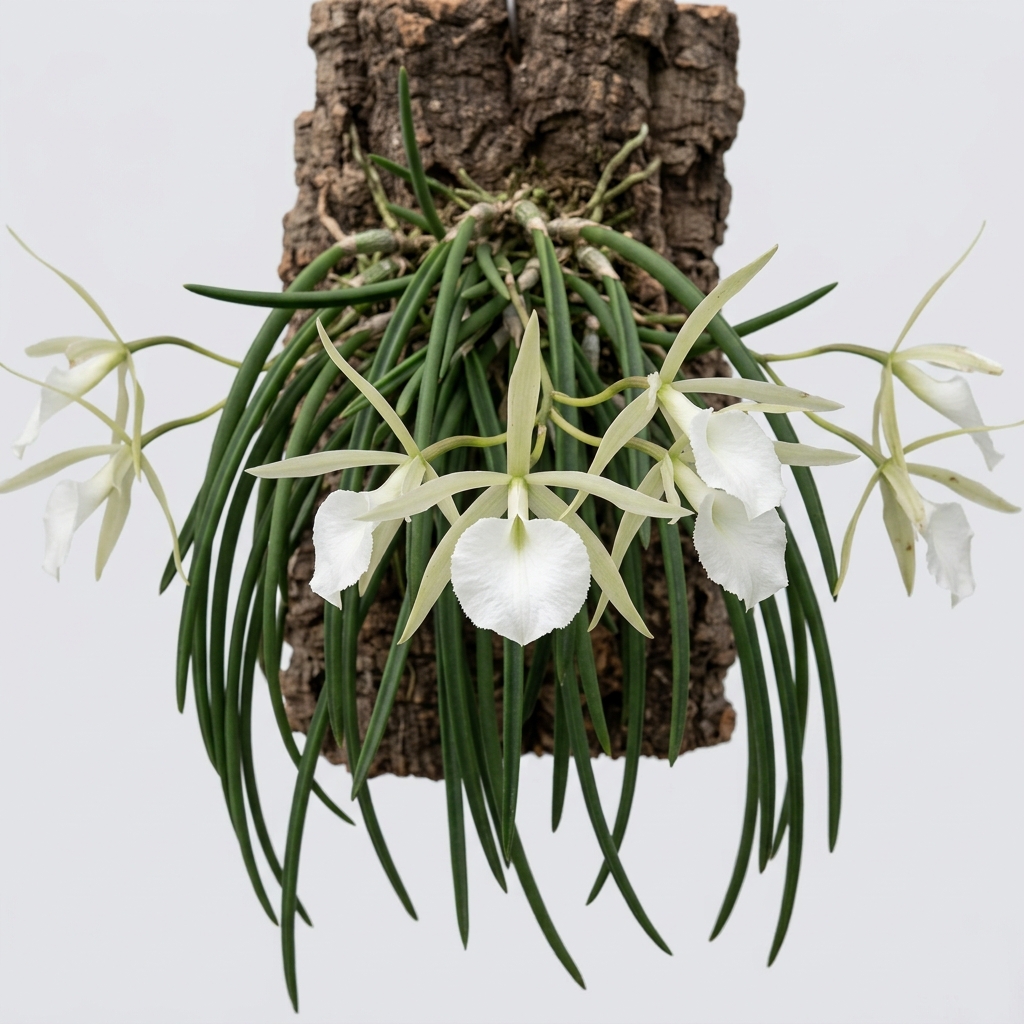
Brassavola Acaulis is a distinctive epiphytic orchid species highly prized by collectors for its striking pendulous growth habit and elegant, night-fragrant blossoms. Belonging to the esteemed Cattleya alliance, this orchid is native to the tropical forests of Central America, where it typically grows on tree trunks and branches. Unlike many of its upright relatives, its narrow, terete leaves drape gracefully downward, making it an useful selection for mounted cultivation or hanging baskets.
Growers value this orchid not only for its unique cascading silhouette but also for its large, starry flowers that feature a prominent, heart-shaped white lip. When in bloom, a single specimen can fill an entire growing space with a rich, sweet perfume after dusk. Its resilient nature and adaptability to intermediate and warm conditions make it a rewarding choice for both intermediate hobbyists and experienced orchid enthusiasts seeking a dramatic structural element for their collection.
💡 Did You Know?
The species name acaulis literally means stemless in botanical Latin. This refers to the orchid's exceptionally short, almost invisible pseudobulbs, which make the long, fleshy, needle-like leaves appear to grow directly out of the creeping rhizome. This unique adaptation helps the plant maintain a low, wind-resistant profile on its native tree-trunk hosts.
🌿 Botanical Overview
Brassavola Acaulis is characterized by its unique vegetative structure, which sets it apart from many other members of its genus. The specific epithet acaulis translates to stemless, highlighting the orchid’s extremely short, inconspicuous pseudobulbs. These abbreviated stems give the illusion that the long, fleshy, cylindrical leaves emerge directly from the creeping rhizome. This compact growth habit allows the plant to hug its host tree tightly in its native canopy habitats.
The leaves themselves are terete, meaning they are rounded and pencil-like in cross-section, a morphological adaptation designed to minimize water loss in high-light, wind-swept environments. This succulent-like foliage stores moisture efficiently, enabling the orchid to withstand short periods of drought. In cultivation, this growth form dictates a mounting or basket-growing approach to accommodate the natural downward drape of the foliage.
🌸 Flower Characteristics
The blossoms of Brassavola Acaulis are a testament to the classic beauty of the genus, presenting a starry, elegant form. Each inflorescence typically produces one to three large flowers, which can measure up to several inches in diameter. The sepals and petals are narrow, elongated, and often exhibit a pale green, cream, or light yellow hue that frames the central feature of the flower.
The most prominent element is the large, pristine white labellum, or lip, which is broad, spade-shaped, and occasionally marked with delicate greenish or yellowish tones deep within the throat. The flowers emerge from the base of the leaf joints and hang downward, aligning perfectly with the pendulous habit of the foliage. This presentation creates a cascading display of white stars against the dark green, needle-like leaves.
Fragrance & Bloom Profile
Like many members of the Brassavola genus, Brassavola Acaulis is celebrated for its nocturnal fragrance. During the daylight hours, the flowers remain virtually scentless, conserving energy and resources. As dusk approaches, the blooms begin to release a powerful, sweet perfume with citrus and floral undertones, designed to attract night-flying moth pollinators in the wild.
This nocturnal scent profile is highly consistent among healthy specimens, though the intensity can vary depending on ambient temperature and humidity levels. The blooms are relatively long-lasting, often remaining fresh for three to five weeks if kept in a cool, stable environment. To fully appreciate this sensory feature, growers often place blooming specimens in living areas or near open windows where the evening breeze can disperse the fragrance.
Parentage & Hybrid Lineage
Brassavola Acaulis is a distinct, naturally occurring species rather than a man-made hybrid. While its exact evolutionary history and wild distribution are subject to ongoing botanical study, it is widely recognized as a valid species within the subtribe Laeliinae. In historical literature, it has occasionally been confused with or grouped alongside Brassavola nodosa, but modern taxonomists distinguish it by its shorter pseudobulbs, longer pendulous leaves, and larger flower size.
In orchid hybridization, Brassavola Acaulis has been utilized to introduce its pendulous growth habit, compact stem structure, and large lip size to new grexes. Hybrids derived from this species often inherit the characteristic starry flower shape and nocturnal fragrance, though these traits can vary depending on the dominant characteristics of the breeding partner.
🌱 Growing Conditions
To cultivate Brassavola Acaulis successfully, growers should attempt to replicate its native tropical canopy environment. This species thrives in bright, indirect light, similar to the conditions preferred by many Cattleyas. A slight yellow-green tint on the cylindrical leaves indicates that the plant is receiving optimal light levels, whereas dark green leaves suggest insufficient light, which may inhibit blooming.
💡 Care Tip
Because of its downward-draping growth habit, mount this orchid on a cork bark or tree fern plaque rather than potting it. This allows the roots to breathe freely and mimics its natural epiphytic environment, preventing moisture from pooling around the crown.
Temperature ranges should be kept warm to intermediate, with daytime temperatures between 75°F and 85°F (24°C to 29°C) and a slight drop at night to around 60°F to 65°F (15°C to 18°C). High humidity, ideally between 50% and 70%, is essential, especially when the orchid is grown mounted. To prevent fungal issues in these humid conditions, continuous and active air circulation must be maintained around the foliage and root zone.
Watering, Feeding & Potting Media
Because of its pendulous growth habit and susceptibility to root rot, Brassavola Acaulis is most successfully grown when mounted on cork bark, tree fern plaques, or placed in open slatted wooden baskets. If potted, a highly porous, fast-draining medium such as extra-large fir bark mixed with charcoal and perlite is mandatory to ensure the roots dry rapidly after watering.
Watering frequency depends heavily on the mounting method. Mounted plants may require daily watering during the hot summer months, while those in baskets or pots should be watered only when the medium has dried out completely. During the active growing season, apply a balanced, highly diluted orchid fertilizer weekly, following the weakly, weekly method. Flush the root zone with pure water periodically to prevent salt buildup.
Blooming Season & Care Notes
The primary blooming season for Brassavola Acaulis typically occurs in late spring and throughout the summer, although healthy plants can occasionally produce flowers at other times of the year. The initiation of flower buds is closely tied to seasonal light increases and consistent watering. Once the flower spikes begin to emerge from the leaf bases, avoid changing the plant’s orientation to the light source, as this can cause the buds to twist or fail to open properly.
After the blooming cycle concludes, the orchid enters a brief period of semi-dormancy. During this time, watering should be slightly reduced, allowing the plant to rest before the next flush of vegetative growth begins. Repotting or remounting is best performed just as new root tips begin to emerge from the base of the newest growth, minimizing transplant shock.
⚠️ Common Issues
⚠️ Common Mistake
The most frequent error is overwatering this orchid when grown in traditional pots. Its roots require rapid wet-to-dry cycles, and keeping the growing medium constantly damp will quickly lead to root rot, leaf drop, and the eventual decline of the plant.
- Root Rot:
Caused by overwatering or compacted, water-retaining potting media that deprives roots of oxygen. - Dehydration:
Indicated by shriveled, wrinkled cylindrical leaves, often due to insufficient watering of mounted specimens. - Bud Blast:
Sudden dropping or yellowing of flower buds, usually triggered by drastic changes in temperature, drafty conditions, or low humidity. - Scale and Mealybugs: Pests that hide in the tight crevices at the base of the leaves and pseudobulbs; treat promptly with insecticidal soap or horticultural oil.
- Leaf Spotting: Fungal or bacterial spots arising from water sitting on the foliage overnight in stagnant air.
❓ Frequently Asked Questions
Can Brassavola Acaulis be grown in a standard plastic pot?
While it is possible, growing this species in a standard plastic pot is highly discouraged due to its pendulous growth habit and strict requirement for rapid drying. If you must use a pot, opt for a clay orchid pot with ample side slits and fill it with an extremely coarse, free-draining bark medium to prevent root rot.
How do I know if my Brassavola Acaulis is getting enough light?
The foliage is the best indicator of light levels. Healthy leaves should be a light, olive-green color, sometimes displaying tiny purple freckles under high-light conditions. If the leaves are deep forest green, the orchid is not receiving enough light to trigger successful blooming.
Why are the flower buds on my orchid turning yellow and falling off?
This issue, known as bud blast, is typically caused by environmental stress. Common culprits include sudden temperature drops, dry indoor air, drafty locations near heating or cooling vents, or moving the plant to a different spot while the buds are actively developing.
How often should I water a mounted Brassavola Acaulis?
Mounted specimens dry out very quickly and generally require daily watering during the warm spring and summer growing seasons. In winter, or during periods of high humidity and cloudy weather, you can reduce watering to every two to three days, ensuring the roots dry completely between applications.
⭐ Final Growing Notes
Brassavola Acaulis remains a captivating species that rewards attentive growers with its architectural foliage and spectacular, night-scented blooms. By prioritizing high light, excellent air movement, and a mounting method that respects its natural pendulous growth, you can enjoy this tropical treasure for many years. Its low-maintenance nature, once its basic moisture and light requirements are met, makes it a stellar addition to any diverse orchid collection.
⚕️ Health, Safety & Edibility
Understanding how a plant interacts with people, pets, and the surrounding environment is part of responsible cultivation. This section uses conservative, general guidance and does not replace professional medical or veterinary advice.
Human Safety: No published evidence currently identifies species-specific toxicity concerns for Brassavola Acaulis during normal handling. As with most ornamental plants, it should not be intentionally consumed.
Pet Safety: Published information does not indicate that this orchid commonly poses a toxicity concern for cats or dogs. However, chewing leaves, flowers, roots, or potting media may still cause mild digestive upset.
Edibility: This orchid is cultivated for ornamental display rather than food. Ornamental plants may carry fertilizers, pesticides, or other horticultural treatments that make them unsuitable for consumption.
Skin Contact: Routine handling is not generally associated with skin irritation. Gardeners with sensitive skin may prefer wearing gloves when repotting, pruning, or handling potting media.
🌱 Propagation Tip
Propagate this species by dividing mature clumps during the spring repotting cycle. Ensure each division has at least three to four healthy, mature pseudobulbs with active root systems, and secure the new divisions tightly to their new mounts to encourage rapid establishment.
⭐ Expert Advice
To maximize flower production, provide a slight drop in night temperatures during the late winter months. This subtle differential, combined with high levels, acts as a natural trigger for the development of healthy flower spikes in the spring.

Leave A Comment