
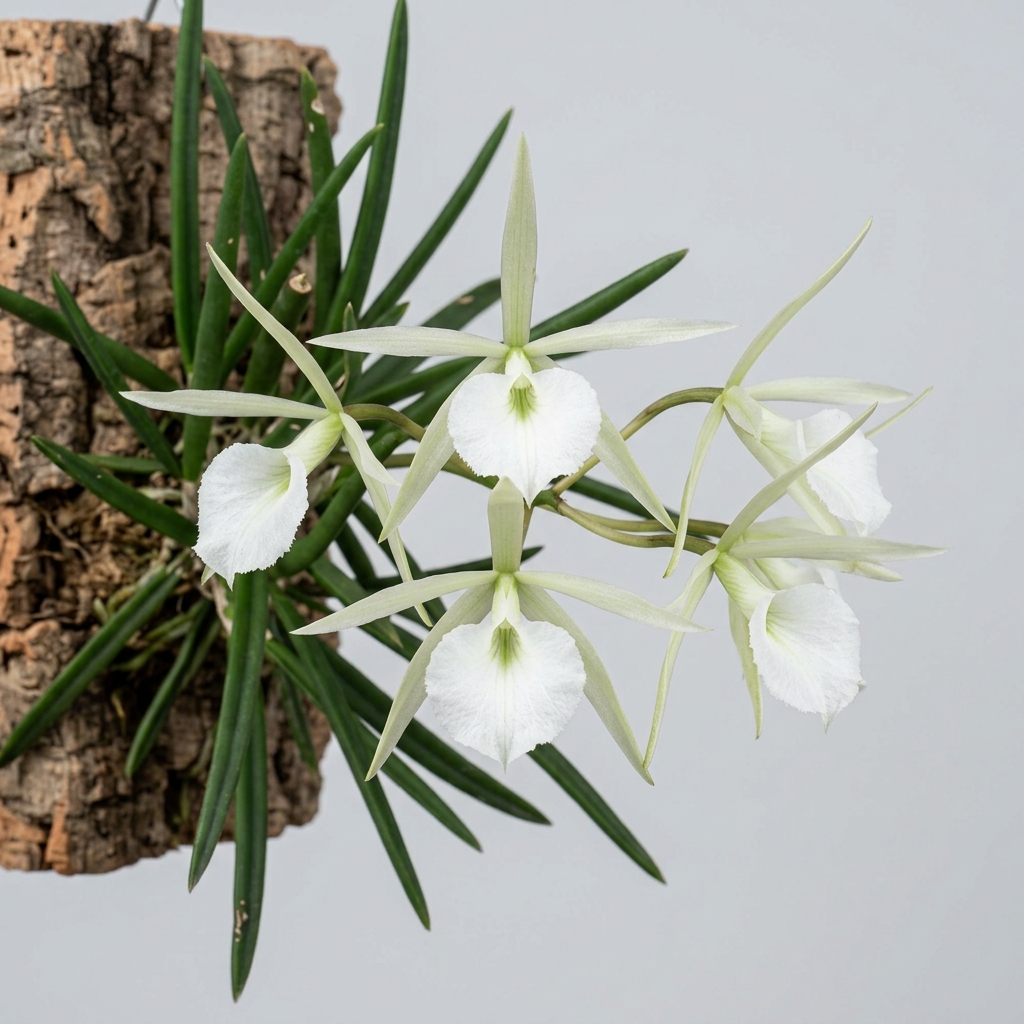
Brassavola Tuberculata is a captivating epiphytic orchid species highly prized by collectors for its striking, star-shaped blossoms and remarkable nocturnal fragrance. Belonging to the genus Brassavola, this resilient orchid features distinctive, pencil-like terete leaves that help it conserve moisture in its native South American habitats. Its elegant growth habit and low-maintenance nature make it an exceptional choice for both novice and experienced orchid enthusiasts seeking a reliable bloomer.
In cultivation, this species is celebrated for its ability to thrive mounted on cork bark or grown in highly draining baskets, mimicking its natural epiphytic lifestyle. The pale green to white flowers contrast beautifully against the dark, needle-like foliage, creating a dramatic visual display when in full bloom. Its adaptability to varying light levels and tolerance of occasional dry spells have secured its status as a staple in warm-climate orchid collections.
💡 Did You Know?
The narrow, cylindrical leaves of Brassavola Tuberculata are a specialized evolutionary adaptation called terete leaves. By minimizing their surface area, these leaves significantly reduce water loss through transpiration, allowing the orchid to survive prolonged dry periods on exposed tree branches and rock faces in its native South American habitats.
🌿 Botanical Overview
Brassavola Tuberculata is native to the rocky and forested regions of Brazil, Argentina, Paraguay, and Bolivia. It grows primarily as an epiphyte on tree trunks or as a lithophyte on exposed rock faces, where it is subjected to bright sunlight and drying winds. To survive these conditions, the plant has evolved specialized terete leaves that are narrow, cylindrical, and deeply channeled, minimizing surface area to reduce water loss.
The pseudobulbs are slender and inconspicuous, merging seamlessly into the upright or pendulous leaves. This structural adaptation allows the orchid to withstand periods of drought that would severely stress broader-leafed species. Over time, healthy specimens form dense, cascading clumps that produce numerous flowering spikes from the base of the leaves.
🌸 Flower Characteristics
The flowers of Brassavola Tuberculata are classically star-shaped, featuring narrow, elongated sepals and petals that range in color from pale greenish-yellow to pristine white. The most prominent feature of the blossom is the broad, heart-shaped or spade-shaped labellum (lip), which is typically pure white and may exhibit a soft yellow or light green coloration deep within the throat.
Each inflorescence can bear between two and several flowers, held on short, sturdy spikes that emerge from the leaf axils. The blossoms generally measure around two to three inches in diameter. Their elegant, crystalline texture catches the light beautifully, making them a standout feature in any growing area.
Fragrance & Bloom Profile
One of the most alluring traits of Brassavola Tuberculata is its intense nocturnal fragrance. During the daytime, the flowers remain virtually odorless, conserving energy. As dusk approaches, they release a powerful, sweet perfume with distinct notes of citrus, clover, and spice, designed to attract night-pollinating moths in the wild.
The blooms are relatively long-lasting, often remaining fresh for three to six weeks depending on environmental conditions. To maximize the duration of the bloom cycle, growers should maintain stable temperatures and avoid getting water directly on the open petals, which can cause premature spotting or decay.
Parentage & Hybrid Lineage
As a naturally occurring species rather than a man-made hybrid, Brassavola Tuberculata possesses a stable genetic profile shaped by its native environment. In taxonomic circles, it is closely related to Brassavola perrinii and is sometimes treated synonymously or as a subspecies in older literature, though modern growers generally distinguish it by subtle vegetative and floral variations.
Within orchid breeding, this species and its close relatives have been used to introduce drought tolerance, compact growth habits, and nocturnal fragrance into complex intergeneric hybrids. It crosses readily with members of the Cattleya alliance, contributing to popular hybrid genera such as Brassocattleya and Brassolaeliocattleya.
🌱 Growing Conditions
To cultivate Brassavola Tuberculata successfully, growers should strive to replicate its bright, airy native habitat. This orchid thrives in bright, indirect light, and can tolerate some direct morning or late afternoon sun. High light levels are crucial for stimulating robust blooming; leaves that turn a light green with a slight reddish or purple speckling indicate optimal light exposure.
💡 Care Tip
To achieve the best bloom production, ensure your orchid receives bright, filtered that produces a slight reddish-purple speckling on the leaves. This coloration is a natural sun-screen mechanism indicating the plant has reached its optimal threshold for flowering.
Temperature requirements are warm to intermediate, ideally ranging from 70°F to 85°F (21°C to 29°C) during the day, with a night drop of about 10°F to 15°F to encourage bud initiation. Excellent air movement is critical at all times to prevent stagnant moisture from lingering around the roots and foliage, which can lead to fungal infections.
Watering, Feeding & Potting Media
Because of its epiphytic nature, Brassavola Tuberculata requires a growing medium that drains rapidly and allows the roots to dry quickly after watering. Mounting the orchid on cork bark or tree fern plaques is highly recommended, as this closely mimics its natural growth habit. Alternatively, it can be grown in wooden slat baskets or plastic pots filled with coarse fir bark, charcoal, and perlite.
Watering should be frequent and thorough during the active growing season, typically spring and summer, but the roots must be allowed to dry completely between applications. During the cooler winter months, watering should be reduced significantly, providing just enough moisture to prevent the terete leaves from shriveling. Feed the plant with a balanced, diluted orchid fertilizer every two to three weeks during active growth, flushing the medium with pure water periodically to prevent salt buildup.
Blooming Season & Care Notes
The primary blooming season for Brassavola Tuberculata typically occurs from late summer into autumn, though well-established plants in optimal conditions may bloom sporadically at other times of the year. Once the flowers fade, the spent spikes should be cut back close to the base of the leaf to maintain a tidy appearance.
Repotting or remounting is best performed in the spring, just as new root growth begins to emerge from the base of the newest pseudobulbs. This timing allows the plant to establish itself quickly in its new medium with minimal transplant shock. Avoid disturbing the root system unless the potting medium has begun to decompose or the plant has completely outgrown its container.
⚠️ Common Issues
⚠️ Common Mistake
The most frequent error is overwatering this orchid when grown in traditional plastic pots. Brassavola Tuberculata roots require rapid drying and constant airflow; keeping the potting medium constantly damp will quickly lead to root rot and the decline of the plant.
- Root Rot:
Caused by overwatering or compacted, poorly draining potting media that deprives roots of oxygen. - Shriveled Leaves: A sign of dehydration, which can result from either underwatering or a loss of functional roots due to rot.
- Bud Blast:
Premature dropping of flower buds, often triggered by sudden changes in temperature, drafts, or low humidity. - Pests:
Scale insects and mealybugs can occasionally hide in the crevices of the terete leaves or at the base of the pseudobulbs. - Lack of Blooms: Usually caused by insufficient light levels; ensure the plant receives bright, filtered sunlight to stimulate flowering.
❓ Frequently Asked Questions
How often should I water my mounted Brassavola Tuberculata?
Mounted specimens dry out very quickly and typically require daily watering during the hot summer months, especially when grown outdoors. In winter, reduce watering to every few days or when the roots appear dry and silvery.
Why are the leaves on my orchid turning reddish-purple?
A light reddish or purple tint on the terete leaves is generally a positive sign that the orchid is receiving the maximum amount of light it can tolerate. This high-light exposure is often necessary to trigger a heavy bloom cycle.
Can Brassavola Tuberculata be grown indoors under LED lights?
Yes, this orchid adapts well to indoor cultivation under high-intensity LED grow lights. Position the plant close to the light source to ensure it receives the bright conditions it requires to thrive and flower.
What should I do if the potting medium starts to break down?
If the bark medium begins to decompose and retain too much moisture, repot the orchid immediately in fresh, coarse media. The best time to do this is in the spring when active new root growth is just beginning.
⭐ Final Growing Notes
Brassavola Tuberculata remains a highly rewarding orchid that brings a touch of wild tropical elegance to any collection. By providing it with bright light, exceptional drainage, and a distinct wet-to-dry cycle, growers can enjoy its striking star-shaped blooms and intoxicating night fragrance year after year. Its resilient nature and unique architectural form make it a true classic among epiphytic species.
⚕️ Health, Safety & Edibility
Understanding how a plant interacts with people, pets, and the surrounding environment is part of responsible cultivation. This section uses conservative, general guidance and does not replace professional medical or veterinary advice.
Human Safety: No published evidence currently identifies species-specific toxicity concerns for Brassavola Tuberculata during normal handling. As with most ornamental plants, it should not be intentionally consumed.
Pet Safety: Published information does not indicate that this orchid commonly poses a toxicity concern for cats or dogs. However, chewing leaves, flowers, roots, or potting media may still cause mild digestive upset.
Edibility: This orchid is cultivated for ornamental display rather than food. Ornamental plants may carry fertilizers, pesticides, or other horticultural treatments that make them unsuitable for consumption.
Skin Contact: Routine handling is not generally associated with skin irritation. Gardeners with sensitive skin may prefer wearing gloves when repotting, pruning, or handling potting media.
🌱 Propagation Tip
This orchid is best propagated by division during spring repotting. Ensure each division has at least three to four healthy pseudobulbs with active lead growth and viable roots. Avoid dividing small specimens, as larger clumps produce far more abundant floral displays.
⭐ Expert Advice
If your orchid refuses to bloom despite receiving high , try increasing the differential between day and night. A drop of 10 to 15 degrees Fahrenheit at night during the late summer can act as a powerful trigger for bud initiation.




Leave A Comment