
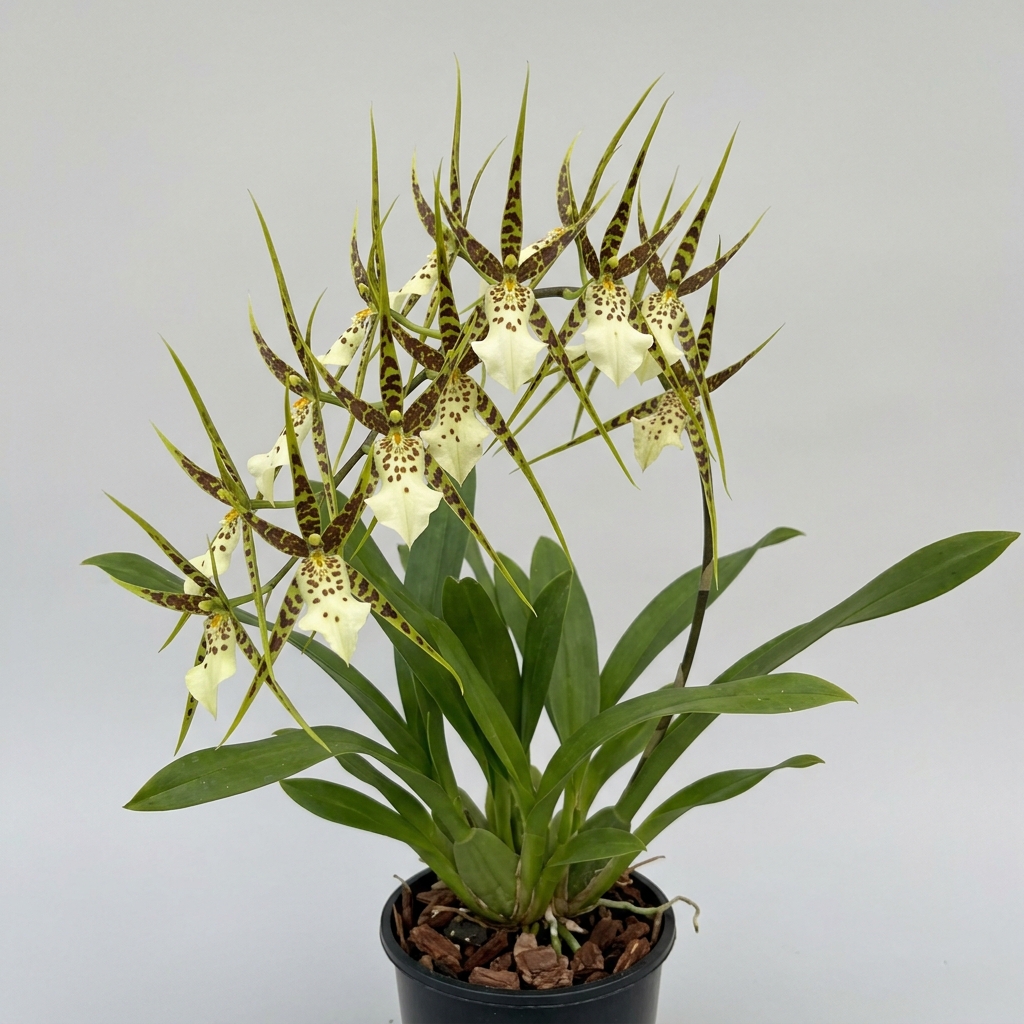
Brassia Rex is a highly celebrated orchid hybrid renowned for its dramatic, spider-like blossoms and robust growth habit. Belonging to the Brassia genus, often collectively referred to as spider orchids, this cultivar is favored by enthusiasts for its striking visual presence and relatively accessible care requirements. The plant produces elongated, arching spikes adorned with numerous large, star-shaped flowers that command attention in any indoor collection or greenhouse.
Cultivators value Brassia Rex not only for its exotic, spidery appearance but also for its vigorous growth and reliable blooming cycle. The flowers feature long, tapered sepals and petals that sway gracefully with the slightest breeze, mimicking the appearance of arachnids to attract natural pollinators. This hybrid adapts well to typical home environments, making it an excellent choice for growers looking to transition from basic grocery-store orchids to more specialized botanical varieties.
💡 Did You Know?
The spider-like shape of Brassia Rex flowers is an evolutionary adaptation known as entomophily, specifically designed to mimic spiders. In the wild, female spider-hunting wasps mistake the petals for prey, attacking the flower and inadvertently collecting or depositing pollen in the process.
🌿 Botanical Overview
Brassia Rex is a sympodial epiphytic orchid characterized by its large, flattened, ovate pseudobulbs. These storage organs are topped by one or two strap-like, leathery green leaves that can reach significant lengths. The plant expands horizontally via a creeping rhizome, producing new leads annually that mature into flowering-sized pseudobulbs under optimal conditions.
The overall growth habit is robust, with healthy specimens quickly filling their containers. The root system consists of thick, fleshy roots covered in velamen, which helps the plant absorb moisture and nutrients from the air and surrounding substrate. In its native-like cultivated state, it shows a strong seasonal growth pattern, alternating between active vegetative growth and a semi-dormant resting phase.
🌸 Flower Characteristics
The defining feature of Brassia Rex is its extraordinary floral display. The flowers are arranged in a neat, two-ranked fashion along an arching inflorescence that emerges from the base of the mature pseudobulb. Each bloom can measure up to several inches from top to bottom, dominated by extremely long, narrow sepals and petals that taper to fine points.
The base coloration of the petals and sepals is typically a pale greenish-yellow, heavily marked with dark brown, chocolate, or maroon spots and bars near the center. The lip, or labellum, is broad, flared, and lighter in color, often creamy white or pale yellow, featuring delicate spotting and a slightly ruffled margin. This dramatic contrast creates a highly striking, insect-like appearance.
Fragrance & Bloom Profile
This cultivar is widely recognized for its distinct and often powerful fragrance. The scent is commonly described as spicy, musky, or slightly sweet, reminiscent of black pepper or exotic spices. The fragrance is typically most intense during the morning hours when light and temperature levels begin to rise, filling the growing area with its unique aroma.
A single flower spike can carry anywhere from eight to fifteen individual blooms, which open nearly simultaneously for a dramatic presentation. The flowers are relatively long-lasting, often remaining in pristine condition for three to five weeks, depending on ambient temperatures and humidity levels.
Parentage & Hybrid Lineage
Brassia Rex is a primary hybrid, widely reported in horticultural literature to be a cross between Brassia Verrucosa and Brassia Gireoudiana. This lineage combines the best traits of both parent species, resulting in a plant that shows greater vigor, larger flowers, and a more adaptable nature than either parent alone.
While the registration details and historical award records are highly celebrated among orchid societies, specific commercial registration dates and hybridizer details can vary slightly across different regional registries. Consequently, growers should focus on the hybrid’s proven cultural resilience, which inherits the temperature tolerance of its parentage.
🌱 Growing Conditions
To thrive, Brassia Rex requires bright, indirect light. A east- or shaded south-facing window is ideal, where the plant can receive filtered sunlight without the risk of leaf scorch. The foliage should maintain a healthy light-green color; dark green leaves suggest insufficient light, while yellowing or red-tinted leaves indicate excessive exposure.
💡 Care Tip
Provide strong, constant air movement around your Brassia Rex. Good ventilation prevents moisture from lingering on the foliage, which significantly reduces the risk of fungal leaf spotting and helps the thick roots dry out evenly between waterings.
Temperature: wise, this hybrid prefers intermediate to warm conditions. Daytime temperatures between 70°F and 85°F, with a nighttime drop to 60°F or 65°F, will encourage strong growth and reliable blooming. Adequate air movement is crucial, especially in high-humidity environments, to prevent stagnant air from fostering fungal or bacterial pathogens.
Watering, Feeding & Potting Media
During the active growing season, Brassia Rex should be watered thoroughly and frequently. The potting medium should be allowed to approach dryness but not dry out completely before the next watering. When the pseudobulbs are fully mature, watering can be slightly reduced to mimic the natural dry season of its ancestral species.
A well-draining, coarse potting mix is essential to prevent root rot. A mixture of medium-grade fir bark, horticultural charcoal, and perlite works exceptionally well. Feed the plant regularly during active growth with a balanced orchid fertilizer diluted to half-strength, applying it every second or third watering, followed by a flush with pure water to prevent salt buildup.
Blooming Season & Care Notes
Blooming typically occurs in the spring or early summer, though well-grown plants may occasionally produce spikes at other times of the year. The flower spikes emerge from the sheath at the base of the newly matured pseudobulb. Once the spike begins to develop, avoid changing the plant’s orientation to the light source, as this can cause the buds to twist and open in an untidy arrangement.
Repotting should be performed only when necessary, typically every two to three years when the potting medium begins to decompose or the plant outgrows its container. The best time to repot is immediately after flowering, just as new root growth begins to emerge from the base of the newest pseudobulb.
⚠️ Common Issues
⚠️ Common Mistake
A frequent error is keeping the potting medium constantly wet or using a fine mix that suffocates the roots. Brassia Rex requires rapid drainage; keeping the roots waterlogged will quickly lead to rot, causing the pseudobulbs to shrivel and the plant to decline.
- Root Rot:
Caused by overwatering or a decomposing potting medium that retains too much moisture, leading to soft, brown roots and shriveled pseudobulbs. - Leaf Spotting: Fungal or bacterial spots can develop on the foliage if water is allowed to sit on the leaves overnight or if air circulation is inadequate.
- Bud Blast:
Sudden changes in temperature, low humidity, or drafty conditions can cause developing flower buds to yellow, shrivel, and drop before opening. - Pseudobulb Shriveling: A sign of dehydration, which can be caused by either underwatering or a loss of roots due to overwatering.
- Pests:
Spider mites, mealybugs, and scale insects can occasionally target the tender new growth and the undersides of the broad leaves.
❓ Frequently Asked Questions
How do I encourage my Brassia Rex to rebloom?
To encourage reblooming, ensure the plant receives bright, indirect light and a noticeable drop in night temperatures during the autumn and winter months. This temperature differential, combined with a slight reduction in watering, helps trigger the development of new flower spikes from the mature pseudobulbs.
Why are the pseudobulbs on my Brassia Rex shriveling?
Shriveled pseudobulbs indicate that the plant is not absorbing enough water. This can be due to underwatering, or conversely, overwatering which has rotted the root system, leaving the orchid unable to take up moisture. Inspect the roots to determine the cause before adjusting your watering routine.
What is the best potting medium for this orchid?
A coarse, fast-draining medium is ideal for Brassia Rex. A blend of medium-grade fir bark, charcoal, and perlite provides the necessary aeration and drainage. Some growers add a small amount of sphagnum moss to retain light moisture, but the mix must never remain soggy.
Can Brassia Rex be grown under LED grow lights?
Yes, Brassia Rex adapts well to indoor cultivation under LED grow lights. Position the plant so it receives moderate to high light intensity, ensuring the lights are kept at a safe distance to prevent leaf scorching, and maintain a consistent day-night light cycle of 12 to 14 hours.
⭐ Final Growing Notes
Brassia Rex remains a standout choice for any orchid collection, offering a spectacular combination of dramatic spider-like blooms, rich fragrance, and robust growth. By providing bright indirect light, consistent moisture during the growing season, and excellent air circulation, growers can enjoy the exotic beauty of this classic hybrid for many years.
🌱 Propagation Tip
Propagate Brassia Rex by division during repotting, ensuring each new division has at least three to four healthy, mature pseudobulbs. Avoid dividing the plant too frequently, as larger specimens with multiple leads produce far more spectacular and abundant flower spikes.
⭐ Expert Advice
To achieve pristine, symmetrical flower spikes, do not rotate or move the orchid once the flower spike begins to emerge. The developing buds are highly phototropic and will naturally align themselves toward the source; rotating the pot will cause the flowers to open facing different directions.




Leave A Comment