
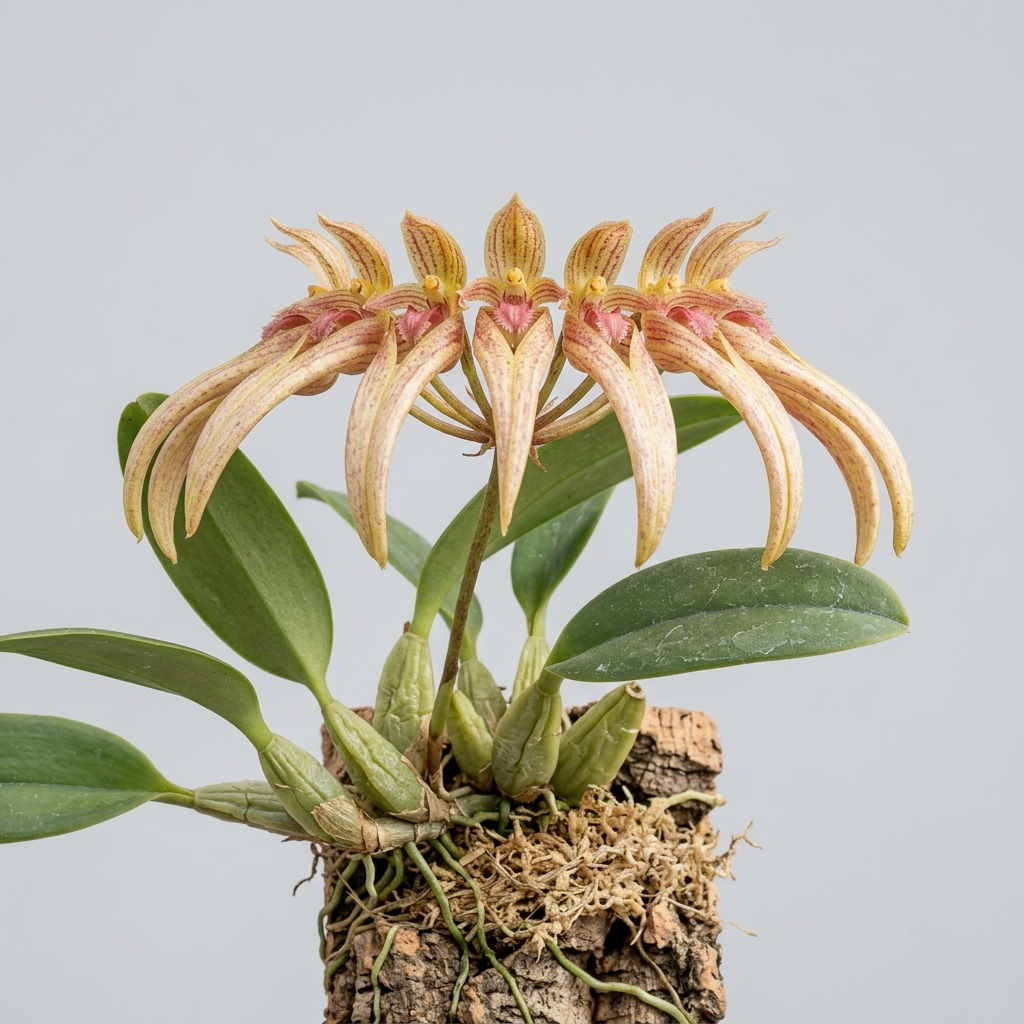
Bulbophyllum Flabellum-Veneris, commonly known as the Venus’ Fan Bulbophyllum, is a captivating miniature to small-sized epiphytic orchid species native to the warm, humid forests of Southeast Asia. Highly prized by collectors for its extraordinary floral architecture, this orchid produces a striking, fan-like arrangement of flowers that radiate from a central point, mimicking a delicate folding fan. Its creeping growth habit and unique presentation make it a standout addition to any specialized orchid collection, particularly for those who appreciate the diverse and unusual forms within the vast Bulbophyllum genus.
Cultivating this species successfully requires an understanding of its natural tropical habitat, where it thrives in high humidity, consistent moisture, and dappled light. Unlike many common houseplants, this orchid is typically grown on mounts or in shallow baskets to accommodate its spreading rhizomes and shallow root system. For growers willing to provide the attentive care it demands, Bulbophyllum Flabellum-Veneris rewards the effort with highly unusual, structurally complex blooms that showcase the fascinating evolutionary adaptations of the orchid family.
💡 Did You Know?
Bulbophyllum Flabellum-Veneris is part of the Bulbophyllum orchid group, a favorite among growers because its flowers, growth habit, and care needs make it useful for comparing cultivated orchids within the same . Observing its leaves, roots, and bloom spikes can help growers understand how this cultivar responds to indoor conditions.
🌿 Botanical Overview
Bulbophyllum Flabellum-Veneris belongs to the hyper-diverse genus Bulbophyllum, which is one of the largest genera in the plant kingdom. This species is characterized by its creeping rhizomes that support small, distinct, egg-shaped pseudobulbs. Each pseudobulb bears a single, leathery, oblong leaf that remains evergreen under proper growing conditions. The plant’s growth habit is spreading, allowing it to quickly colonize mounting plaques or shallow baskets as new pseudobulbs emerge along the rhizome.
In its native habitat throughout Southeast Asia, including regions of Thailand, Malaysia, and Indonesia, this orchid grows as an epiphyte on tree trunks and branches. It is accustomed to the sheltered, humid understory of tropical forests, where it receives constant air movement and frequent rainfall. This evolutionary background dictates its cultural requirements in cultivation, emphasizing the need for high atmospheric humidity and a substrate that never completely dries out.
🌸 Flower Characteristics
The most defining feature of Bulbophyllum Flabellum-Veneris is its inflorescence, which typically emerges from the base of the pseudobulb. The slender flower spike arches upward before presenting a semi-circular umbel of flowers. These flowers are arranged in a radiating fan shape, with the lateral sepals elongated and fused along their inner margins to create a cohesive, skirt-like appearance. The color palette of the blooms ranges from pale yellow and cream to flushed pink, magenta, or reddish-brown, often adorned with delicate spotting or veining.
Individual flowers are relatively small, but their collective arrangement in the fan structure creates a highly visible and dramatic display. The tiny dorsal sepal and petals are often fringed with fine hairs or appendages that move slightly in the breeze, a feature designed to attract specific insect pollinators. The small, hinged lip (labellum) is highly mobile, tipping forward and backward with the slightest movement of air or touch.
Fragrance & Bloom Profile
The fragrance of Bulbophyllum Flabellum-Veneris is not as intensely pungent as some of its relatives in the genus, but it does possess a distinct scent profile. Many growers report a faint, slightly musty, or earthy aroma that is typical of fly-pollinated orchids. This fragrance is generally only noticeable in close proximity to the blooms and during the warmest parts of the day.
The blooms typically last for one to two weeks, depending on environmental conditions such as temperature and humidity. While the individual flowering period is relatively brief, a mature, well-established specimen can produce multiple spikes successively or simultaneously, extending the overall display. The visual impact of the fan-shaped inflorescence far outweighs its modest fragrance, making it a favorite for exhibition and close-up photography.
Parentage & Hybrid Lineage
As a naturally occurring species rather than a man-made hybrid, Bulbophyllum Flabellum-Veneris does not have a complex pedigree of parental cultivars. In botanical literature, it is sometimes referenced under synonyms or closely related species complexes, such as Bulbophyllum lepidum. Accurate identification can sometimes be challenging due to the high variability of species within the section Cirrhopetalum, to which this orchid belongs.
While it is primarily grown as a species, hybridizers occasionally use it in breeding programs to introduce the fan-shaped flowering habit and compact growth form to new Bulbophyllum hybrids. However, registered hybrids utilizing this specific species remain relatively uncommon compared to more mainstream orchid genera. Growers value this plant primarily for its wild, authentic botanical heritage.
🌱 Growing Conditions
To cultivate Bulbophyllum Flabellum-Veneris successfully, growers must replicate its warm, humid forest home. It thrives in intermediate to warm temperatures, ideally ranging from 65°F to 85°F (18°C to 29°C) during the day, with a slight drop at night to stimulate healthy growth and flowering. It is sensitive to extreme cold and should be protected from temperatures dropping below 55°F (13°C).
💡 Care Tip
For best results, grow Bulbophyllum Flabellum-Veneris in bright filtered with steady and gentle airflow. Avoid placing the plant in harsh midday sun, but do not keep it in a dark corner; weak is one of the most common reasons cultivated orchids refuse to rebloom.
Light levels should be kept moderate to low, mimicking the dappled shade of a forest canopy. Bright, indirect light is ideal, while direct afternoon sunlight will quickly scorch the thin leaves. High humidity is critical for this species; a range of 70% to 85% is optimal. To prevent stagnant air from encouraging fungal pathogens in such humid conditions, continuous, gentle air movement must be provided using small fans.
Watering, Feeding & Potting Media
Watering is the most active component of caring for Bulbophyllum Flabellum-Veneris. Because the plant has shallow roots and lacks large water-storing pseudobulbs, it has very little tolerance for drought. The growing medium should be kept consistently moist but never waterlogged. If grown on a mount, daily watering or misting may be required during the warm summer months.
A high-quality, long-fibered sphagnum moss is often the preferred medium, either packed loosely in shallow net pots or wrapped around a cork bark mount. Alternatively, a mix of fine fir bark, perlite, and chopped moss can be used in shallow pans. Fertilization should be light and frequent; a balanced, highly diluted orchid fertilizer applied weekly at one-quarter strength during the active growing season is sufficient. Flush the medium with pure water periodically to prevent salt buildup.
Blooming Season & Care Notes
Bulbophyllum Flabellum-Veneris can bloom at various times of the year, but it most commonly initiates flower spikes during the summer and autumn months. The emergence of spikes is often triggered by seasonal shifts in temperature and day length. Once the flower spikes begin to develop, it is crucial to maintain stable environmental conditions, as sudden drops in humidity or drafts can cause the delicate buds to blast.
After the blooming cycle is complete, the old flower spikes can be cut back to the base of the pseudobulb. Repotting or remounting is best performed in the spring, just as new root growth begins to emerge from the base of the newest pseudobulbs. Minimize disturbance to the root system during this process, as Bulbophyllum roots can be sensitive to disruption.
⚠️ Common Issues
⚠️ Common Mistake
The most common mistake is by calendar instead of root and potting-media condition. Bulbophyllum roots need moisture and air at the same time, so constantly wet bark or sphagnum can lead to root loss even when the leaves still look healthy.
- Root Rot:
Caused by compacted, poorly draining media or overwatering without adequate aeration. - Dehydration:
Indicated by shriveled pseudobulbs and wrinkled leaves, usually due to underwatering or low humidity. - Bud Blast:
The premature drying and dropping of flower buds, often triggered by sudden drafts, dry air, or temperature shocks. - Leaf Spotting: Fungal or bacterial spots can develop on the foliage if water sits on the leaves overnight in stagnant air.
- Pests:
Mealybugs and spider mites can occasionally target the tender new growth and the undersides of leaves.
❓ Frequently Asked Questions
Can Bulbophyllum Flabellum-Veneris be grown indoors on a windowsill?
Yes, it can be grown indoors, but maintaining the required 70% to 85% humidity can be challenging in a standard home environment. Growing the orchid in a glass terrarium, wardian case, or near a dedicated humidifier is highly recommended to prevent dehydration.
Why are the pseudobulbs on my orchid shriveling?
Shriveled pseudobulbs typically indicate a lack of moisture. This can be caused by underwatering, extremely low ambient humidity, or a compromised root system that can no longer absorb water. Check the roots to ensure they are healthy and not rotted.
How often should I fertilize this Bulbophyllum species?
This orchid benefits from a “weakly, weekly” fertilization routine. Apply a balanced orchid fertilizer diluted to one-quarter strength once a week during the active spring and summer growing seasons, and reduce feeding to once a month during winter.
Is it better to mount this orchid or grow it in a pot?
Because of its creeping rhizome habit, Bulbophyllum Flabellum-Veneris often performs best when mounted on cork bark or tree fern plaques. If potting is preferred, use a shallow, wide pan or a net basket filled with sphagnum moss to allow the plant to spread.
⭐ Final Growing Notes
Bulbophyllum Flabellum-Veneris is a rewarding species that brings a touch of exotic, tropical wonder to any orchid collection. While its high humidity and moisture requirements make it slightly more demanding than standard grocery-store orchids, its spectacular fan-shaped blooms are well worth the extra attention. By providing consistent warmth, filtered light, and attentive watering, growers can enjoy the unique botanical artistry of this remarkable Southeast Asian treasure for many years.
⚕️ Health, Safety & Edibility
Understanding how a plant interacts with people, pets, and the surrounding environment is part of responsible cultivation. This section uses conservative, general guidance and does not replace professional medical or veterinary advice.
Human Safety: No published evidence currently identifies species-specific toxicity concerns for Bulbophyllum Flabellum-Veneris during normal handling. As with most ornamental plants, it should not be intentionally consumed.
Pet Safety: Published information does not indicate that this orchid commonly poses a toxicity concern for cats or dogs. However, chewing leaves, flowers, roots, or potting media may still cause mild digestive upset.
Edibility: This orchid is cultivated for ornamental display rather than food. Ornamental plants may carry fertilizers, pesticides, or other horticultural treatments that make them unsuitable for consumption.
Skin Contact: Routine handling is not generally associated with skin irritation. Gardeners with sensitive skin may prefer wearing gloves when repotting, pruning, or handling potting media.
🌱 Propagation Tip
Propagation should be approached patiently. Most home growers should wait for natural keikis or divide only mature, healthy plants when the orchid type allows it. Never remove a young growth until it has strong roots and enough leaves to support itself away from the parent plant.
⭐ Expert Advice
Repot after flowering when fresh root tips begin to appear. This timing helps the plant anchor quickly into new bark or sphagnum and reduces stress, especially for orchids grown indoors where airflow, , and drying speed can change from season to season.

Leave A Comment