
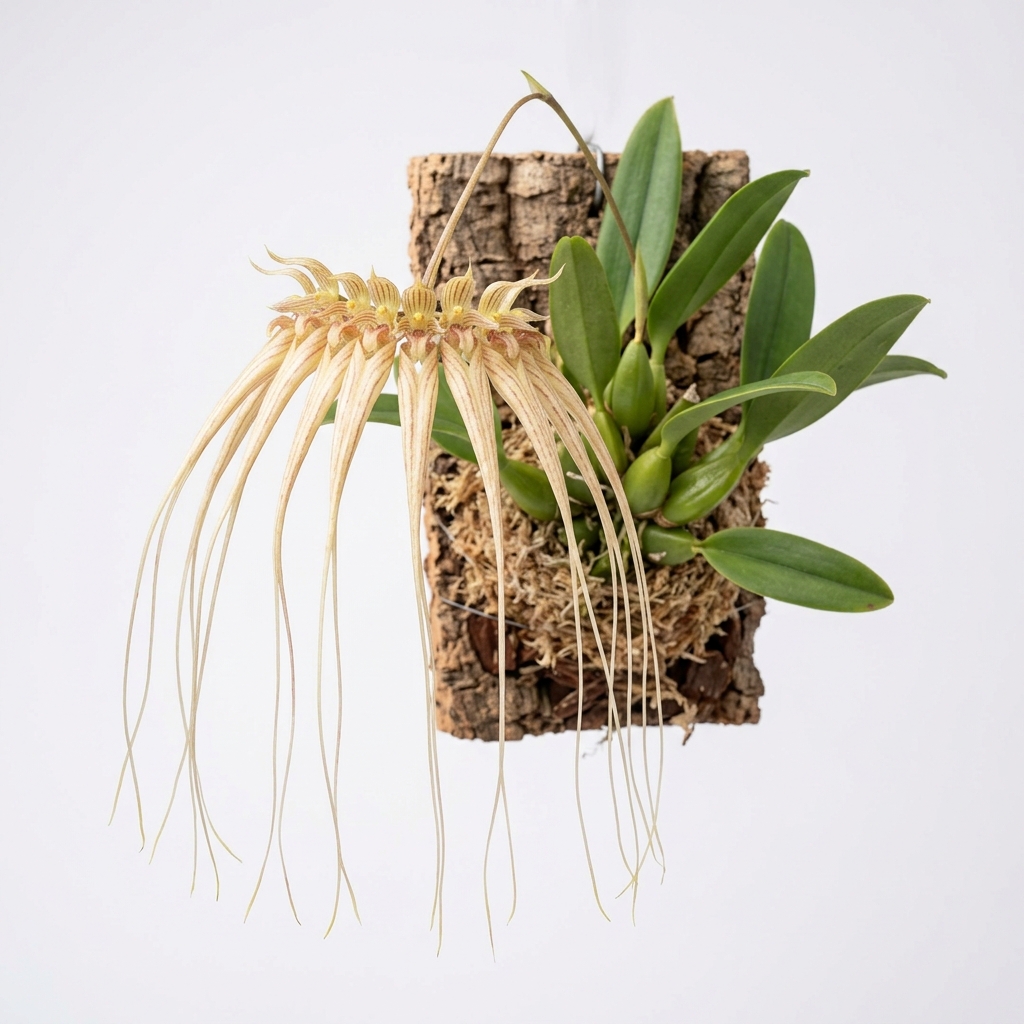
Bulbophyllum Longissimum is a highly sought-after orchid prized for its extraordinary, thread-like lateral sepals that drape elegantly below the plant. Belonging to the vast and diverse Bulbophyllum genus, this orchid captures the attention of collectors with its unique fan-shaped umbels of delicate, elongated blossoms. Its distinctive growth habit and dramatic floral presentation make it a standout addition to any specialized orchid collection.
Cultivating this remarkable orchid requires an understanding of its tropical rainforest origins. It thrives in high humidity, warm temperatures, and consistent moisture, making it an excellent candidate for basket culture or mounted displays where its pendulous blooms can hang freely. While it demands more attention to environmental consistency than common household orchids, the reward of its spectacular, cascading floral display is well worth the effort.
💡 Did You Know?
The extraordinary lateral sepals of Bulbophyllum Longissimum can grow up to twelve inches or more in length. These long, ribbon-like structures sway in the slightest breeze, mimicking the movement of insects or debris to attract its natural fly pollinators in the wild canopy.
🌿 Botanical Overview
Bulbophyllum Longissimum is an epiphytic orchid native to the warm, wet forests of Southeast Asia, particularly Thailand, Myanmar, and Vietnam. It features a creeping rhizome growth habit, with distinct, ovoid to conical pseudobulbs spaced along the rhizome. Each pseudobulb produces a single, leathery, dark green leaf that is oblong and persistent, helping the plant photosynthesize in the shaded understory of its native canopy.
The species belongs to the Cirrhopetalum section of the genus Bulbophyllum, a group famous for its umbellate inflorescences where flowers are arranged in a circular, fan-like array. The evolutionary adaptation of this growth form allows the plant to maximize its visual appeal to specific pollinators while growing on the mossy branches of tropical trees.
🌸 Flower Characteristics
The most striking feature of Bulbophyllum Longissimum is its flowers. The inflorescence emerges from the base of the pseudobulb, bearing a fan of up to ten flowers. The lateral sepals are extraordinarily elongated, often reaching lengths of twenty to thirty centimeters (eight to twelve inches) or more. These sepals taper into fine, ribbon-like threads that hang vertically, creating a dramatic, cascading effect.
In contrast to the massive lateral sepals, the dorsal sepal and petals are quite small, often decorated with fine hairs or cilia along their margins. The base colors of the flowers typically range from creamy white to pale yellow or soft pink, adorned with delicate, darker longitudinal stripes. The lip, or labellum, is small, fleshy, and highly mobile, hinged in a way that tips forward under the weight of visiting insects.
Fragrance & Bloom Profile
Like many members of its genus, Bulbophyllum Longissimum has evolved to attract fly pollinators. Consequently, its fragrance is not sweet or floral; instead, it is often described as slightly musty, putrid, or reminiscent of decaying organic matter. However, the scent is generally faint and typically only noticeable in close proximity to the blooms on warm, still days.
The blooming cycle usually occurs in the autumn or early winter, though occasional off-season blooms can happen under optimal greenhouse conditions. Individual flowers generally remain open and attractive for seven to fourteen days, depending on ambient temperatures and humidity levels.
Parentage & Hybrid Lineage
Bulbophyllum Longissimum is a naturally occurring species rather than an artificial hybrid. In the orchid trade, it is occasionally sold under specific cultivar names selected for exceptional sepal length or color intensity. It has also been used as a parent in several notable intergeneric and intrageneric hybrids, contributing its extreme sepal length to offspring such as Bulbophyllum Elizabeth Ann (a cross between Bulbophyllum Longissimum and Bulbophyllum rothschildianum).
🌱 Growing Conditions
To cultivate this orchid successfully, growers must replicate its warm, humid forest habitat. It prefers medium to bright indirect light. Direct sunlight should be avoided, as it can easily scorch the thin leaves. A shaded greenhouse, a bright east-facing window, or high-quality LED grow lights are ideal setups.
💡 Care Tip
To mimic its natural canopy habitat, grow this orchid in a slatted wooden basket lined with high-quality sphagnum moss. This setup provides the perfect balance of constant moisture around the roots while allowing excellent airflow to prevent rot.
Temperature: wise, this species is warm to intermediate-loving. Daytime temperatures should ideally range between 75°F and 85°F (24°C to 29°C), with a slight drop at night to around 65°F (18°C). High relative humidity of at least 70% is crucial. To prevent fungal issues in such damp conditions, continuous, gentle air movement must be provided using small fans.
Watering, Feeding & Potting Media
This orchid does not possess large water-storing pseudobulbs, meaning it has little tolerance for drought. The potting medium should remain consistently moist but never waterlogged. Water the plant thoroughly just as the medium begins to approach dryness. Using rainwater, distilled water, or reverse osmosis water is highly recommended, as the fine roots can be sensitive to mineral buildup.
Due to its creeping habit, Bulbophyllum Longissimum is best grown mounted on cork bark or tree fern plaques, or planted in shallow, wide wooden baskets. If potted, a highly porous medium such as long-fiber sphagnum moss mixed with fine tree fern fiber or perlite works best. Feed the plant weekly with a highly diluted, balanced orchid fertilizer during the active growing season, flushing the medium with pure water once a month to remove accumulated salts.
Blooming Season & Care Notes
As the blooming season approaches in late summer and autumn, ensure that humidity remains high and stable. Sudden drops in humidity or moisture levels can cause the developing flower buds to blast (wither and die before opening). Once the flower spike begins to emerge from the base of the pseudobulb, avoid changing the plant’s orientation relative to the light source, as this can cause the spike to twist awkwardly.
After flowering has finished, allow the plant a brief period of reduced watering, though it should still not be allowed to dry out completely. Repotting or remounting should only be done in the spring when new root growth is visible at the base of the lead pseudobulb.
⚠️ Common Issues
⚠️ Common Mistake
A frequent error is allowing the potting medium to dry out completely between waterings. Unlike some orchids with large pseudobulbs that store water for long periods, this species prefers consistent moisture and can quickly suffer leaf drop and pseudobulb shriveling if left dry.
- Root Rot:
Caused by compacted, poorly draining media or overwatering. Ensure the potting mix remains airy and fresh. - Leaf Spotting: Fungal or bacterial spots can develop if humidity is high but air circulation is stagnant. Increase fan speed and avoid wetting the foliage late in the evening.
- Bud Blast:
The premature drying of flower buds, usually triggered by a sudden drop in humidity, drafty conditions, or underwatering. - Shriveled Pseudobulbs: A sign of dehydration, either due to underwatering or a loss of the root system from rot.
- Pests:
Mealybugs and spider mites can occasionally hide in the crevices of the pseudobulbs or under the leaves. Treat promptly with insecticidal soap or horticultural oil.
❓ Frequently Asked Questions
How long do the flowers of Bulbophyllum Longissimum last?
The flowers typically last between one and two weeks. To maximize their lifespan, keep the plant in a cool, shaded location with high humidity and avoid getting the open blossoms wet during watering.
Can I grow Bulbophyllum Longissimum in a standard plastic pot?
While possible, it is not ideal. Because of its creeping rhizome and pendulous flowers, this orchid performs much better in shallow wooden baskets, net pots, or mounted directly onto cork bark plaques where the roots can breathe and the flowers can hang naturally.
Why are the leaf tips of my orchid turning brown?
Brown leaf tips are usually a sign of low humidity, mineral buildup from tap water, or underwatering. Switch to pure water (distilled or rainwater) and ensure your growing area maintains at least 70% relative humidity.
Does Bulbophyllum Longissimum have a bad smell?
Yes, like many Bulbophyllums, it produces a faint, slightly putrid scent to attract flies. However, the fragrance is generally very mild and is rarely noticeable unless you place your nose directly up to the flower.
⭐ Final Growing Notes
Bulbophyllum Longissimum is a true marvel of the orchid world, offering an unparalleled visual display for those willing to meet its moisture and humidity requirements. By providing consistent watering, excellent air movement, and a suitable mounting or basket setup, growers can enjoy the dramatic, curtain-like blooms of this exotic species year after year. It remains a rewarding and captivating choice for any dedicated orchid enthusiast.
⚕️ Health, Safety & Edibility
Understanding how a plant interacts with people, pets, and the surrounding environment is part of responsible cultivation. This section uses conservative, general guidance and does not replace professional medical or veterinary advice.
Human Safety: No published evidence currently identifies species-specific toxicity concerns for Bulbophyllum Longissimum during normal handling. As with most ornamental plants, it should not be intentionally consumed.
Pet Safety: Published information does not indicate that this orchid commonly poses a toxicity concern for cats or dogs. However, chewing leaves, flowers, roots, or potting media may still cause mild digestive upset.
Edibility: This orchid is cultivated for ornamental display rather than food. Ornamental plants may carry fertilizers, pesticides, or other horticultural treatments that make them unsuitable for consumption.
Skin Contact: Routine handling is not generally associated with skin irritation. Gardeners with sensitive skin may prefer wearing gloves when repotting, pruning, or handling potting media.
🌱 Propagation Tip
Propagation is best achieved by division during the spring repotting cycle. Ensure each division has at least three to four healthy pseudobulbs with active root systems, and handle the fragile creeping rhizome with extreme care to minimize transplant shock.
⭐ Expert Advice
Maintain high relative of seventy percent or higher, coupled with gentle, continuous air movement from a small fan. This combination is the secret to preventing fungal leaf spot while satisfying the high moisture requirements of this tropical epiphyte.

Leave A Comment