
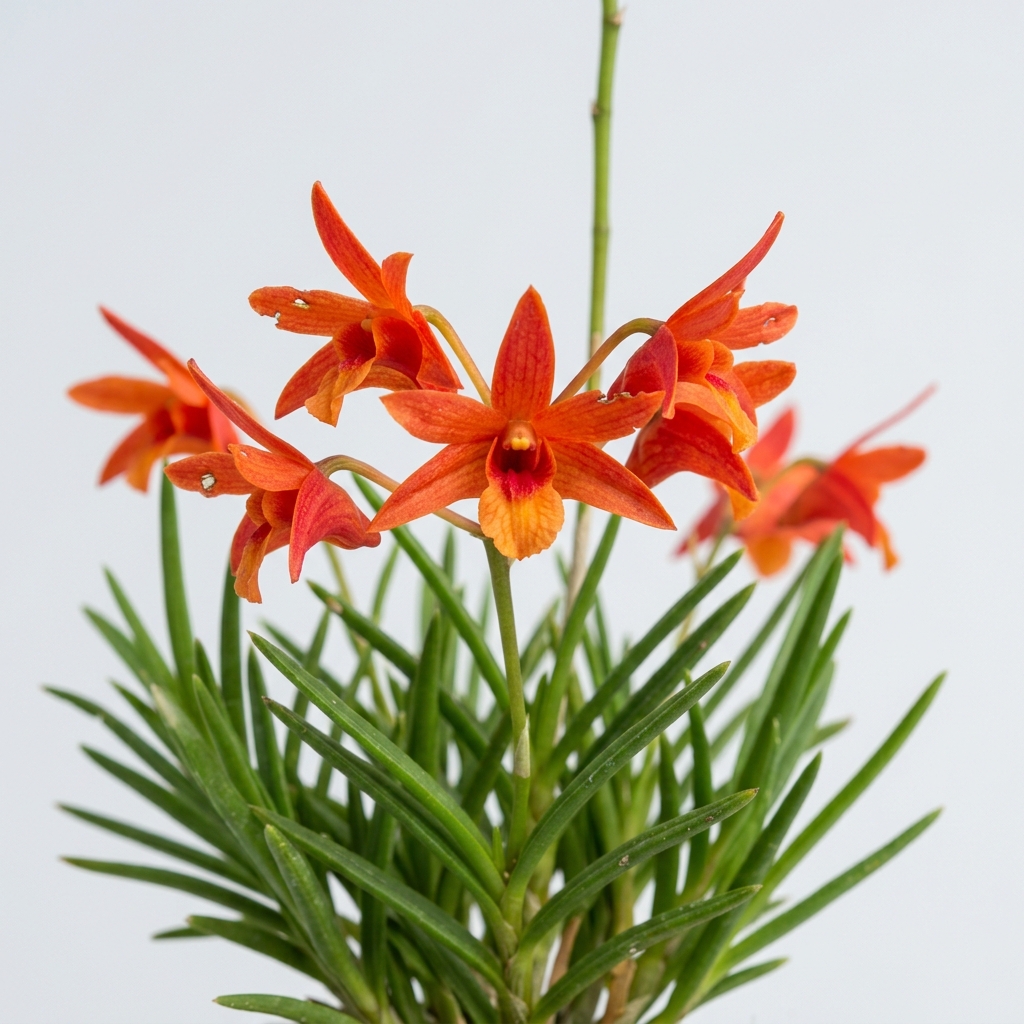
Dendrobium Vexillarius is a highly sought-after miniature to small-sized orchid species native to the high-altitude montane forests of New Guinea. Renowned among collectors for its incredibly vibrant, long-lasting blossoms, this tufted epiphyte or lithophyte brings a striking splash of color to specialized cool-growing collections. Its compact growth habit and needle-like or grass-like leaves make it an excellent candidate for terrariums, vivariums, or dedicated orchid cases where environmental conditions can be precisely managed.
While many tropical orchids favor warm, lowland environments, this montane treasure thrives in cool, humid, and breezy conditions that mimic its native cloud forest habitat. Growers value Dendrobium Vexillarius not only for its brilliant floral displayu2014which can range from fiery orange and red to soft pink and yellowu2014but also for the remarkable longevity of its flowers, which can remain pristine for several months. Cultivating this species successfully requires a shift away from standard orchid care toward a regime of consistent moisture, high humidity, and buoyant air movement.
💡 Did You Know?
Dendrobium Vexillarius is part of the Dendrobium orchid group, a favorite among growers because its flowers, growth habit, and care needs make it useful for comparing cultivated orchids within the same . Observing its leaves, roots, and bloom spikes can help growers understand how this cultivar responds to indoor conditions.
🌿 Botanical Overview
Dendrobium Vexillarius belongs to the section Oxyglossum within the vast Dendrobium genus, a group celebrated for its miniature stature and exceptionally long-lasting flowers. In the wild, this species is found growing on mossy tree branches or rock faces at elevations ranging from 1,200 to over 3,000 meters above sea level. These high-altitude origins dictate its physiological preference for cool temperatures and constant atmospheric moisture.
The plant features clustered, pseudobulbs that are typically slender, erect, or slightly curved, carrying a few narrow, linear leaves. The foliage often shows a dark green hue, sometimes tinged with purple or red when exposed to higher light levels. This compact growth form allows the orchid to conserve resources in its rugged native environment while maximizing light absorption under the dense canopy of the cloud forest.
🌸 Flower Characteristics
The flowers of Dendrobium Vexillarius are the primary draw for orchid enthusiasts, presenting a stunning contrast to the plant’s diminutive foliage. The blossoms emerge from the nodes of both leafy and leafless pseudobulbs, often appearing in small clusters or as solitary flowers. The sepals and petals are typically lanceolate and sharply pointed, creating a star-like or triangular silhouette that appears elegant and delicate.
One of the most remarkable features of the flower is the lip, or labellum, which is often narrow and may feature contrasting tips or subtle striping. The color palette of this species is highly variable, with distinct color forms recognized by collectors, including bright orange, scarlet red, canary yellow, and deep magenta. The floral tissue is unusually thick and waxy, a structural adaptation that contributes directly to the incredible endurance of the blooms.
Fragrance & Bloom Profile
Unlike many of its lowland relatives, Dendrobium Vexillarius is not widely celebrated for its scent. Fragrance in this species is generally considered absent or is not consistently documented in common horticultural literature. The evolutionary strategy of this orchid relies primarily on its intense, saturated colors to attract specific montane pollinators, such as birds or specialized insects, rather than olfactory cues.
What the flowers lack in perfume, they more than make up for in sheer longevity. A single bloom can remain fresh and vibrant on the plant for three to six months under optimal conditions. This prolonged blooming cycle means that a mature, well-grown specimen can appear to be in perpetual flower, with new buds opening before the older blossoms have faded.
Parentage & Hybrid Lineage
Dendrobium Vexillarius is a distinct, naturally occurring species rather than a man-made hybrid. While it is highly prized in its pure form, its exceptional flower longevity and brilliant coloration have made it an intriguing subject for hybridizers working within the Oxyglossum section. However, registered hybrids utilizing this species remain relatively uncommon and are not widely distributed in the general commercial market.
Because documentation on specific cultivar selections and artificial crosses can be limited or highly specialized, growers should treat any labeled hybrid parentage with cautious optimism. Most plants available in the trade are species selections propagated from seed or tissue culture, selected for intense color forms or improved vigor under typical greenhouse conditions.
🌱 Growing Conditions
Replicating the montane cloud forest environment is the key to success with Dendrobium Vexillarius. Bright, filtered light is essential for robust growth and abundant flowering. While the plant enjoys strong light, direct midday sun must be avoided to prevent the delicate leaves from scorching. A light level comparable to that provided for Miltoniopsis or cool-growing Masdevallias is generally ideal.
💡 Care Tip
For best results, grow Dendrobium Vexillarius in bright filtered with steady and gentle airflow. Avoid placing the plant in harsh midday sun, but do not keep it in a dark corner; weak is one of the most common reasons cultivated orchids refuse to rebloom.
Temperature management is perhaps the most critical aspect of cultivating this species. It thrives in cool to intermediate conditions, ideally with daytime temperatures ranging from 60u00b0F to 72u00b0F (15u00b0C to 22u00b0C) and a distinct drop at night to 50u00b0F to 58u00b0F (10u00b0C to 14u00b0C). High humidity, ideally between 70% and 85%, must be maintained constantly, coupled with excellent, buoyant air movement to prevent stagnant air from encouraging fungal pathogens.
Watering, Feeding & Potting Media
In their native habitats, these orchids experience near-constant moisture from rain, mist, and condensation. Consequently, Dendrobium Vexillarius should never be allowed to dry out completely. The potting medium should remain evenly moist but never waterlogged or soggy, which can quickly suffocate the fine, delicate root system. Using high-quality pure water, such as rainwater, reverse osmosis water, or distilled water, is highly recommended due to the species’ sensitivity to dissolved mineral salts.
A potting medium that retains moisture while allowing excellent drainage is crucial. High-grade New Zealand sphagnum moss, either alone or mixed with fine tree fern fiber and perlite, works exceptionally well in small plastic or clay pots. Alternatively, plants can be mounted on cork bark or tree fern plaques, provided they are misted daily and kept in a high-humidity environment. Fertilization should be light and infrequent; a highly diluted, balanced orchid fertilizer applied every two to three weeks during active growth is sufficient.
Blooming Season & Care Notes
While Dendrobium Vexillarius can produce flowers at almost any time of the year, peak blooming activity typically occurs from late winter through spring. The initiation of buds is often stimulated by the natural seasonal drop in night temperatures during autumn. Once buds begin to form, it is vital to maintain stable environmental conditions, as sudden changes in temperature or humidity can lead to bud drop.
After the flowering cycle is complete, the plant may enter a brief period of slowed growth. Repotting is best performed during the spring, just as new root growth begins to emerge from the base of the newest pseudobulbs. Because this species resents root disturbance, repotting should only be done when the potting medium begins to break down, typically every two years, taking care to minimize damage to the active root tips.
⚠️ Common Issues
Cultivating this high-altitude species can present challenges, particularly for growers in warm or dry climates. Common issues include:
⚠️ Common Mistake
The most common mistake is by calendar instead of root and potting-media condition. Dendrobium roots need moisture and air at the same time, so constantly wet bark or sphagnum can lead to root loss even when the leaves still look healthy.
- Root Rot:
Caused by compacted, decaying potting media or overwatering without adequate drainage. - Bud Blast:
The premature drying and dropping of flower buds, usually triggered by sudden drops in humidity or drafts of dry air. - Leaf Spotting: Fungal or bacterial spots can develop on the foliage if air circulation is inadequate in high-humidity environments.
- Heat Stress: Prolonged exposure to temperatures above 80u00b0F (27u00b0C) can cause leaf yellowing, leaf drop, and a rapid decline in plant health.
- Pests:
Spider mites and mealybugs can occasionally target the tender new growth, requiring prompt treatment with mild insecticidal soap or neem oil.
❓ Frequently Asked Questions
Can Dendrobium Vexillarius be grown under LED lights?
Yes, this compact orchid performs exceptionally well under modern LED grow lights. Position the plant where it receives bright, indirect light, and monitor the temperature closely, as some LED fixtures can emit localized heat that may dry out the surrounding air.
Why are the leaves on my orchid turning yellow and dropping?
Yellowing and dropping leaves are often a sign of heat stress or root rot. Ensure that daytime temperatures remain cool, humidity is high, and the potting medium is fresh and well-draining rather than compacted and waterlogged.
How often should I water a mounted Dendrobium Vexillarius?
Mounted plants dry out much faster than potted ones and typically require daily misting or watering, sometimes twice a day during hot or dry weather, to maintain the necessary moisture levels around the roots.
Is this orchid suitable for a beginner grower?
Due to its strict requirements for cool temperatures, high humidity, and pure water, this species is generally recommended for intermediate to advanced growers who can provide specialized environmental controls.
⭐ Final Growing Notes
Dendrobium Vexillarius is a true gem of the orchid world, offering unparalleled floral longevity and brilliant coloration in a compact package. While its environmental demands require a dedicated approach to temperature and humidity control, the reward of seeing its vibrant, star-like blossoms endure for months on end is well worth the effort. For the patient grower with a cool greenhouse, terrarium, or dedicated growing space, this montane species stands as a testament to the diverse beauty of New Guinea’s unique flora.
⚕️ Health, Safety & Edibility
Understanding how a plant interacts with people, pets, and the surrounding environment is part of responsible cultivation. This section uses conservative, general guidance and does not replace professional medical or veterinary advice.
Human Safety: No published evidence currently identifies species-specific toxicity concerns for Dendrobium Vexillarius during normal handling. As with most ornamental plants, it should not be intentionally consumed.
Pet Safety: Published information does not indicate that this orchid commonly poses a toxicity concern for cats or dogs. However, chewing leaves, flowers, roots, or potting media may still cause mild digestive upset.
Edibility: This orchid is cultivated for ornamental display rather than food. Ornamental plants may carry fertilizers, pesticides, or other horticultural treatments that make them unsuitable for consumption.
Skin Contact: Routine handling is not generally associated with skin irritation. Gardeners with sensitive skin may prefer wearing gloves when repotting, pruning, or handling potting media.
🌱 Propagation Tip
Propagation should be approached patiently. Most home growers should wait for natural keikis or divide only mature, healthy plants when the orchid type allows it. Never remove a young growth until it has strong roots and enough leaves to support itself away from the parent plant.
⭐ Expert Advice
Repot after flowering when fresh root tips begin to appear. This timing helps the plant anchor quickly into new bark or sphagnum and reduces stress, especially for orchids grown indoors where airflow, , and drying speed can change from season to season.

Leave A Comment