
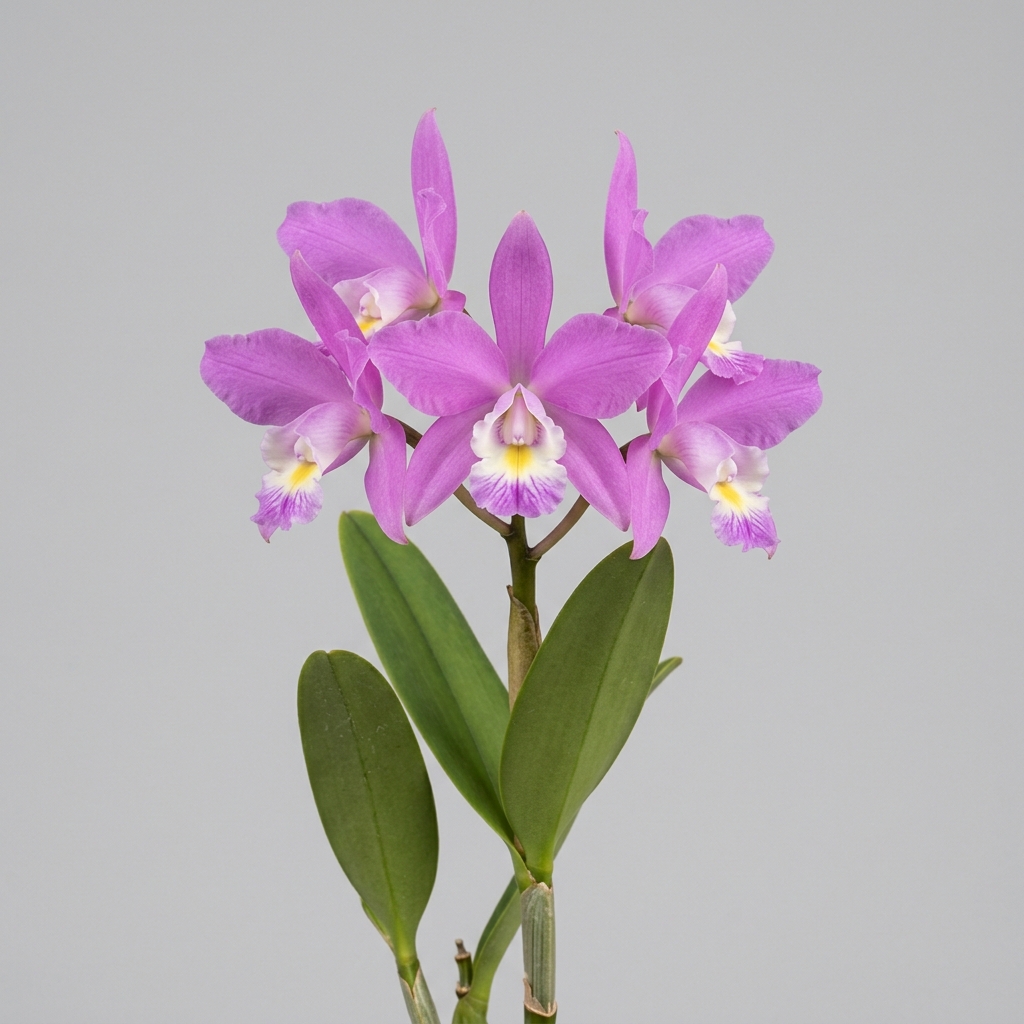
Cattleya harrisoniana is a highly prized bifoliate orchid species native to southeastern Brazil, celebrated for its elegant, long-lasting blooms and robust growth habit. This species is a staple in classical orchid collections, cherished for its striking lavender-pink flowers and its reliable summer-to-autumn blooming cycle. Its natural resilience makes it an excellent choice for growers looking to expand their collection of species orchids.
Growers value this orchid not only for its visual appeal but also for its sweet, floral fragrance and relative adaptability compared to more delicate bifoliate species. Its upright, slender pseudobulbs and dual-leaf presentation make it an attractive plant even when out of bloom, serving as an excellent representative of the genus Cattleya in any greenhouse or indoor growing space.
💡 Did You Know?
Cattleya harrisoniana was named in honor of Mrs. Harrison, an English orchid enthusiast who successfully cultivated and bloomed the species in the early 19th century after it was sent from Brazil. This historical connection highlights the species' long-standing popularity in European horticulture, where it has been cherished for nearly two centuries for its reliable growth and vibrant floral displays.
🌿 Botanical Overview
Cattleya harrisoniana is native to the coastal regions of southeastern Brazil, where it primarily grows as an epiphyte on trees or occasionally as a lithophyte on moss-covered rocks. It thrives in humid, low-elevation forests and swampy areas, which influences its preference for consistent moisture and high humidity in cultivation. The species is well-adapted to environments that experience seasonal shifts in rainfall and temperature.
Physically, this orchid is characterized by its tall, slender, cylindrical pseudobulbs that can reach up to 12 to 18 inches in height. Unlike unifoliate Cattleyas, which bear a single leaf, this bifoliate species carries two (and occasionally three) thick, leathery, elliptic leaves at the apex of each pseudobulb. These leaves are designed to store water and nutrients, helping the plant survive periods of lower moisture in its native habitat.
🌸 Flower Characteristics
The flowers of Cattleya harrisoniana are highly regarded for their symmetrical form and rich coloration. Typically measuring 3 to 4 inches in diameter, the blooms are presented in clusters of two to five on an upright, sturdy inflorescence that emerges from a green sheath at the top of the newest pseudobulb. The petals and sepals are typically a uniform shade of rose-lavender or purplish-pink, displaying a slightly waxy texture that catches the light beautifully.
The lip, or labellum, is the most distinctive feature of the flower. It is trilobed, with the lateral lobes folding over the column to form a tube-like structure. The midlobe of the lip is heavily corrugated or ridged, featuring a prominent yellow or cream-colored disc in the center, often bordered by white. This bright contrast serves as a visual guide for natural pollinators in the wild.
Fragrance & Bloom Profile
This species is highly celebrated for its intense, sweet fragrance, which is often compared to the scent of sweet peas or honey. The perfume is most pronounced during the morning and early afternoon hours, especially when the plant is exposed to warm, bright conditions. The scent can easily fill a small greenhouse or growing room, adding a sensory dimension to its visual appeal.
The blooming cycle typically begins in late summer and can extend into early autumn. Individual flowers are remarkably long-lasting for a Cattleya species, often remaining fresh and vibrant for three to five weeks if the plant is kept in a cool, draft-free environment with moderate humidity levels.
Parentage & Hybrid Lineage
Cattleya harrisoniana is a naturally occurring species rather than a man-made hybrid. It is closely related to Cattleya loddigesii, and the two have historically been confused or grouped together by early botanists. However, Cattleya harrisoniana is distinguished by its darker, more saturated flower color, its deeply corrugated lip, and its tendency to bloom later in the summer season.
In orchid breeding, this species has been used extensively to introduce rich pink and lavender coloration, multi-floral blooming habits, and sweet fragrance to modern Cattleya hybrids. It passes on its robust growth habit and upright flower presentation to its progeny, making it a valuable parent in both historical and contemporary hybridization programs.
🌱 Growing Conditions
To grow Cattleya harrisoniana successfully, provide bright, filtered light. A slight yellow-green tint on the leaves indicates optimal light levels, whereas dark green leaves suggest the plant is not receiving enough light to trigger blooming. Avoid direct midday sun, which can scorch the foliage.
💡 Care Tip
Provide Cattleya harrisoniana with strong, buoyant air movement at all times. This species naturally grows in coastal and swampy regions of Brazil where breezes are constant. Excellent airflow dries the foliage quickly after , preventing fungal spotting and helping the roots breathe within their coarse potting medium.
Temperature: wise, this orchid thrives in intermediate to warm conditions. Ideal daytime temperatures range from 75°F to 85°F, with a night drop to around 60°F to 65°F. This diurnal temperature fluctuation is crucial for stimulating healthy growth and bud development. Maintain a relative humidity level of 50% to 70%, supported by constant, gentle air movement to prevent stagnant air pockets.
Watering, Feeding & Potting Media
During the active spring and summer growing season, Cattleya harrisoniana requires frequent, copious watering. However, the potting medium must be highly porous and fast-draining to allow the roots to dry out rapidly between waterings. A coarse mix of fir bark, charcoal, and perlite works exceptionally well. Alternatively, the plant can be mounted on cork bark or tree fern plaques if high humidity can be maintained.
Apply a balanced, water-soluble orchid fertilizer diluted to quarter- or half-strength weekly during the active growth phase. Flush the potting medium with pure water once a month to wash away accumulated fertilizer salts, which can damage the sensitive root tips. Reduce watering and suspend feeding during the cooler winter months when the plant enters a semi-dormant resting phase.
Blooming Season & Care Notes
As the new pseudobulbs mature in mid-to-late summer, a green flower sheath will appear at the leaf junction. Once the buds begin to swell inside the sheath, avoid overhead watering or misting, as water trapped inside the sheath can lead to bud rot. Keep the plant in a stable position and avoid rotating it, which can cause the developing buds to twist as they orient themselves toward the light source.
Repotting should be done with extreme caution. Bifoliate Cattleyas are notoriously sensitive to root disturbance and should only be repotted when new green root tips are actively emerging from the base of the newest pseudobulb. Repotting at any other time can cause the plant to decline rapidly, as older roots rarely adapt well to new media.
⚠️ Common Issues
⚠️ Common Mistake
A frequent error is repotting Cattleya harrisoniana at the wrong time of year. Bifoliate Cattleyas are notoriously sensitive to root disturbance. Repotting when the plant is not actively producing new root tips can cause severe decline or even death, so always wait until green root tips emerge from the newest growth.
- Root Rot:
Caused by overwatering, poor drainage, or degraded, compacted potting media that suffocates the root system. - Bud Blast:
The sudden yellowing and dropping of buds, often triggered by rapid temperature fluctuations, low humidity, or drafty conditions. - Scale and Mealybugs: Pests that frequently hide under the dry, papery sheaths covering the pseudobulbs; regular inspection and removal of these sheaths is recommended.
- Dehydration:
Indicated by shriveled pseudobulbs and wrinkled leaves, which can occur if the root system has rotted away or if the plant is underwatered.
❓ Frequently Asked Questions
How do I distinguish Cattleya harrisoniana from Cattleya loddigesii?
While similar, Cattleya harrisoniana typically blooms in late summer, features darker rose-lavender flowers, and has a deeply corrugated or ridged yellow disc on the lip. Cattleya loddigesii generally blooms in late winter or spring and has lighter flowers with a smoother lip structure.
Why are the pseudobulbs on my Cattleya harrisoniana shriveling?
Shriveling pseudobulbs usually indicate a lack of moisture. This can be due to underwatering or, more commonly, root rot. If the roots have rotted from overwatering, the plant can no longer absorb moisture, leading to dehydration symptoms in the pseudobulbs.
Can Cattleya harrisoniana be grown under LED lights?
Yes, this species adapts well to high-output LED grow lights. Ensure the lights are positioned close enough to provide bright, indirect light levels (around 2,500 to 3,500 foot-candles) for 12 to 14 hours a day, keeping a close eye on leaf color to monitor light intensity.
When is the best time to repot Cattleya harrisoniana?
Only repot this orchid when you see new, active root growth emerging from the base of the newest pseudobulb. Bifoliate Cattleyas do not tolerate root disturbance well, and repotting during their dormant phase can lead to severe plant decline.
⭐ Final Growing Notes
Cattleya harrisoniana remains an outstanding species for both novice and experienced orchid enthusiasts. By respecting its seasonal growth cycle, providing bright light, and exercising extreme caution during repotting, growers will be rewarded with a spectacular display of fragrant, long-lasting, rose-lavender flowers year after year. It stands as a testament to the enduring beauty and elegance of the wild orchid species of Brazil.
🌱 Propagation Tip
Propagate this species by division only when the plant has outgrown its container and possesses at least six to eight healthy pseudobulbs. Carefully divide the rhizome using a sterile blade, ensuring each new division has at least three active pseudobulbs and a viable lead eye to support new growth.
⭐ Expert Advice
To achieve the deepest pink and lavender tones in the flowers, slightly lower the ambient and increase shading once the buds begin to emerge from the sheath. This slow maturation process allows the pigments to develop more intensely, resulting in richer, longer-lasting blooms with superior color saturation.




Leave A Comment