
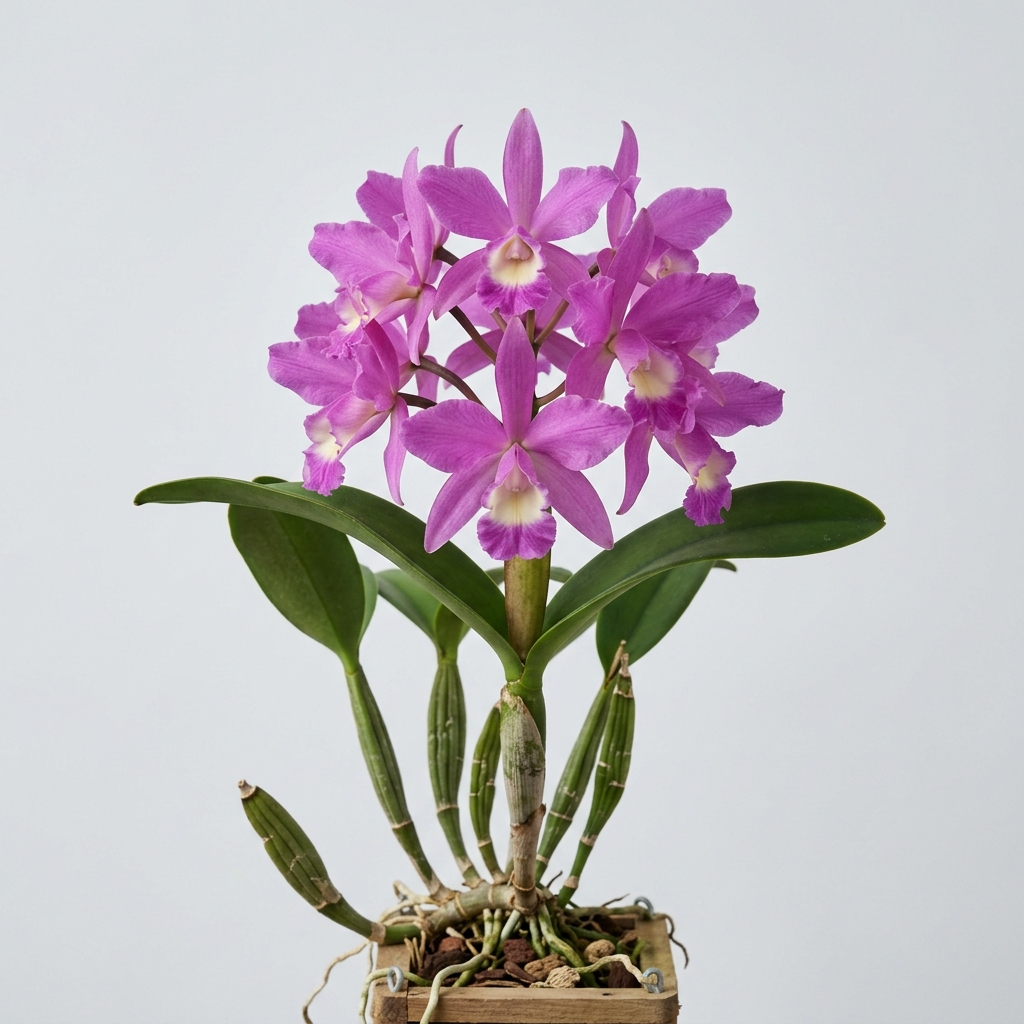
Cattleya Skinneri, historically classified under the genus Cattleya and closely allied with Guarianthe, is one of the most cherished and resilient orchid species in cultivation. Renowned for its vibrant clusters of rose-purple blossoms and robust growth habit, this bifoliate orchid has been a cornerstone of private collections and public exhibitions for generations. Growers prize it not only for its striking floral display but also for its adaptability to typical home and greenhouse environments.
Originating from the seasonally dry forests of Central America, this orchid produces upright, club-shaped pseudobulbs topped with two thick, leathery leaves. During its peak blooming season, a single specimen can produce multiple dense inflorescences, transforming the plant into a spectacular dome of color. Its ease of culture makes it an excellent choice for intermediate hobbyists looking to transition from common grocery store orchids to classic collector species.
💡 Did You Know?
Cattleya Skinneri, locally known as the Guaria Morada, is the national flower of Costa Rica. In its native habitats, it is deeply woven into local folklore and traditional spring celebrations, where it is frequently grown on the clay-tiled roofs of historic homes to bring good fortune and vibrant color to the household.
🌿 Botanical Overview
Cattleya Skinneri shows a classic sympodial growth pattern, producing new pseudobulbs along a horizontal rhizome. The pseudobulbs are distinctly club-shaped, slender at the base and swelling toward the top, where they support two persistent, elliptical leaves. This bifoliate leaf arrangement is characteristic of its section within the Cattleya alliance, distinguishing it from unifoliate species that bear only a single leaf per pseudobulb.
In its native habitats across Central America, this orchid grows primarily as an epiphyte on tall forest trees, though it occasionally establishes itself as a lithophyte on rocky cliffs. Its root system is highly adapted to these environments, featuring a thick layer of velamen that rapidly absorbs atmospheric moisture and nutrients before drying out quickly in the surrounding air currents.
🌸 Flower Characteristics
The flowers of Cattleya Skinneri are celebrated for their quantity and vibrant presentation. Unlike some large-flowered Cattleya species that produce only a few massive blooms per spike, this orchid produces dense, upright clusters of five to fifteen flowers, and sometimes more on exceptionally mature specimens. Each flower typically measures between two and three inches in diameter.
The petals and sepals are generally uniform in color, ranging from a soft rose-pink to a deep, saturated lavender-purple. The lip, or labellum, is funnel-shaped and wraps around the column, featuring a striking white or pale yellow throat that provides a beautiful contrast to the darker margins. Select horticultural forms, such as the pure white “alba” or the blue-toned “coerulea,” are highly sought after by collectors for their unique color variations.
Fragrance & Bloom Profile
The fragrance of Cattleya Skinneri is often described as a delicate, sweet scent with subtle floral notes, though its presence and intensity can vary widely among individual plants and cultivars. Some clones emit a noticeable perfume during the warmest hours of the day, while others may be virtually unscented.
The blooms are remarkably long-lasting for the genus, often remaining fresh for four to six weeks if kept in cool, stable conditions. The flowers open nearly simultaneously on the inflorescence, creating a sudden and dramatic burst of color that makes the plant a standout feature in any collection during its spring blooming cycle.
Parentage & Hybrid Lineage
As a naturally occurring species, Cattleya Skinneri does not have a hybrid parentage, but it has played an invaluable role in orchid hybridization. It is the parent of numerous primary hybrids and complex crosses, prized by breeders for imparting its multi-flowered habit, vigorous growth, and rich coloration to its offspring.
In contemporary botanical nomenclature, some taxonomists place this species in the genus Guarianthe due to structural differences in the lip and pollinia, classifying it as Guarianthe skinneri. However, in the horticultural trade and among many traditional growers, it remains widely recognized and labeled under its classic Cattleya designation.
🌱 Growing Conditions
To cultivate Cattleya Skinneri successfully, growers should aim to replicate its natural seasonal environment. It thrives in bright, indirect light, requiring approximately 2,500 to 3,500 foot-candles. In a home setting, an east- or shaded south-facing window is ideal, while greenhouse growers often use 30% to 50% shade cloth to prevent the foliage from scorching.
💡 Care Tip
To encourage abundant blooming, ensure your orchid receives a distinct drop of 10 to 15 degrees Fahrenheit between day and night during the autumn months, along with slightly reduced .
Temperature requirements fall into the intermediate to warm range. Daytime temperatures of 75°F to 85°F are optimal during the growing season, with a night drop to 60°F or 65°F. Adequate air movement is critical at all times to prevent stagnant air pockets, which can encourage fungal pathogens on the leaves and roots.
Watering, Feeding & Potting Media
During the active growing season in spring and summer, Cattleya Skinneri requires frequent and thorough watering. The potting medium should be allowed to dry out almost completely between waterings, as waterlogged roots will quickly rot. A balanced, water-soluble orchid fertilizer applied at quarter or half strength every second or third watering supports robust pseudobulb development.
The ideal potting medium is a coarse, free-draining mix, typically composed of medium to large fir bark, horticultural charcoal, and perlite. Clay pots are highly recommended because they allow the root zone to breathe and dry more evenly. Alternatively, mature plants can be successfully mounted on cork bark or tree fern plaques if high humidity can be consistently maintained.
Blooming Season & Care Notes
The primary blooming season occurs in late winter and early spring, emerging from sheaths that formed on the mature pseudobulbs during the previous summer. As the flower buds begin to swell inside the sheath, it is important to keep the plant stable and avoid changing its orientation to the light source, which can cause the buds to twist or develop unevenly.
After flowering concludes, the orchid enters a brief period of semi-dormancy. During this time, watering should be significantly reduced, providing just enough moisture to prevent the pseudobulbs from shriveling. Repotting should only be performed when new root tips begin to emerge from the base of the newest pseudobulb, signaling the start of a new growth cycle.
⚠️ Common Issues
⚠️ Common Mistake
The most common mistake is overwatering during the winter rest period. Excess moisture when the plant is not actively growing will quickly lead to root rot and the eventual decline of the orchid.
- Root Rot:
Caused by overwatering or compacted potting media that retains too much moisture. - Bud Blast:
Sudden drops in humidity or temperature fluctuations can cause developing buds to yellow and drop before opening. - Scale and Mealybugs: These pests often hide under the dry sheaths of the pseudobulbs and should be treated promptly with horticultural oil or insecticidal soap.
- Leaf Scorching: Yellow or black patches on the leaves indicate exposure to excessively intense direct sunlight.
❓ Frequently Asked Questions
How often should I water my Cattleya Skinneri?
Watering frequency depends on your environmental conditions, but generally, you should water thoroughly once the potting medium has dried out. During the active summer growth phase, this may be twice a week, while in the winter rest period, it may be reduced to once every ten to fourteen days.
Why are the pseudobulbs on my orchid shriveling?
Shriveled pseudobulbs usually indicate dehydration, which can be caused by either underwatering or root loss due to overwatering. Check the root system; if the roots are firm and white, the plant needs more water. If they are brown and mushy, the roots have rotted, and the plant cannot absorb moisture.
Can I grow Cattleya Skinneri under LED lights?
Yes, this orchid can be grown successfully under high-output LED grow lights. Ensure the lights are positioned close enough to provide the required bright intensity (around 2,500 foot-candles) for 12 to 14 hours a day, while monitoring the leaves to ensure they do not overheat.
When is the best time to repot this orchid?
The absolute best time to repot is in the spring, immediately after the blooming cycle ends and just as new green root tips begin to emerge from the base of the newest pseudobulb. Repotting at this precise moment ensures the plant establishes quickly in its new medium.
⭐ Final Growing Notes
Cattleya Skinneri remains a timeless favorite for a reason, offering a spectacular reward of vibrant spring blooms in exchange for straightforward, consistent care. By respecting its natural seasonal cycle of wet summer growth and dry winter rest, growers of all experience levels can enjoy the stunning, long-lasting floral displays of this legendary Central American orchid.
⚕️ Health, Safety & Edibility
Understanding how a plant interacts with people, pets, and the surrounding environment is part of responsible cultivation. This section uses conservative, general guidance and does not replace professional medical or veterinary advice.
Human Safety: No published evidence currently identifies species-specific toxicity concerns for Cattleya Skinneri during normal handling. As with most ornamental plants, it should not be intentionally consumed.
Pet Safety: Published information does not indicate that this orchid commonly poses a toxicity concern for cats or dogs. However, chewing leaves, flowers, roots, or potting media may still cause mild digestive upset.
Edibility: This orchid is cultivated for ornamental display rather than food. Ornamental plants may carry fertilizers, pesticides, or other horticultural treatments that make them unsuitable for consumption.
Skin Contact: Routine handling is not generally associated with skin irritation. Gardeners with sensitive skin may prefer wearing gloves when repotting, pruning, or handling potting media.
🌱 Propagation Tip
Propagate mature specimens by division during repotting, ensuring each new division has at least three to four healthy, mature pseudobulbs with an active lead eye to support new growth.
⭐ Expert Advice
Keep the dry papery sheaths on the pseudobulbs intact unless they harbor pests. These sheaths provide natural structural support and protect the tender emerging eyes from physical damage and moisture loss.

Leave A Comment