
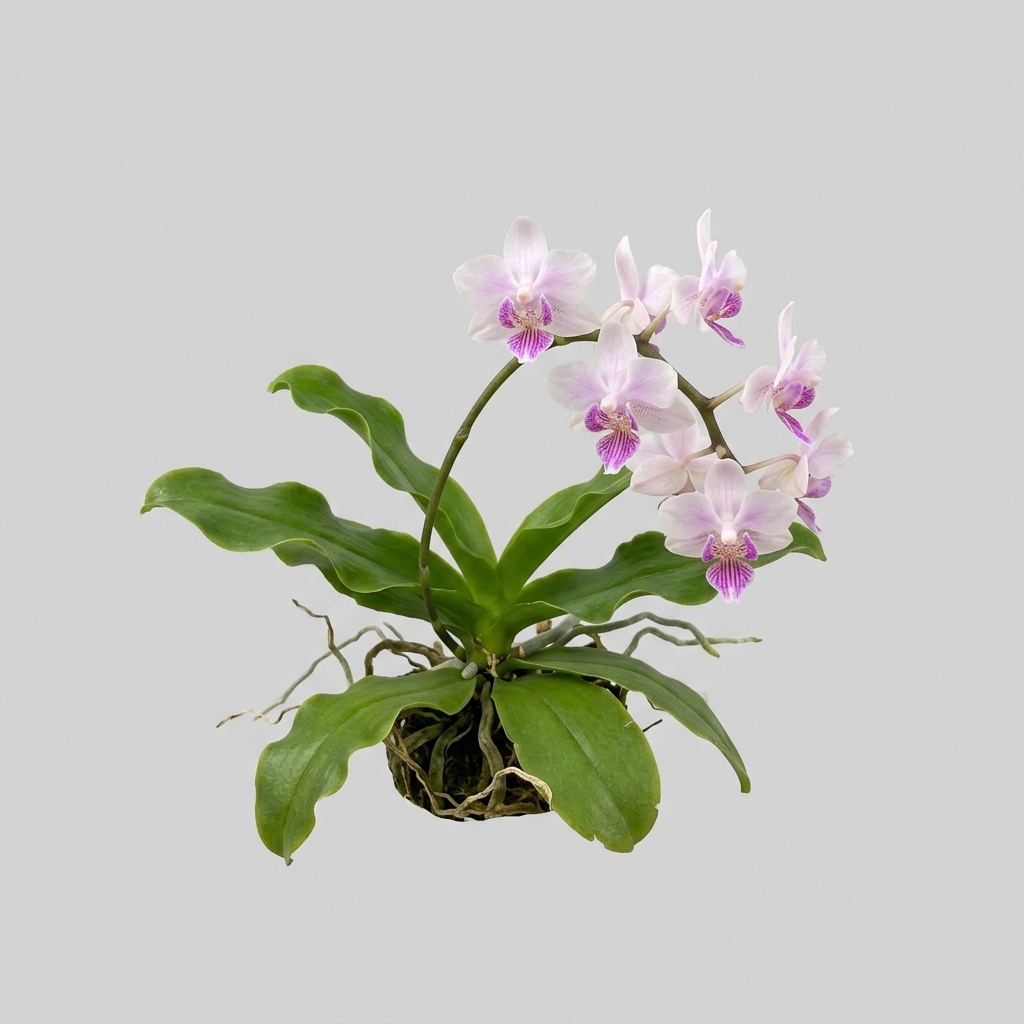
Phalaenopsis Deliciosa is a charming miniature orchid species highly prized by collectors for its delicate growth habit and abundant, intricate blossoms. Native to the damp, shaded forests of Southeast Asia, this epiphytic gem offers a delightful departure from the massive hybrid moth orchids commonly found in grocery stores. Its compact size makes it an ideal candidate for terrarium culture, windowsill growing, or mounting on cork bark, where its natural pendulous growth habit can be fully appreciated.
Despite its diminutive stature, this species produces remarkably detailed flowers that reward close inspection. Growers value Phalaenopsis Deliciosa not only for its frequent flowering potential but also for its elegant, slightly wavy-edged foliage. Whether grown as a specimen plant in a small pot or established on a natural mount, this orchid brings a touch of wild tropical elegance to any indoor growing space.
💡 Did You Know?
Phalaenopsis Deliciosa was once classified under the Kingidium due to its distinct floral structure. Although modern DNA testing has placed it firmly within the Phalaenopsis , many seasoned orchid growers still affectionately refer to it by its historical name, Kingidium deliciosum, in legacy collections.
🌿 Botanical Overview
Phalaenopsis Deliciosa, historically classified under the genus Kingidium, is a monopodial epiphyte native to a broad range stretching from India through southern China and down into Indonesia. In its natural habitat, it grows on tree trunks and branches in shady, humid river valleys and lowland forests. This wide distribution contributes to its adaptability in cultivation, though it consistently prefers warm, humid environments.
The plant features short stems clothed in oblong, leathery leaves that typically reach only 10 to 15 centimeters in length. The leaves often exhibit a distinctive undulating or wavy margin, which helps growers identify the species even when it is not in bloom. Its root system is relatively fine compared to larger Phalaenopsis hybrids, requiring a substrate that retains moisture while allowing excellent gas exchange.
🌸 Flower Characteristics
The blossoms of Phalaenopsis Deliciosa are tiny but structurally complex, usually measuring between 1.5 and 2 centimeters in diameter. They are borne on arching or pendulous inflorescences that can be simple or branched, sometimes carrying dozens of flowers simultaneously. The petals and sepals are typically white to pale pink, providing a soft backdrop for the highly detailed lip.
The labellum, or lip, is the defining feature of the flower. It is deeply three-lobed, often adorned with striking magenta or purple stripes and spots, and features a yellow callus at its base. The contrast between the pale outer segments and the richly colored, intricate lip makes each miniature bloom look like a hand-painted masterpiece.
Fragrance & Bloom Profile
Fragrance in Phalaenopsis Deliciosa is a subject of some debate among growers, as it can be highly clone-dependent. Some individuals report a faint, sweet, citrus-like scent that is most noticeable in the morning hours under warm, humid conditions. Other specimens appear to be entirely unscented.
The blooming cycle is highly rewarding. While a primary flush of flowers typically occurs in the summer and autumn, healthy plants in stable conditions can produce flowers sequentially or push new spikes at almost any time of the year. The individual flowers are relatively long-lasting, and because the spikes can branch, a single blooming cycle can extend over several weeks or even months.
Parentage & Hybrid Lineage
As a naturally occurring species rather than a man-made hybrid, Phalaenopsis Deliciosa carries a pure genetic lineage. It has, however, been used extensively in hybridizing programs to introduce compact growth habits, multi-floral blooming traits, and intricate lip patterns to modern Phalaenopsis hybrids.
In older literature, growers will frequently find this species listed under synonyms such as Kingidium deliciosum, Kingiella deliciosa, or Phalaenopsis decumbens. When purchasing or researching this orchid, it is helpful to keep these historical names in mind, as some older reference guides and award registries still use the legacy nomenclature.
🌱 Growing Conditions
Replicating the understory environment of Southeast Asian forests is key to successfully cultivating Phalaenopsis Deliciosa. It thrives in low to medium indirect light, similar to the light levels preferred by standard moth orchids. Direct sunlight must be strictly avoided, as the thin leaves are highly susceptible to scorching and heat stress.
💡 Care Tip
Because Phalaenopsis Deliciosa has finer roots than standard hybrid moth orchids, it cannot tolerate prolonged dry spells. Keep the growing medium evenly moist, and consider using a clear plastic pot to easily monitor root hydration and health.
Temperature: wise, this species prefers warm to intermediate conditions. Ideal daytime temperatures range from 21°C to 29°C (70°F to 85°F), with a slight drop at night to stimulate healthy growth and spike initiation. High relative humidity, ideally between 60% and 80%, is crucial for preventing leaf desiccation and supporting the fine root system. Good air movement is essential to prevent stagnant air from causing fungal or bacterial issues in these humid conditions.
Watering, Feeding & Potting Media
Unlike its larger relatives, Phalaenopsis Deliciosa has finer roots and thinner leaves, meaning it has less capacity to store water and should never be allowed to dry out completely. The potting medium should remain consistently damp but never waterlogged. Watering frequency will depend heavily on the growing setup; mounted plants may require daily misting, while potted specimens might only need watering every few days.
A high-quality, fine-grade fir bark mix blended with chopped sphagnum moss works exceptionally well in small plastic or clay pots. Alternatively, mounting the orchid on a slab of cork bark or tree fern with a small pad of sphagnum moss around the roots showcases its natural growth habit beautifully. Feed the plant weekly with a highly diluted, balanced orchid fertilizer, using the “weakly, weekly” method, and flush the medium with pure water once a month to prevent salt buildup.
Blooming Season & Care Notes
While summer and autumn are the primary blooming seasons, Phalaenopsis Deliciosa can surprise growers with blooms year-round if environmental conditions remain stable. When a flower spike emerges, avoid changing the plant’s orientation to the light source, as this can cause the developing buds to twist or fail to open properly.
Once the blooming cycle is complete, do not rush to cut the green flower spikes. This species can produce secondary branches or sequential blooms from old spikes. Only cut the spike back to the base of the plant if it has turned completely yellow or brown and dry. Repotting is best done in the spring, just as new active root growth is observed, ensuring minimal disturbance to the delicate root system.
⚠️ Common Issues
⚠️ Common Mistake
A frequent error is treating this miniature species exactly like a large, drought-tolerant hybrid. Allowing the potting medium of Phalaenopsis Deliciosa to dry out completely for extended periods will quickly lead to root loss, leaf shriveling, and dropped flower buds.
- Root rot:
Caused by overwatering or compacted, decomposing potting media that suffocates the fine root system. - Bud blast:
Sudden drops in humidity, drafts, or underwatering can cause developing buds to yellow and drop before opening. - Leaf scorch: Bleached or black patches on the leaves indicate the plant is receiving too much direct sunlight.
- Pests:
Spider mites and mealybugs can hide in the crevices of the wavy leaves; treat early with insecticidal soap or horticultural oil. - Dehydration:
Shriveled leaves and dry, silvery roots indicate insufficient watering or low ambient humidity.
❓ Frequently Asked Questions
Can Phalaenopsis Deliciosa be grown in a terrarium?
Yes, its miniature size and high humidity requirements make Phalaenopsis Deliciosa an excellent candidate for terrariums or vivariums. Ensure there is adequate internal air circulation to prevent stagnant moisture on the leaves.
How do I know if my Phalaenopsis Deliciosa needs watering?
Check the potting medium and the roots. If the medium feels barely damp or the roots visible through a clear pot turn a silvery-gray, it is time to water. Avoid letting the medium dry out to a crisp.
Why are the buds on my orchid falling off before opening?
This is known as bud blast. It is usually triggered by environmental stress, such as a sudden drop in humidity, exposure to cold drafts, underwatering, or moving the plant to a new location while in bud.
Is Phalaenopsis Deliciosa suitable for beginners?
It is slightly more demanding than standard grocery store hybrid Phalaenopsis due to its finer roots and higher humidity needs. However, for a beginner willing to monitor moisture levels closely, it is a highly rewarding entry into species orchids.
⭐ Final Growing Notes
Phalaenopsis Deliciosa is a captivating species that proves spectacular orchid displays do not require massive amounts of space. By providing consistent warmth, high humidity, and careful attention to moisture, growers can enjoy the intricate beauty of its miniature blooms for years to come. It remains a must-have species for any enthusiast looking to explore the diverse and enchanting world of miniature orchids.
⚕️ Health, Safety & Edibility
Understanding how a plant interacts with people, pets, and the surrounding environment is part of responsible cultivation. This section uses conservative, general guidance and does not replace professional medical or veterinary advice.
Human Safety: No published evidence currently identifies species-specific toxicity concerns for Phalaenopsis Deliciosa during normal handling. As with most ornamental plants, it should not be intentionally consumed.
Pet Safety: Published information does not indicate that this orchid commonly poses a toxicity concern for cats or dogs. However, chewing leaves, flowers, roots, or potting media may still cause mild digestive upset.
Edibility: This orchid is cultivated for ornamental display rather than food. Ornamental plants may carry fertilizers, pesticides, or other horticultural treatments that make them unsuitable for consumption.
Skin Contact: Routine handling is not generally associated with skin irritation. Gardeners with sensitive skin may prefer wearing gloves when repotting, pruning, or handling potting media.
🌱 Propagation Tip
While this species is primarily propagated through seed in professional laboratories, mature, healthy plants may occasionally produce a keiki—a genetically identical baby plant—along an old flower spike. Allow the keiki to develop several strong roots before carefully detaching and potting it.
⭐ Expert Advice
For the ultimate natural display, mount Phalaenopsis Deliciosa on a slab of cork bark with a small pad of high-quality sphagnum moss. This setup mimics its wild epiphytic growth habit, allows the roots to breathe perfectly, and prevents the crown rot issues often caused by overwatering in pots.

Leave A Comment