
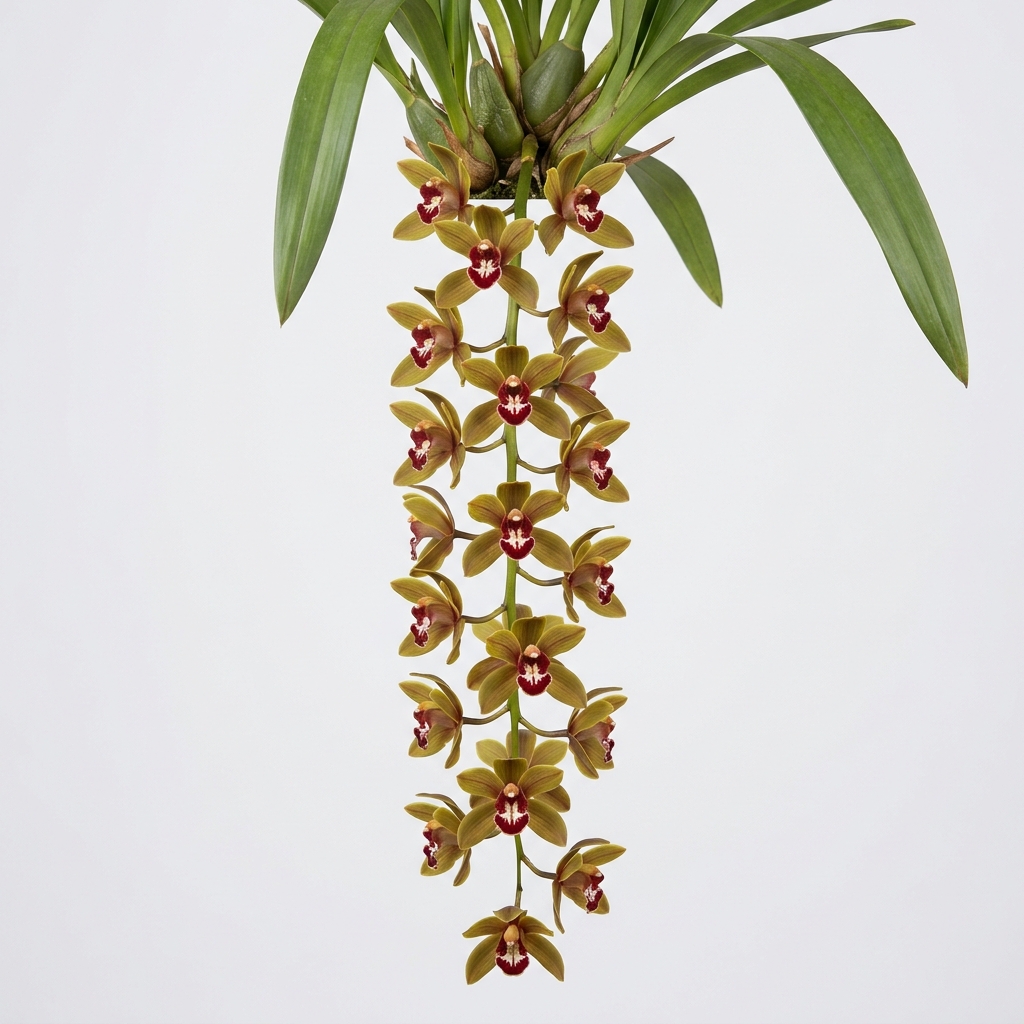
Cymbidium Finlaysonianum is a striking and robust orchid species native to the tropical rainforests of Southeast Asia, highly prized by collectors for its dramatic pendulous growth habit. Unlike the more common upright cool-growing Cymbidium hybrids, this warm-growing epiphyte produces spectacular cascading flower spikes that can reach over a meter in length. It is an ideal choice for growers who have the space to accommodate its large, leathery foliage and hanging presentation.
Cultivated primarily in hanging baskets or mounted high on sturdy mounts, this species offers a unique architectural presence in any orchid collection. Its ability to thrive in warmer, more humid environments than typical montane Cymbidiums makes it particularly valuable for tropical and subtropical enthusiasts. When in full bloom, a mature specimen presents a breathtaking curtain of olive-yellow and deep red-lipped blossoms.
💡 Did You Know?
In its native Southeast Asian habitats, Cymbidium Finlaysonianum can form massive, heavy clumps weighing over a hundred pounds, securely anchored high in the forks of large forest trees. These giant specimens sometimes host entire micro-ecosystems within their dense root masses, showcasing the incredible structural resilience of this epiphytic orchid species.
🌿 Botanical Overview
Cymbidium Finlaysonianum is a large-statured orchid species that naturally grows as an epiphyte on tree trunks or occasionally as a lithophyte on exposed rocks. It is native to low-elevation forests across Malaysia, Indonesia, the Philippines, and Thailand. The plant features large, tightly clustered pseudobulbs enveloped by the bases of thick, strap-like, leathery leaves that can grow up to 75 centimeters long.
The root system of this species is exceptionally robust, designed to anchor the heavy plant to tree branches while absorbing moisture and nutrients from passing rain. Because of its native habitat in lowland tropical regions, it has evolved to tolerate much higher temperatures and lower seasonal temperature fluctuations than its montane, cool-growing relatives.
🌸 Flower Characteristics
The most defining feature of Cymbidium Finlaysonianum is its pendulous inflorescence, which emerges from the base of the pseudobulb and hangs straight down, sometimes reaching lengths of up to 1.2 meters. Each spike can carry between 15 and 45 individual flowers, spaced evenly along the stem to create a cascading chain effect.
The individual flowers are typically 4 to 6 centimeters across. The sepals and petals are narrow and range in color from olive-green to a warm, brownish-yellow. The lip, or labellum, provides a sharp contrast, featuring a white base heavily marked with deep purple, magenta, or dark red bands and a yellow callus in the center.
Fragrance & Bloom Profile
The fragrance of Cymbidium Finlaysonianum is a subject of discussion among growers, as it is often described as variable or weakly documented. Some specimens produce a faint, sweet, or herbal scent during the warmest hours of the day, while others are reported to have a slightly musty or earthy aroma.
The blooms are long-lasting, typically remaining fresh on the spike for three to five weeks depending on environmental conditions. Because the flowers open sequentially from the base of the spike to the tip, the overall blooming display can extend over a significant period during the spring and summer months.
Parentage & Hybrid Lineage
As a naturally occurring species rather than a man-made hybrid, Cymbidium Finlaysonianum does not have a complex parentage. It belongs to the section Aloinifolium within the genus Cymbidium, a group characterized by thick, coriaceous leaves and pendulous inflorescences.
In orchid hybridization, this species has been used occasionally to introduce warm-tolerance, pendulous spike habits, and robust growth characteristics into modern Cymbidium hybrids. However, its direct hybrid descendants are relatively uncommon compared to those derived from cool-growing Chinese and Himalayan species, making pure specimens highly sought after by species purists.
🌱 Growing Conditions
To grow Cymbidium Finlaysonianum successfully, one must replicate its warm, tropical canopy environment. It requires bright, filtered light, similar to what a Cattleya would receive. While it can tolerate some direct morning sun, harsh midday sunlight will scorch the thick leaves. High light levels are essential for triggering the development of flower spikes.
💡 Care Tip
Ensure your growing area has continuous, gentle air movement. Because this species thrives in high and warm temperatures, active air circulation is vital to prevent fungal leaf spot diseases and keep the root zone oxygenated.
Temperature ranges should remain warm to hot, with daytime temperatures ideally between 80°F and 90°F (27°C to 32°C) and nighttime temperatures dropping no lower than 60°F to 65°F (15°C to 18°C). High humidity of 60% to 80% is critical, paired with strong, continuous air movement to prevent fungal pathogens from settling on the foliage.
Watering, Feeding & Potting Media
During the active growing season in spring and summer, Cymbidium Finlaysonianum requires abundant watering. The potting medium should be kept consistently moist but never waterlogged. As growth slows in the winter, watering should be reduced, allowing the medium to dry out slightly between waterings, though the pseudobulbs should never be allowed to shrivel.
Feed the plant weekly with a balanced orchid fertilizer diluted to half-strength during the active growth phase. Because of its pendulous blooming habit, this orchid is best grown in wooden slat baskets, net pots, or mounted on large cork slabs. If potted, use an extremely coarse, free-draining medium consisting of large fir bark, charcoal, and perlite to ensure the roots receive ample oxygen.
Blooming Season & Care Notes
Blooming typically occurs from late spring through mid-summer. As the flower spikes begin to emerge from the base of the pseudobulbs, it is vital to hang the container high enough to allow the spikes to cascade naturally without touching the ground or shelving. Moving or rotating the plant while the spike is developing can cause the buds to orient poorly.
Repotting should only be done when the potting medium begins to break down or the plant has completely outgrown its container, usually every two to three years. The best time to repot or divide the plant is immediately after the blooming cycle has finished, just as new root growth begins to emerge from the base of the newest pseudobulbs.
⚠️ Common Issues
⚠️ Common Mistake
A frequent error is treating this species like a standard cool-growing Cymbidium. Exposing it to cold autumn temperatures to induce blooming will stall its growth and can cause severe foliage damage or root loss.
- Root Rot:
Caused by overwatering or using a decomposed, compacted potting medium that suffocates the roots. - Leaf Scorch: Appears as bleached or black patches on the leaves, resulting from sudden exposure to direct, intense sunlight.
- Bud Blast:
The premature dropping of flower buds, often triggered by sudden changes in temperature, low humidity, or drafty conditions. - Spider Mites:
Common pests that thrive in warm, dry environments, presenting as fine webbing on the undersides of the leathery leaves. - Fungal Leaf Spotting: Dark spots on the foliage caused by high humidity combined with stagnant, poor air circulation.
❓ Frequently Asked Questions
Why is my Cymbidium Finlaysonianum not blooming?
The most common reason for a lack of blooms is insufficient light. This species requires very bright, filtered light to trigger spike development. Ensure the plant is receiving adequate light, and verify that it is not being kept too cool, as it requires warmer temperatures than standard Cymbidium hybrids to initiate flowering.
Can I grow Cymbidium Finlaysonianum in a standard plastic pot?
While it is possible to grow this orchid in a pot, it is not recommended due to its strictly pendulous flower spikes. If grown in a standard pot on a flat surface, the cascading spikes will drape over the rim and may damage themselves on the table or floor. Hanging baskets or mounted setups are highly preferred.
How often should I divide my Cymbidium Finlaysonianum?
Division should be done sparingly, as larger specimen plants produce the most spectacular floral displays. If you must divide the plant during repotting, ensure that each division contains at least three to four healthy, mature pseudobulbs with active lead growths to ensure rapid recovery.
What should I do if the pseudobulbs begin to shrivel?
Shriveling pseudobulbs indicate dehydration, which can be caused by underwatering or, paradoxically, root rot. Check the root system first; if the roots are healthy and dry, increase your watering frequency. If the roots are mushy and brown, repot the plant immediately in fresh, coarse media and reduce watering until new roots form.
⭐ Final Growing Notes
Cymbidium Finlaysonianum is a rewarding species for growers who can accommodate its large size and warm-growing requirements. Its spectacular, cascading chains of olive and red flowers provide a dramatic tropical aesthetic that standard upright orchids cannot match. By providing bright light, high humidity, and a free-draining hanging environment, enthusiasts can enjoy the majestic beauty of this Southeast Asian treasure for decades.
⚕️ Health, Safety & Edibility
Understanding how a plant interacts with people, pets, and the surrounding environment is part of responsible cultivation. This section uses conservative, general guidance and does not replace professional medical or veterinary advice.
Human Safety: No published evidence currently identifies species-specific toxicity concerns for Cymbidium Finlaysonianum during normal handling. As with most ornamental plants, it should not be intentionally consumed.
Pet Safety: Published information does not indicate that this orchid commonly poses a toxicity concern for cats or dogs. However, chewing leaves, flowers, roots, or potting media may still cause mild digestive upset.
Edibility: This orchid is cultivated for ornamental display rather than food. Ornamental plants may carry fertilizers, pesticides, or other horticultural treatments that make them unsuitable for consumption.
Skin Contact: Routine handling is not generally associated with skin irritation. Gardeners with sensitive skin may prefer wearing gloves when repotting, pruning, or handling potting media.
🌱 Propagation Tip
When dividing a mature specimen, always use a sterile, sharp blade and ensure each division retains at least three connected pseudobulbs. Apply a dusting of cinnamon powder to the cut surfaces to prevent infection before repotting.
⭐ Expert Advice
To maximize the visual impact of the pendulous blooms, hang the basket at or slightly above eye level. This allows the long, cascading flower spikes to hang freely without obstruction, presenting the blossoms perfectly.

Leave A Comment