
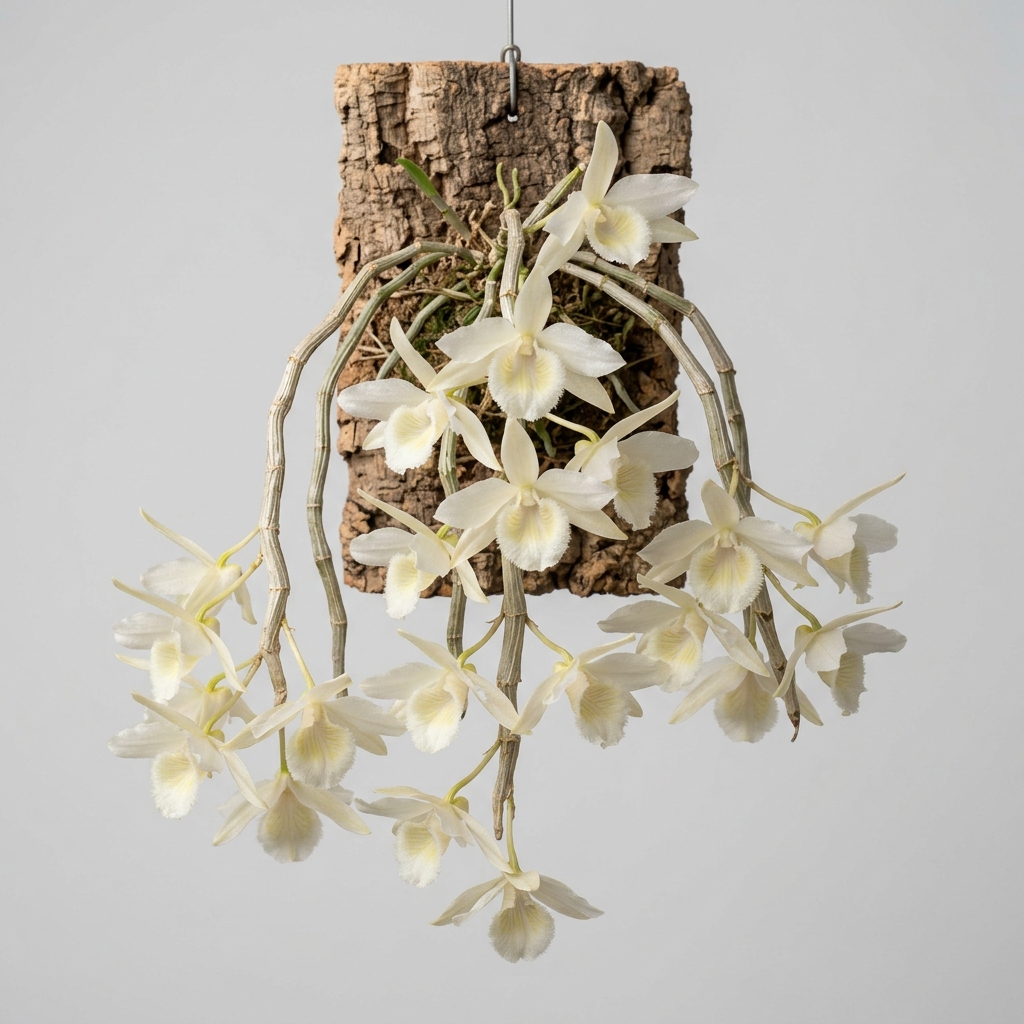
Dendrobium Cretaceum, commonly known as the chalky Dendrobium, is a captivating epiphytic orchid species native to the seasonal, open forests of Southeast Asia. It is highly regarded by collectors for its pendulous growth habit, characterized by cascading, cylindrical canes that naturally shed their leaves prior to a dramatic spring flowering. This deciduous cycle is a key evolutionary adaptation to its native monsoonal climate, allowing the plant to conserve energy and moisture before putting on its annual floral display.
Growers highly value this species for the striking visual contrast of its crystalline, chalk-white flowers against a softly colored, velvety lip. While it requires a disciplined approach to seasonal watering to bloom successfully, its rewarding floral output and elegant growth form make it an exceptional addition to intermediate orchid collections, particularly when displayed in hanging baskets or mounted on natural bark slabs.
💡 Did You Know?
The species name cretaceum is derived from the Latin word for chalk, directly referencing the distinctive matte, chalk-white texture of its petals. This unique floral coloration, paired with a densely fuzzy, yellow-veined lip, makes it one of the most visually striking pendulous species in the entire Dendrobium .
🌿 Botanical Overview
Dendrobium Cretaceum is naturally distributed across a broad range in Southeast Asia, including the Himalayan foothills, Myanmar, Thailand, Laos, and Vietnam. In these regions, it grows as an epiphyte on tree trunks at elevations ranging from 600 to 1,600 meters. The climate in its native habitat is highly seasonal, characterized by warm, wet summers with heavy monsoon rains, followed by cool, dry winters with minimal precipitation.
Vegetatively, the plant produces pendulous, cylindrical pseudobulbs, commonly referred to as canes, which can reach lengths of 30 to 50 centimeters. These canes are covered in alternate, lanceolate leaves during the active growing season. As autumn approaches, the leaves gradually turn yellow and drop, leaving the canes completely bare. This deciduous state is a natural phase of the orchid’s life cycle and is essential for its long-term health and flowering potential.
🌸 Flower Characteristics
The blossoms of Dendrobium Cretaceum are highly distinctive, typically measuring between 3 and 5 centimeters in diameter. They emerge from the nodes of the previous year’s leafless canes, appearing either singly or in small clusters of two to three. The petals and sepals exhibit a matte, crystalline texture and are a clean, chalky white or pale cream color, which gives the species its botanical name.
The most striking feature of the flower is its rounded, highly pubescent (fuzzy) lip or labellum. The throat of the lip is typically colored in shades of pale yellow or cream, adorned with delicate, radiating veins of pink, purple, or light red. This intricate patterning and soft, velvety texture serve as a visual guide for natural pollinators in the wild.
Fragrance & Bloom Profile
This species is known to produce a light, pleasant fragrance that is most noticeable during the morning hours when temperatures begin to rise. Growers often describe the scent as clean, sweet, or slightly soapy, though the intensity can vary depending on environmental conditions such as humidity and air movement. The blooms are moderately long-lasting, typically remaining fresh for two to three weeks if kept in a cool, draft-free environment.
Parentage & Hybrid Lineage
As a naturally occurring species rather than a man-made hybrid, Dendrobium Cretaceum does not have a parentage lineage. It belongs to the section Dendrobium within the genus, sharing close affinity with other deciduous, pendulous species such as Dendrobium primulinum and Dendrobium aphyllum. While it has been used occasionally in breeding programs to introduce its unique chalk-white coloration and fuzzy lip characteristics to new hybrids, it remains most highly prized by collectors in its pure, unhybridized species form.
🌱 Growing Conditions
To cultivate Dendrobium Cretaceum successfully, growers should aim to replicate its native seasonal environment. During the active growing season from spring to early autumn, the plant thrives in warm to intermediate temperatures, ideally ranging from 22°C to 30°C during the day. It requires bright, filtered light; direct midday sun should be avoided to prevent leaf scorch, but high light levels are necessary to build up the energy reserves needed for blooming.
💡 Care Tip
Mount this orchid on a cork plaque or plant it in a hanging basket. Because its canes naturally grow downward in a pendulous fashion, standard upright potting can trap water in the crown and lead to stem rot.
Excellent air circulation is critical at all times of the year. Because of its pendulous growth habit, stagnant air can easily lead to fungal or bacterial infections in the crown and leaf joints. Maintaining a relative humidity of 60% to 80% during the summer will support robust vegetative growth.
Watering, Feeding & Potting Media
During the spring and summer, when new canes and roots are actively developing, Dendrobium Cretaceum requires copious watering. The potting medium or mount should be watered thoroughly as soon as it approaches dryness. A balanced, water-soluble orchid fertilizer should be applied weekly at a quarter or half strength during this active growth phase to encourage strong, thick canes.
Because of its pendulous growth habit, this orchid is best grown mounted on cork bark slabs or planted in hanging wooden baskets. If basket culture is used, a highly porous, fast-draining medium consisting of coarse fir bark, charcoal, and perlite is recommended. This ensures that the roots dry rapidly after watering, preventing root rot.
Blooming Season & Care Notes
The blooming cycle of Dendrobium Cretaceum is strictly tied to its winter rest period. In late autumn, as natural light levels and temperatures begin to drop, watering must be reduced significantly, and fertilizing must be stopped entirely. The plant should be kept in a cooler location, with night temperatures dropping to around 10°C to 13°C.
During this winter rest, the leaves will drop, and the canes may shrivel slightly. Water should only be provided in very small amounts—such as a light misting—if the canes begin to shrivel excessively. In early spring, small buds will begin to emerge from the nodes of the bare canes. Watering should only be gradually resumed once the buds are well-developed and new vegetative growth begins to emerge from the base of the plant.
⚠️ Common Issues
⚠️ Common Mistake
The most common error is the orchid during its winter dormancy. Providing regular water or fertilizer during this cool rest period will suppress flower bud development, often forcing the plant to produce vegetative keikis instead of blooms.
- Bud Blast:
Sudden temperature fluctuations, drafts, or premature watering before the buds are fully formed can cause the developing flower buds to turn yellow and drop. - Root Rot:
Overwatering during the cool winter rest period is the most common cause of root loss, which can severely weaken or kill the plant. - Keiki Production: Applying fertilizer or watering too early in the spring can cause the plant to produce vegetative offsets (keikis) along the canes instead of flower buds.
- Spider Mites:
These pests can target the plant during the dry winter rest when humidity levels drop; regular monitoring and maintaining moderate ambient humidity can help prevent infestations.
❓ Frequently Asked Questions
Why is my Dendrobium Cretaceum losing its leaves in autumn?
This is a completely natural, deciduous process. Dendrobium Cretaceum sheds its leaves annually in autumn to prepare for its winter rest and later spring blooming cycle. Do not increase watering when this occurs.
How do I trigger blooms on Dendrobium Cretaceum?
To trigger blooming, you must provide a strict cool, dry winter rest starting in late autumn. Reduce watering to a bare minimum, stop all fertilizing, and expose the plant to cooler night temperatures and bright light.
Can I grow Dendrobium Cretaceum in a standard plastic pot?
It is not recommended. Because of its pendulous, cascading canes, this orchid is best grown mounted on cork bark or in a hanging basket. Standard pots make it difficult for the canes to cascade naturally and increase the risk of crown rot.
What should I do if my orchid produces keikis instead of flowers?
Keikis are often produced if the plant is watered or fertilized too early during its winter rest. You can allow the keikis to grow until they have roots at least two inches long, then gently remove and mount them as new individual plants.
⭐ Final Growing Notes
Dendrobium Cretaceum is a highly rewarding species that showcases the fascinating adaptability of epiphytic orchids. By respecting its natural seasonal rhythm—providing abundant water and warmth in summer, followed by a cool, dry dormancy in winter—growers can enjoy a spectacular annual display of delicate, chalk-white blossoms that bring a touch of wild Southeast Asian beauty into the home greenhouse.
⚕️ Health, Safety & Edibility
Understanding how a plant interacts with people, pets, and the surrounding environment is part of responsible cultivation. This section uses conservative, general guidance and does not replace professional medical or veterinary advice.
Human Safety: No published evidence currently identifies species-specific toxicity concerns for Dendrobium Cretaceum during normal handling. As with most ornamental plants, it should not be intentionally consumed.
Pet Safety: Published information does not indicate that this orchid commonly poses a toxicity concern for cats or dogs. However, chewing leaves, flowers, roots, or potting media may still cause mild digestive upset.
Edibility: This orchid is cultivated for ornamental display rather than food. Ornamental plants may carry fertilizers, pesticides, or other horticultural treatments that make them unsuitable for consumption.
Skin Contact: Routine handling is not generally associated with skin irritation. Gardeners with sensitive skin may prefer wearing gloves when repotting, pruning, or handling potting media.
🌱 Propagation Tip
This species readily produces adventitious offsets, known as keikis, along its canes. Wait until the keiki has developed several roots at least two inches long before gently detaching and mounting it independently.
⭐ Expert Advice
When the winter rest begins, move the plant to a cooler location with bright . Only mist the canes lightly if they begin to shrivel severely; a slight wrinkling of the pseudobulbs is normal and indicates the plant is properly entering its dry cycle.

Leave A Comment