
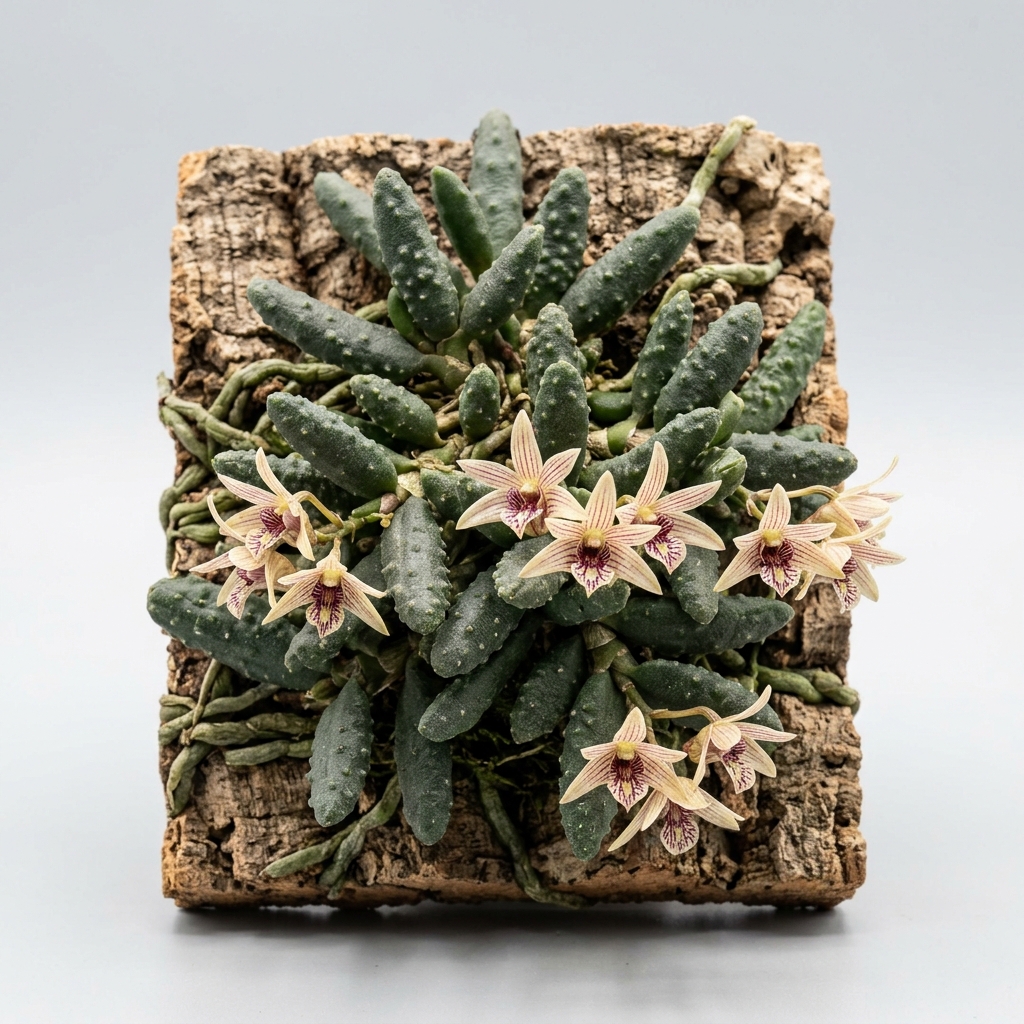
Dendrobium Cucumerinum, commonly referred to as the cucumber orchid, is one of the most distinctive and fascinating epiphytic orchids native to Eastern Australia. Highly prized by collectors for its unusual succulent-like foliage, this species features prostrate, creeping rhizomes that produce thick, fleshy leaves covered in small bumps, closely resembling miniature cucumbers. This unique vegetative adaptation allows the plant to store moisture efficiently, making it an intriguing bridge between the worlds of orchids and succulents.
While the foliage alone makes it a standout addition to any collection, this orchid also produces delicate, star-shaped flowers that emerge in small clusters from the base of the leaves. The blooms feature cream, white, or pale-greenish petals adorned with fine reddish-purple stripes, creating a striking contrast against the rugged, textured leaves. Cultivating this species successfully requires an understanding of its natural habitat, where it thrives in bright, airy conditions clinging to tree bark.
💡 Did You Know?
The bumpy, cucumber-like leaves of Dendrobium Cucumerinum are a brilliant evolutionary adaptation to dry climates. These succulent leaves are covered in tiny, water-storing cells that give them their characteristic textured surface. This unique structure allows the orchid to survive prolonged dry spells in its native Australian canopy, where water drains away instantly from its mounted home.
🌿 Botanical Overview
Dendrobium Cucumerinum belongs to a specialized group of orchids often classified under the genus Dockrillia by some taxonomists, characterized by their terete or succulent leaves and creeping growth habit. In its native Australian habitats, particularly in New South Wales and Queensland, it grows as an epiphyte on the rough bark of trees such as Casuarina. The plant forms dense, low-growing mats that hug the mounting surface, spreading horizontally rather than growing upright.
The most striking botanical feature is the tuberculate texture of the leaves. Each leaf is cylindrical, slightly curved, and covered in numerous small, wart-like bumps. This adaptation minimizes water loss in seasonally dry environments, allowing the orchid to withstand periods of low rainfall. The root system is relatively fine but highly efficient at gripping rough bark and absorbing atmospheric moisture and nutrients rapidly.
🌸 Flower Characteristics
The flowers of Dendrobium Cucumerinum are relatively small but intricately detailed, typically measuring about one to two centimeters in diameter. They are borne on short inflorescences that arise from the nodes along the creeping rhizome, usually bearing two to ten flowers per spike. The petals and sepals are narrow, linear, and tend to curve or twist slightly, giving the bloom a delicate, spidery appearance.
Coloration is generally cream-colored, pale yellow, or light greenish-white, decorated with prominent longitudinal stripes of reddish-brown or purple near the base of the segments. The labellum, or lip, is a key feature, presenting a white or cream base with distinctly wavy or ruffled margins and three raised ridges running down its center. The flowers are presented in a downward or outward-facing posture, nestled closely against the textured foliage.
Fragrance & Bloom Profile
The fragrance of this species is a subject of much discussion among orchid enthusiasts. It is frequently described as having a distinct, spicy, or slightly sweet scent, which some growers compare to the aroma of ripe cucumbers or melon, while others detect a more medicinal or herbal note. The intensity of the fragrance is highly dependent on environmental conditions, typically peaking during the warmest hours of midday when light levels are highest.
Individual blooms are moderately long-lasting, typically remaining fresh for two to three weeks depending on temperature and humidity. Because the flowers are relatively small and sit close to the creeping foliage, they are best appreciated up close, making mounted specimens hung at eye level ideal for enjoying both the visual details and the unique scent.
Parentage & Hybrid Lineage
As a naturally occurring species rather than a man-made hybrid, Dendrobium Cucumerinum does not have a complex lineage of parental cultivars. It represents a distinct evolutionary branch within the subtribe Dendrobiinae. While some taxonomists prefer the classification Dockrillia cucumerina to highlight its succulent, non-pseudobulbous nature, it remains widely traded and recognized under its traditional Dendrobium designation in horticultural circles.
Hybridization involving this species is relatively rare due to its highly specialized morphology, but some adventurous breeders have attempted crosses with other terete-leaved orchid species. These hybrids aim to combine the unique, cucumber-like foliage with the larger or more colorful flowers of related species. However, documented and registered hybrids remain limited, and the species itself is primarily grown and appreciated in its pure, wild-type form.
🌱 Growing Conditions
To cultivate this orchid successfully, growers must replicate the bright, airy conditions of its native Australian woodlands. This orchid requires bright, filtered light to thrive. It can tolerate some direct morning sun, but intense midday sunlight should be avoided to prevent the fleshy leaves from scorching or turning an unhealthy yellow-red color. Adequate light is crucial for stimulating flower production.
💡 Care Tip
Always mount this orchid rather than potting it. Use a rough slab of cork bark or tree fern wood. This allows the creeping rhizome to spread naturally and ensures the roots dry out completely within hours of , mimicking its natural canopy habitat.
Temperature requirements fall within the intermediate to warm range. During the growing season, daytime temperatures of 70°F to 85°F (21°C to 29°C) are ideal, with a slight drop at night to promote healthy metabolism. The plant can tolerate cooler winter temperatures down to 50°F (10°C) if kept relatively dry. High air movement is absolutely critical for this species; stagnant air combined with high humidity can quickly lead to rot.
Watering, Feeding & Potting Media
Because of its creeping growth habit and susceptibility to root rot, Dendrobium Cucumerinum is almost exclusively grown mounted on slabs of cork bark, tree fern, or hardwood. Growing this orchid in a traditional pot with standard orchid mix is generally not recommended, as the media retains too much moisture around the rhizome and fine roots, leading to rapid decline.
Watering should be frequent but highly ephemeral. Mounted plants should be thoroughly misted or soaked, then allowed to dry out completely within a few hours. During the active growing season in spring and summer, daily watering may be necessary, especially in warm, dry environments. In the winter, watering should be significantly reduced, providing just enough moisture to prevent the succulent leaves from shriveling. Feed with a highly diluted, balanced orchid fertilizer every second or third watering during active growth.
Blooming Season & Care Notes
The primary blooming season for this orchid typically occurs in late spring to mid-summer, though occasional blooms can appear at other times of the year if growing conditions are optimal. A distinct winter rest period with cooler temperatures and reduced watering is often necessary to trigger the development of flower buds.
After flowering has finished, the old flower spikes will naturally wither and can be carefully trimmed away. Repotting or remounting should only be done when the plant has outgrown its mount or the mount itself begins to decay. This is best performed in early spring when new root growth is just beginning, minimizing disturbance to the sensitive root system.
⚠️ Common Issues
⚠️ Common Mistake
The most common mistake is overwatering, especially during the winter rest period. Keeping the roots constantly wet or growing the plant in a traditional pot will quickly lead to root rot and the eventual death of the orchid. Always allow the plant to dry completely between waterings.
- Root Rot:
Caused by excessive moisture retention or growing the plant in a pot with poor drainage. - Shriveling Leaves: Indicates severe dehydration, often due to a loss of healthy roots or insufficient watering frequency.
- Leaf Scorch: Yellow or brown patches on the leaves resulting from exposure to intense, direct midday sunlight.
- Pests:
Scale and mealybugs can hide in the deep crevices of the textured, bumpy leaves and should be treated promptly with horticultural soap. - Bud Blast:
Sudden dropping of flower buds before opening, typically triggered by rapid shifts in temperature or humidity.
❓ Frequently Asked Questions
Can I grow Dendrobium Cucumerinum in a plastic pot?
It is highly discouraged to grow this species in a traditional plastic pot. Its creeping rhizomes and fine roots require rapid drying cycles. Mounting the orchid on cork bark or a hardwood slab is the most successful cultivation method.
How often should I water my mounted cucumber orchid?
During the warm spring and summer growing season, mounted plants may need daily watering or misting. However, they must dry out completely within a few hours. In winter, reduce watering to once every one to two weeks.
Why are the leaves on my orchid turning reddish-purple?
A slight reddish tint on the bumpy leaves usually indicates that the plant is receiving the maximum amount of light it can tolerate. If the leaves turn bright red or develop dry brown patches, move the plant to a slightly shadier location.
What causes the flower buds to drop before opening?
Bud blast is typically caused by environmental stress, such as a sudden drop in humidity, drafty conditions, or extreme temperature fluctuations. Keep the plant in a stable, humid environment with consistent air movement when buds are developing.
⭐ Final Growing Notes
Dendrobium Cucumerinum is a rewarding orchid for growers looking to add a touch of botanical eccentricity to their collection. Its succulent-like appearance and creeping growth habit make it a fascinating conversation piece even when not in bloom. By providing bright light, excellent air circulation, and a mounted growing environment that allows the roots to dry rapidly, enthusiasts can enjoy the unique charm of this Australian native for many years.
⚕️ Health, Safety & Edibility
Understanding how a plant interacts with people, pets, and the surrounding environment is part of responsible cultivation. This section uses conservative, general guidance and does not replace professional medical or veterinary advice.
Human Safety: No published evidence currently identifies species-specific toxicity concerns for Dendrobium Cucumerinum during normal handling. As with most ornamental plants, it should not be intentionally consumed.
Pet Safety: Published information does not indicate that this orchid commonly poses a toxicity concern for cats or dogs. However, chewing leaves, flowers, roots, or potting media may still cause mild digestive upset.
Edibility: This orchid is cultivated for ornamental display rather than food. Ornamental plants may carry fertilizers, pesticides, or other horticultural treatments that make them unsuitable for consumption.
Skin Contact: Routine handling is not generally associated with skin irritation. Gardeners with sensitive skin may prefer wearing gloves when repotting, pruning, or handling potting media.
🌱 Propagation Tip
Propagation is best achieved by division of larger, established mats. Ensure each division has at least four to five healthy leaves and an active growing point. Carefully secure the new division to its mount using monofilament line or floral wire until new roots grip the surface.
⭐ Expert Advice
To trigger a heavy flush of spring blooms, provide a cooler, drier rest period during the winter months. Reduce to a misting every one to two weeks and lower night temperatures to around 50°F to 55°F (10°C to 13°C) for several weeks.

Leave A Comment