
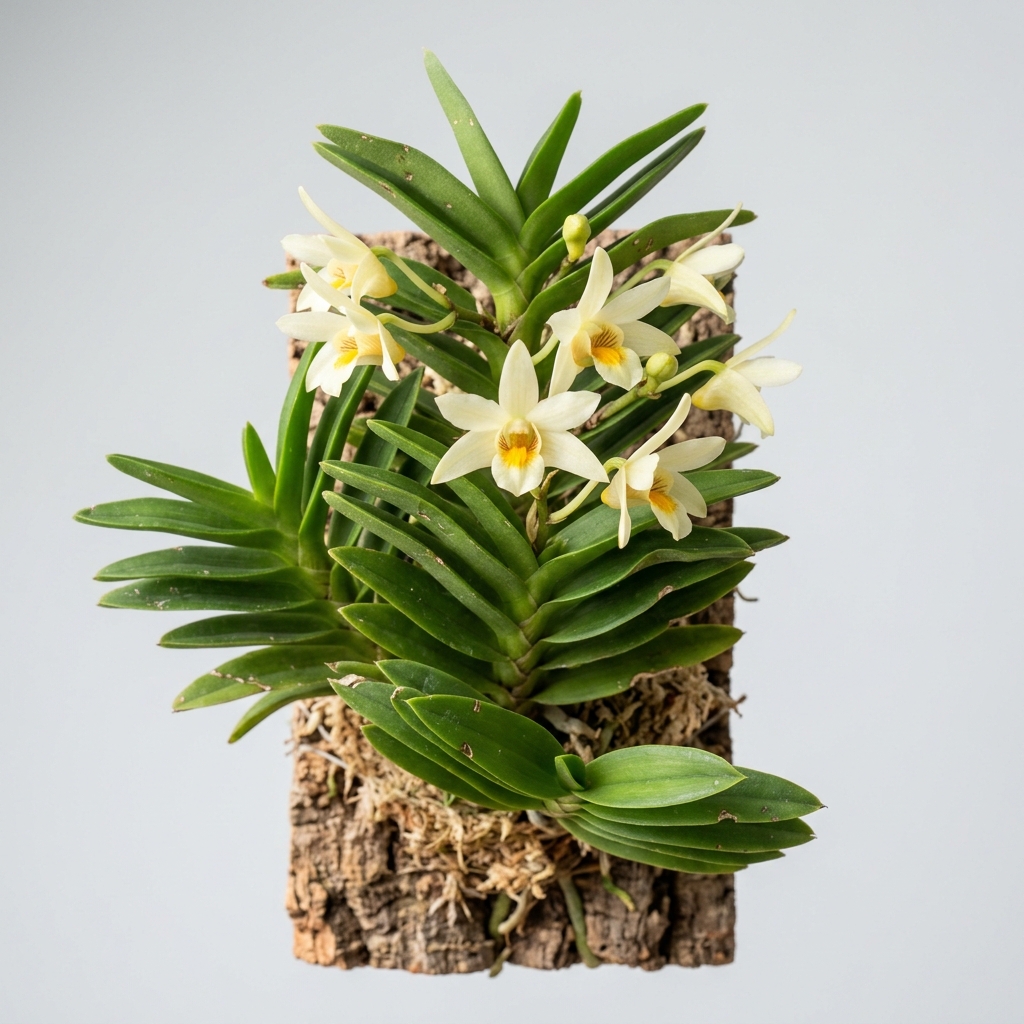
Dendrobium Equitans is a fascinating epiphytic orchid species highly prized by collectors for its unique foliage and delicate blooms. Unlike typical cane-type Dendrobiums, this orchid features striking, flattened, equitant leaves that overlap in a tight, fan-like arrangement, closely resembling a miniature iris or Lockhartia. This architectural growth habit makes the plant highly decorative and visually appealing even when it is not in active bloom.
Orchid enthusiasts value this species not only for its distinctive vegetative form but also for its successive blooming nature. While individual flowers are relatively short-lived, a healthy specimen can produce blooms repeatedly from the same nodes throughout the warmer months. This successive flowering habit, combined with its compact size, makes it an excellent choice for terrariums, orchid cases, or mounted displays in specialized collections.
💡 Did You Know?
The term equitant in this orchid's name refers to its unique leaf structure, where the leaves overlap in two alternating ranks, resembling a rider straddling a horse. This architectural foliage makes the plant highly decorative even when it is not in bloom.
🌿 Botanical Overview
Dendrobium Equitans is native to the tropical regions of Taiwan and the Philippines, where it grows primarily as an epiphyte on tree trunks and branches in humid, low-to-medium elevation forests. The plant lacks the prominent, swollen pseudobulbs found in many other Dendrobium species. Instead, it produces slender, branching stems that are completely covered by the bases of its overlapping, fleshy leaves.
The leaves themselves are the most defining botanical feature of this species. They are laterally flattened, succulent-like, and arranged in two alternating ranks along the stem. This equitant growth habit is an evolutionary adaptation designed to capture moisture and nutrients efficiently in canopy environments while minimizing water loss. As the plant matures, the stems tend to take on an arching or pendulous habit, making it exceptionally suited for hanging baskets or mounted culture.
🌸 Flower Characteristics
The flowers of Dendrobium Equitans are relatively small, typically measuring between 1 and 1.5 centimeters in diameter. They emerge individually or in small clusters from the nodes along the upper portions of the leaf-bearing stems. The petals and sepals are typically creamy white to pale yellow, presenting a delicate, crystalline texture that catches the light beautifully.
The most prominent feature of the blossom is the trilobed labellum, or lip. The lip is often adorned with a bright yellow or orange callus near the center, which serves as a visual guide for pollinators. The flowers are presented on short pedicels, holding them close to the foliage and creating a lovely contrast against the deep green, architectural leaves.
Fragrance & Bloom Profile
The fragrance of Dendrobium Equitans is a delightful characteristic, though its intensity can vary depending on environmental conditions such as temperature and humidity. Many growers report a subtle, sweet, or melon-like aroma that is most pronounced during the morning hours on warm, sunny days. This pleasant scent adds an extra layer of sensory appeal to the plant’s blooming cycles.
Unlike some orchids that display a single, long-lasting flush of flowers, this species is characterized by its ephemeral blooms. Individual flowers typically last only a few days before fading. However, the plant compensates for this by blooming successively from the same nodes over an extended period, ensuring that a mature, well-grown specimen can remain in flower for several weeks or even months at a time.
Parentage & Hybrid Lineage
Dendrobium Equitans is a naturally occurring species rather than a man-made hybrid. It belongs to a specialized group within the vast genus Dendrobium that features flattened, non-pseudobulbous stems. Because it is a true species, its genetic lineage is pure, and its characteristics are highly stable when propagated vegetatively.
While it is not widely used in commercial hybridization programs, it is highly sought after by species collectors who appreciate its wild form and botanical purity. In horticultural literature, it is sometimes classified under different sections of the genus Dendrobium, but its distinct equitant foliage remains its primary identifying marker among growers.
🌱 Growing Conditions
To cultivate Dendrobium Equitans successfully, growers should aim to replicate its natural tropical canopy environment. It thrives in bright, filtered indirect light. Direct midday sunlight should be avoided, as it can easily scorch the fleshy, succulent leaves, while insufficient light may lead to weak growth and poor flowering.
💡 Care Tip
If mounting your orchid, wrap a thin layer of high-quality sphagnum moss around the roots to help retain moisture, but ensure it remains airy enough to dry quickly after .
Temperature conditions should ideally remain warm to intermediate, with daytime temperatures ranging between 75°F and 85°F, and a slight drop at night to stimulate healthy growth and bud initiation. High humidity is crucial for this species, ideally maintained between 60% and 80%. Excellent air movement is equally vital, especially in high-humidity environments, to prevent stagnant air from causing leaf spot or crown rot.
Watering, Feeding & Potting Media
During the active spring and summer growing seasons, Dendrobium Equitans requires frequent watering. The roots should be allowed to dry slightly between waterings, but the plant should never be left completely dry for extended periods. If mounted, it may require daily misting or watering during hot weather to maintain adequate hydration.
A well-draining potting medium is essential to prevent root rot. While it can be grown in small pots with a coarse fir bark mix, many growers find that mounting the plant on cork bark or tree fern plaques with a small pad of sphagnum moss yields the best results. Feed the plant weekly with a highly diluted, balanced orchid fertilizer during the active growing season, and flush the media with pure water once a month to prevent mineral salt buildup.
Blooming Season & Care Notes
The primary blooming season for Dendrobium Equitans spans from spring through autumn, triggered by warmer temperatures and increased light levels. When the blooming cycle begins, it is important to avoid moving the plant to a location with drastically different environmental conditions, as sudden changes can cause developing buds to drop prematurely.
After a blooming cycle has finished, do not cut the bare stems or older nodes. These structures often remain viable and can produce flowers again in later seasons. During the cooler winter months, the plant enters a semi-dormant rest period. During this time, reduce watering frequency and suspend fertilizing, but continue to provide bright light and high humidity to support the plant until active growth resumes in the spring.
⚠️ Common Issues
⚠️ Common Mistake
A common error is cutting off old, leafless stems. These stems often serve as energy reservoirs and can continue to produce flowers from older nodes for several seasons.
- Root rot, which is typically caused by overwatering, compacted potting media, or inadequate drainage.
- Leaf spotting or fungal infections resulting from high humidity combined with poor air circulation.
- Bud blast, where developing buds shrivel and drop before opening, often triggered by sudden temperature fluctuations or low humidity.
- Dehydration, indicated by wrinkling or shriveling of the fleshy, equitant leaves.
- Pests such as spider mites, mealybugs, or scale, which can hide in the tight crevices of the overlapping foliage.
❓ Frequently Asked Questions
How often does Dendrobium Equitans bloom?
This species is a successive bloomer, meaning it can produce flowers multiple times throughout the spring, summer, and autumn. While individual flowers only last a few days, new buds frequently emerge from the same stems over several months.
Can I grow Dendrobium Equitans under LED grow lights?
Yes, this orchid adapts well to indoor cultivation under high-quality LED grow lights. Position the plant to receive moderate to high light intensity, ensuring the lights are kept at a safe distance to prevent leaf scorching.
Why are the leaves on my orchid turning yellow and dropping?
Yellowing leaves can indicate overwatering, poor drainage, or insufficient airflow. Ensure the potting medium dries out slightly between waterings and that the roots are healthy and not rotting.
Is it better to mount Dendrobium Equitans or pot it?
While it can be grown in a small pot with a highly porous bark mix, mounting this orchid on cork bark or a tree fern plaque is highly recommended. Mounting accommodates its natural pendulous growth habit and ensures excellent root aeration.
⭐ Final Growing Notes
Dendrobium Equitans is a rewarding species for intermediate orchid enthusiasts looking to add unique foliage texture and delicate, successive blooms to their collection. By prioritizing high humidity, consistent air movement, and bright, indirect light, growers can enjoy the architectural beauty of its fan-like leaves and the delightful surprise of its frequent, crystalline flowers.
⚕️ Health, Safety & Edibility
Understanding how a plant interacts with people, pets, and the surrounding environment is part of responsible cultivation. This section uses conservative, general guidance and does not replace professional medical or veterinary advice.
Human Safety: No published evidence currently identifies species-specific toxicity concerns for Dendrobium Equitans during normal handling. As with most ornamental plants, it should not be intentionally consumed.
Pet Safety: Published information does not indicate that this orchid commonly poses a toxicity concern for cats or dogs. However, chewing leaves, flowers, roots, or potting media may still cause mild digestive upset.
Edibility: This orchid is cultivated for ornamental display rather than food. Ornamental plants may carry fertilizers, pesticides, or other horticultural treatments that make them unsuitable for consumption.
Skin Contact: Routine handling is not generally associated with skin irritation. Gardeners with sensitive skin may prefer wearing gloves when repotting, pruning, or handling potting media.
🌱 Propagation Tip
Propagation is typically achieved through division of mature clumps during repotting. Ensure each division has at least three to four healthy stems with active root systems to guarantee successful establishment.
⭐ Expert Advice
To encourage robust blooming, provide a distinct winter rest period with reduced and cooler nighttime temperatures, while maintaining bright and high .

Leave A Comment