
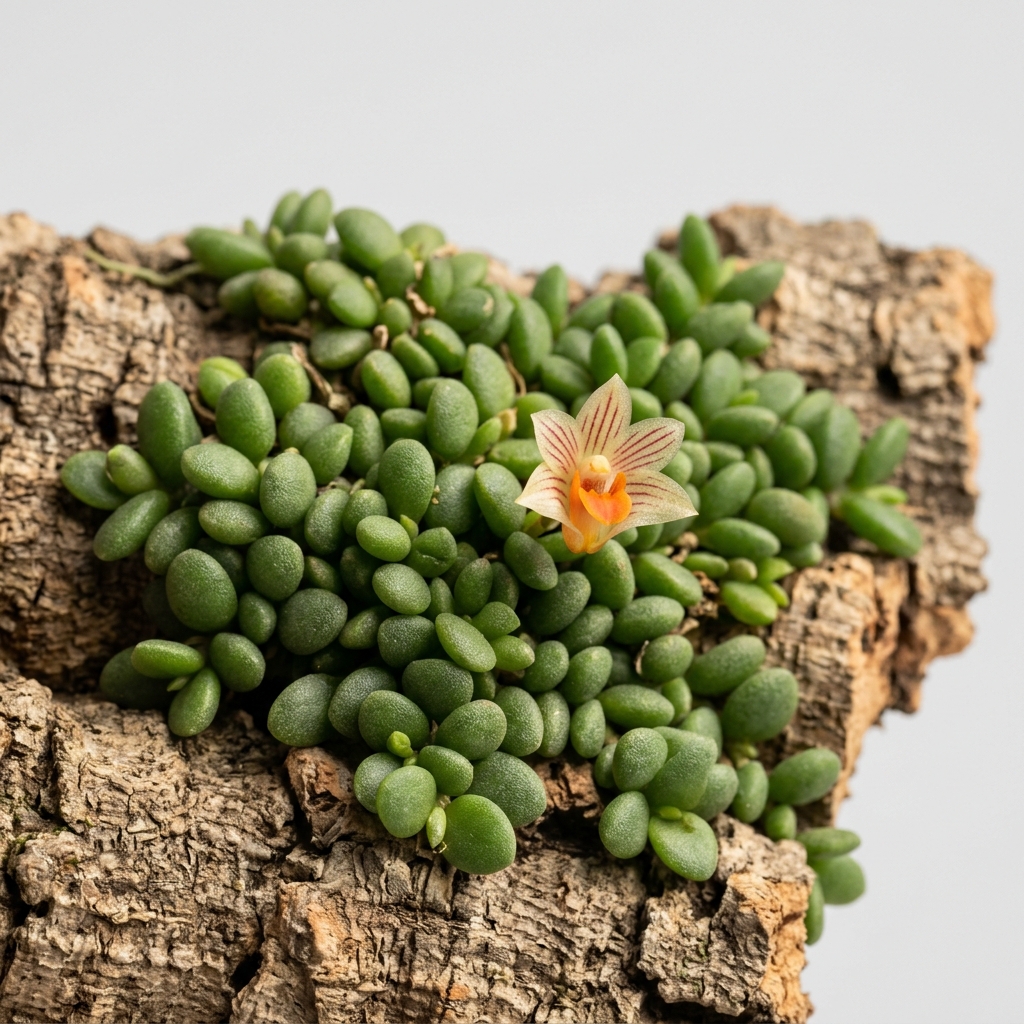
Dendrobium Lichenastrum, commonly referred to as the lichen orchid, is a fascinating miniature epiphytic species native to the tropical rainforests of northeastern Australia. Highly prized by orchid enthusiasts and terrarium hobbyists alike, this unique plant features a creeping growth habit with succulent, mat-forming leaves that closely resemble lichens or small pebbles. Its diminutive size and unusual vegetative structure make it an exceptional choice for growers seeking a distinctive, space-saving botanical specimen.
Despite its small stature, this resilient orchid produces charming, solitary flowers that emerge throughout the year, adding delicate points of interest to its dense green mats. It thrives under conditions that mimic its native montane habitats, requiring bright light, high humidity, and excellent air circulation. For collectors who appreciate the intricate beauty of miniature flora, this species offers a rewarding cultivation experience with relatively straightforward care.
💡 Did You Know?
Despite its common name, the lichen orchid, Dendrobium Lichenastrum is not related to lichens. Its name refers to its remarkable evolutionary adaptation where its thick, creeping leaves mimic the appearance of lichens and mosses growing on rocks, helping it blend into its native Australian environment to avoid herbivores.
🌿 Botanical Overview
Dendrobium Lichenastrum belongs to the section Lichenastrum, which some taxonomists classify under the segregate genus Dockrillia due to its unifoliate, succulent leaves. The plant is characterized by its prostrate, creeping rhizomes that hug the growing surface, forming dense, carpet-like mats over rocks and tree branches in its native Australian habitat.
The leaves are thick, fleshy, and highly variable in shape, ranging from rounded and button-like to elongated and cylindrical. This succulent adaptation allows the plant to store moisture efficiently, enabling it to withstand temporary dry spells in the wild. The foliage typically shows a matte green to olive coloration, sometimes developing reddish hues when exposed to high light levels.
🌸 Flower Characteristics
The flowers of Dendrobium Lichenastrum are remarkably small, usually measuring only about 4 to 7 millimeters across. They are borne singly on short peduncles arising from the base of the leaves. The sepals and petals are typically translucent cream, pale yellow, or light pink, often adorned with fine, reddish-purple longitudinal stripes.
The most prominent feature of the blossom is its fleshy, tongue-shaped labellum, which is usually bright yellow or orange. This contrasting lip serves as a visual guide for micro-pollinators. Despite their tiny size, the flowers are beautifully proportioned and present themselves face-up against the backdrop of the succulent foliage.
Fragrance & Bloom Profile
Fragrance in Dendrobium Lichenastrum is not consistently documented or widely reported by growers. While some individuals note a faint, sweet, or slightly musty scent under warm, humid conditions, many specimens appear to be virtually unscented to the human nose.
The blooming profile is opportunistic rather than strictly seasonal. Instead of producing a single massive flush of flowers, well-established plants tend to bloom sporadically throughout the year, with peak activity often occurring during the warmer months. Individual flowers are relatively long-lasting for their size, often remaining fresh for several weeks.
Parentage & Hybrid Lineage
Dendrobium Lichenastrum is a naturally occurring species rather than a man-made hybrid. Its wild lineage is native to the coastal and montane rainforests of Queensland, Australia, where it grows as an epiphyte on tree trunks or as a lithophyte on damp rocks.
Because of its highly specialized miniature growth habit and tiny flowers, it is rarely used in commercial hybridization programs. However, it remains a highly sought-after species in its pure form among species collectors and orchid taxonomists who value its unique evolutionary adaptations.
🌱 Growing Conditions
To cultivate this miniature orchid successfully, growers should aim to replicate its native Australian canopy environment. It requires bright, filtered light to thrive and flower consistently. While it can tolerate some direct morning sun, harsh midday light should be avoided to prevent scorching the succulent leaves.
💡 Care Tip
Always mount this orchid on cork bark or tree fern plaques rather than potting it. Mounting allows the creeping rhizomes to spread freely and ensures the roots dry rapidly, which is critical for preventing root rot.
Temperature conditions should ideally range from intermediate to warm. Daytime temperatures between 70°F and 85°F are optimal, with a slight drop at night to stimulate healthy growth. High humidity levels of 60% to 80% are essential, coupled with constant, gentle air movement to prevent stagnant moisture from causing rot.
Watering, Feeding & Potting Media
Due to its creeping, mat-forming habit, Dendrobium Lichenastrum is best grown mounted on cork bark, tree fern plaques, or textured hardwood branches. Mounting allows the rhizomes to spread naturally and ensures the roots dry out rapidly after watering, mimicking its wild lithophytic and epiphytic lifestyle.
Watering should be frequent but highly dependent on environmental conditions. Mounted plants should be misted or soaked daily during the active growing season, allowing them to dry completely by nightfall. In winter, watering should be reduced, providing just enough moisture to prevent the succulent leaves from shriveling. Feed weakly with a highly diluted, balanced orchid fertilizer every two to three weeks during periods of active growth.
Blooming Season & Care Notes
While blooming can occur at almost any time of year, the primary flowering period typically aligns with late spring and summer. To encourage robust blooming, ensure the plant receives adequate light and a distinct diurnal temperature drop.
After flowering, the old flower spikes do not need to be removed, as they are extremely small and will naturally wither without harming the plant. Repotting or remounting is rarely necessary and should only be performed when the mounting mount degrades or the plant completely outgrows its space. When remounting, take care not to damage the fine, delicate root system.
⚠️ Common Issues
⚠️ Common Mistake
The most common mistake is keeping the plant constantly wet in a traditional pot. Without rapid wet-dry cycles and excellent air movement around the roots, the delicate root system will quickly suffocate and rot.
- Root Rot:
Caused by overwatering or growing in dense, poorly draining potting media. - Leaf Shriveling: An indication of severe dehydration, often due to insufficient humidity or inadequate watering of mounted specimens.
- Scale and Mealybugs: These pests can hide in the dense mats of foliage; treat promptly with insecticidal soap or neem oil.
- Algae Growth: Can occur on the mount if humidity is high but air circulation is inadequate.
- Lack of Blooms: Usually caused by insufficient light levels or a lack of temperature variation between day and night.
❓ Frequently Asked Questions
Can Dendrobium Lichenastrum be grown in a pot?
While it is technically possible to grow this species in a small, shallow pot with a very open, fast-draining medium like fine bark or tree fern fiber, it is highly recommended to grow it mounted. Its creeping rhizomes naturally prefer to scramble over a flat, vertical surface rather than being confined to a pot.
How do I know if my lichen orchid is getting enough light?
Observe the color of the succulent leaves. Under optimal light conditions, the foliage should be a healthy, vibrant medium green. If the leaves turn a dark, dull green, the plant likely needs more light. Conversely, if the leaves develop a strong reddish or purple tint, it indicates the plant is receiving maximum light limits.
Why are the leaves on my plant shriveling?
Shriveled leaves are a classic sign of dehydration. This can happen if the mounting medium dries out too quickly, if the ambient humidity is too low, or if the root system has rotted due to stagnant water, leaving the plant unable to absorb moisture.
Is this orchid suitable for a terrarium or vivarium?
Yes, its miniature size, creeping habit, and love for high humidity make it an excellent candidate for tropical terrariums and vivariums. However, you must ensure the enclosure has adequate ventilation or internal fans, as stagnant air combined with high moisture will quickly lead to fungal rot.
⭐ Final Growing Notes
Dendrobium Lichenastrum is a captivating miniature marvel that rewards patient growers with its unique, succulent-like appearance and delicate, intricate blossoms. By prioritizing high humidity, bright light, and excellent air circulation on a mounted surface, you can enjoy a thriving, carpet-like specimen that adds an exotic, naturalistic touch to any indoor orchid collection.
⚕️ Health, Safety & Edibility
Understanding how a plant interacts with people, pets, and the surrounding environment is part of responsible cultivation. This section uses conservative, general guidance and does not replace professional medical or veterinary advice.
Human Safety: No published evidence currently identifies species-specific toxicity concerns for Dendrobium Lichenastrum during normal handling. As with most ornamental plants, it should not be intentionally consumed.
Pet Safety: Published information does not indicate that this orchid commonly poses a toxicity concern for cats or dogs. However, chewing leaves, flowers, roots, or potting media may still cause mild digestive upset.
Edibility: This orchid is cultivated for ornamental display rather than food. Ornamental plants may carry fertilizers, pesticides, or other horticultural treatments that make them unsuitable for consumption.
Skin Contact: Routine handling is not generally associated with skin irritation. Gardeners with sensitive skin may prefer wearing gloves when repotting, pruning, or handling potting media.
🌱 Propagation Tip
Propagation is best achieved by carefully dividing larger, established mats. Ensure each division has at least four to five healthy leaves and an active growing point, then secure it tightly to a new mount using monofilament line or floral wire.
⭐ Expert Advice
To trigger a heavy flush of blooms, provide a slight reduction in and a more pronounced day-to-night drop of about 10 to 15 degrees Fahrenheit during the autumn and winter months.

Leave A Comment