
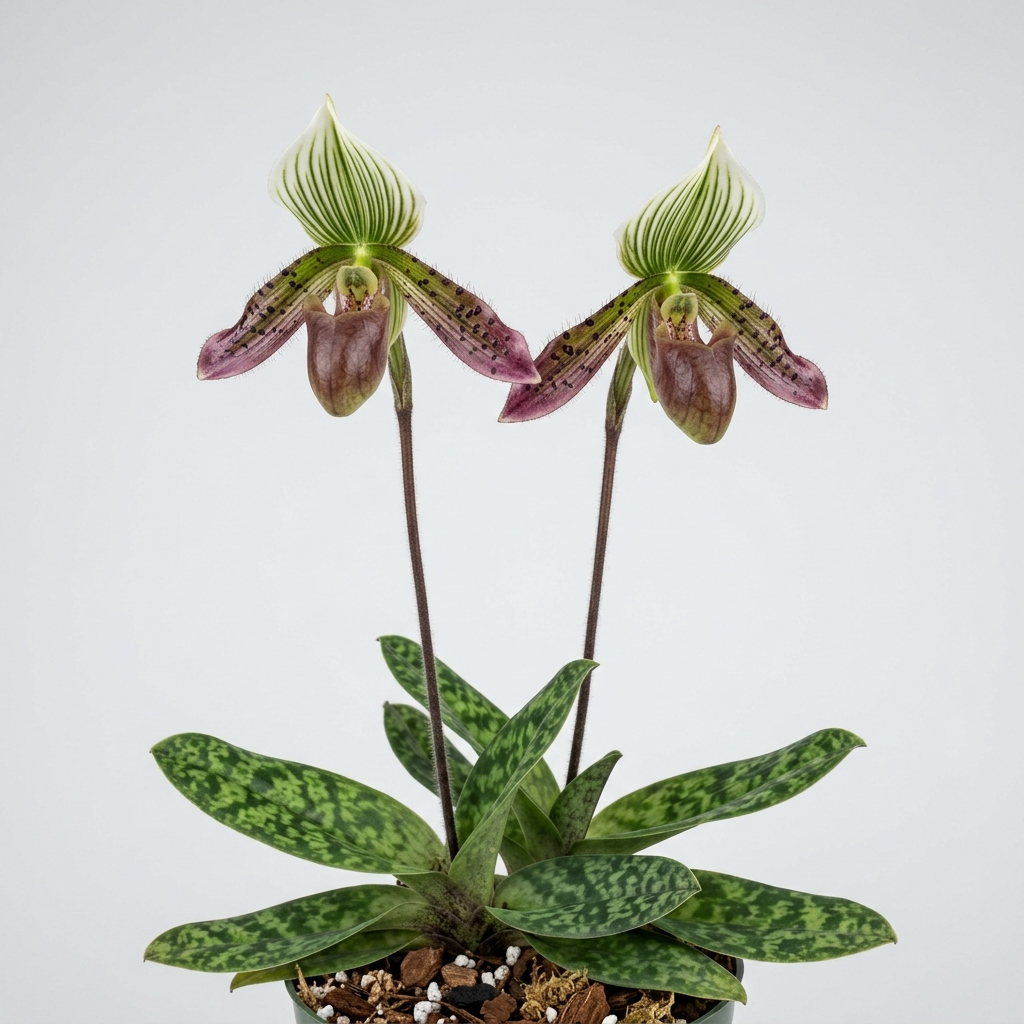
Paphiopedilum Wardii is a highly sought-after terrestrial orchid species within the slipper orchid group, prized by collectors for its striking foliage and dramatic, dark-toned flowers. Native to the cool, moist forest floors of Southeast Asia, particularly Myanmar and southwestern China, this orchid brings an exotic, architectural elegance to indoor collections. Its distinctive mottled leaves make it an attractive specimen even when not in bloom, appealing to both novice growers and seasoned orchid enthusiasts.
Unlike many epiphytic orchids that grow on trees, this slipper orchid thrives in terrestrial or lithophytic conditions, requiring a distinct approach to potting media and moisture retention. The flowers feature a characteristic pouch-like lip, down-swept petals adorned with dark spots, and a dorsal sepal with clean vertical striping. Understanding its specific environmental preferences is key to successfully cultivating this remarkable orchid and enjoying its long-lasting winter blooms.
💡 Did You Know?
Paphiopedilum Wardii belongs to the Paphiopedilum orchid group, where flower presentation is often just as important as . White-flowered cultivars are especially valued indoors because their pale blooms reflect well and pair easily with many home, greenhouse, and display settings.
🌿 Botanical Overview
Paphiopedilum Wardii belongs to the subgenus Sigmatopetalum, a group of slipper orchids famous for their beautifully tessellated or mottled leaves. The foliage displays a striking checkerboard pattern of dark green and pale grayish-green on the upper surface, while the undersides often exhibit purple spotting near the base. This vegetative adaptation helps the plant maximize light absorption on the shaded forest floor where it naturally grows.
In its natural habitat, this species grows in leaf litter, mossy crevices, and on damp rocks along river valleys at moderate elevations. This terrestrial growth habit means its root system is adapted to a constant supply of moisture and high organic matter, rather than the rapid wet-dry cycles experienced by epiphytic orchids. The plant typically grows as a single fan of leaves, gradually clumping over time as new growths emerge from the rhizome.
🌸 Flower Characteristics
The inflorescence of Paphiopedilum Wardii is a standout feature, typically producing a single, long-lasting flower on a tall, dark, pubescent spike that rises well above the foliage. The flower itself is a masterpiece of complex geometry and rich coloration, dominated by shades of green, deep mahogany, and dark purple-brown. The dorsal sepal is pointed, white or pale green, and marked with prominent dark green vertical veins.
The petals are gracefully down-swept, often fringed with fine hairs along the margins, and heavily spotted with dark maroon or blackish dots over a greenish-yellow background. The pouch, or labellum, is deeply cupped, typically a solid bronzy-green or mahogany color with subtle veining. Each bloom can measure up to ten centimeters across and can remain in perfect condition for six to eight weeks under optimal conditions.
Fragrance & Bloom Profile
While some slipper orchids possess subtle aromas, Paphiopedilum Wardii is generally considered to be unscented. Any fragrance reports among growers are rare and not consistently documented in standard botanical literature. The primary appeal of this orchid lies entirely in its visual presentation, where the lack of scent is easily overlooked due to the dramatic contrast of the dark, glossy pouch against the mottled foliage.
Parentage & Hybrid Lineage
Paphiopedilum Wardii is a distinct, naturally occurring species rather than a man-made hybrid. It was first described in the early 20th century and named after the plant collector Kingdon-Ward. In orchid hybridization, it has been widely used as a parent to introduce dark coloration, mottled foliage, and robust growth habits to modern Paphiopedilum hybrids. When purchasing, growers should look for line-bred select forms, which often exhibit superior flower size, flatter petals, and more intense coloration than wild-type imports.
🌱 Growing Conditions
Replicating the forest floor environment is the secret to success with Paphiopedilum Wardii. It thrives in low to moderate indirect light, similar to the conditions preferred by Phalaenopsis orchids. Direct sunlight must be avoided, as it can easily scorch the sensitive mottled leaves. East- or north-facing windows are ideal, or it can be grown successfully under standard fluorescent or LED grow lights.
💡 Care Tip
For best results, grow Paphiopedilum Wardii in bright filtered with steady and gentle airflow. Avoid placing the plant in harsh midday sun, but do not keep it in a dark corner; weak is one of the most common reasons cultivated orchids refuse to rebloom.
Temperature: wise, this species prefers intermediate to cool conditions. Daytime temperatures should ideally range between 65 and 75 degrees Fahrenheit (18 to 24 degrees Celsius), with a night drop to 55 to 60 degrees Fahrenheit (13 to 16 degrees Celsius). This nocturnal temperature drop is particularly important in autumn to help trigger the development of the flower spike. Maintain relative humidity levels between 50% and 70%, supported by good air movement to prevent fungal issues.
Watering, Feeding & Potting Media
Unlike epiphytic orchids with thick pseudobulbs, Paphiopedilum Wardii has no water-storage organs. Consequently, it should never be allowed to dry out completely. The potting medium should remain consistently damp but never soggy. Water thoroughly when the top half-inch of the medium begins to feel dry to the touch, using rainwater, distilled water, or low-mineral tap water to avoid salt buildup on the sensitive roots.
A well-draining, moisture-retentive potting mix is essential. A blend of fine-grade fir bark, perlite, horticultural charcoal, and chopped sphagnum moss works exceptionally well. Feed the orchid with a balanced, highly diluted orchid fertilizer every two to three waterings during the active growing season, and flush the pot with pure water once a month to wash away accumulated salts.
Blooming Season & Care Notes
The typical blooming season for Paphiopedilum Wardii spans from late autumn through winter and into early spring. As the days shorten and temperatures cool, the flower spike will slowly emerge from the center of the mature leaf fan. Once the spike begins to grow, avoid changing the plant’s orientation to the light source, as this can cause the developing bud to twist or present poorly. After the flower fades, cut the spike down to the base of the foliage. Repotting is best done every one to two years in spring, just after flowering concludes and new root growth begins.
⚠️ Common Issues
⚠️ Common Mistake
The most common mistake is by calendar instead of root and potting-media condition. Paphiopedilum roots need moisture and air at the same time, so constantly wet bark or sphagnum can lead to root loss even when the leaves still look healthy.
- Root Rot:
Caused by overwatering or a compacted, broken-down potting medium that suffocates the roots. - Leaf Scorch: Bleached or brown patches on the mottled leaves, indicating excessive light exposure.
- Bud Blast:
The drying up and dropping of flower buds before opening, often triggered by sudden temperature swings, low humidity, or drafty locations. - Mealybugs and Scale: Common pests that hide in the tight crevices at the base of the leaf fans; treat promptly with insecticidal soap or neem oil.
- Bacterial Soft Rot: Dark, wet lesions on the leaves, usually caused by water sitting in the crown of the plant overnight.
❓ Frequently Asked Questions
How often should I water my Paphiopedilum Wardii?
Water your Paphiopedilum Wardii when the top layer of the potting medium feels slightly dry, typically every 5 to 7 days depending on your home’s humidity and temperature. Because these orchids lack pseudobulbs for water storage, they require a consistently moist but well-aerated root zone.
Why are the leaves on my orchid losing their mottled pattern?
If the distinct mottled pattern on the leaves appears faded or washed out, the plant may be receiving too much light. Move the orchid to a slightly shadier location with filtered, indirect light to help restore the rich, dark green contrast of the foliage.
Can I grow Paphiopedilum Wardii under artificial LED lights?
Yes, Paphiopedilum Wardii adapts exceptionally well to indoor growing under LED lights. Position the plant about 12 to 18 inches below the light source, ensuring the intensity is moderate and the lights run for approximately 12 to 14 hours a day to simulate natural daylight cycles.
When is the best time to repot this slipper orchid?
The ideal time to repot Paphiopedilum Wardii is in the spring, shortly after the winter blooming cycle has finished and new vegetative growth begins to emerge. Repotting every one to two years prevents the potting medium from breaking down and suffocating the roots.
⭐ Final Growing Notes
Paphiopedilum Wardii remains one of the most rewarding slipper orchids for indoor cultivation, offering year-round visual interest through its stunning mottled foliage and dramatic winter blooms. By respecting its terrestrial origins—providing consistent moisture, moderate shade, and cool-to-intermediate temperatures—growers of all experience levels can successfully maintain this elegant species. Its slow-growing but steady nature makes it a peaceful and enduring addition to any dedicated orchid collection.
⚕️ Health, Safety & Edibility
Understanding how a plant interacts with people, pets, and the surrounding environment is part of responsible cultivation. This section uses conservative, general guidance and does not replace professional medical or veterinary advice.
Human Safety: No published evidence currently identifies species-specific toxicity concerns for Paphiopedilum Wardii during normal handling. As with most ornamental plants, it should not be intentionally consumed.
Pet Safety: Published information does not indicate that this orchid commonly poses a toxicity concern for cats or dogs. However, chewing leaves, flowers, roots, or potting media may still cause mild digestive upset.
Edibility: This orchid is cultivated for ornamental display rather than food. Ornamental plants may carry fertilizers, pesticides, or other horticultural treatments that make them unsuitable for consumption.
Skin Contact: Routine handling is not generally associated with skin irritation. Gardeners with sensitive skin may prefer wearing gloves when repotting, pruning, or handling potting media.
🌱 Propagation Tip
Propagation should be approached patiently. Most home growers should wait for natural keikis or divide only mature, healthy plants when the orchid type allows it. Never remove a young growth until it has strong roots and enough leaves to support itself away from the parent plant.
⭐ Expert Advice
Repot after flowering when fresh root tips begin to appear. This timing helps the plant anchor quickly into new bark or sphagnum and reduces stress, especially for orchids grown indoors where airflow, , and drying speed can change from season to season.

Leave A Comment