
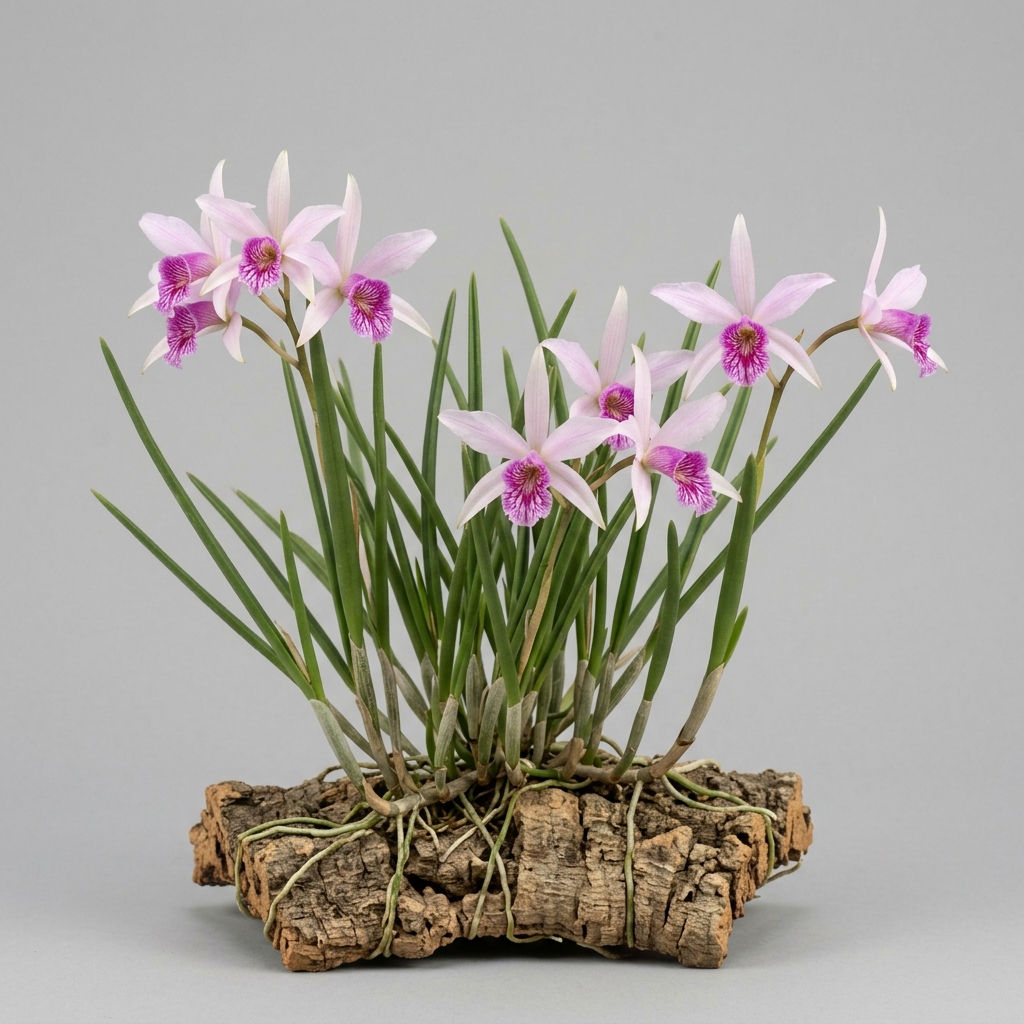
Laelia Lundii is a charming miniature orchid species native to the canopy and gallery forests of Brazil, highly prized by collectors for its compact growth habit and elegant, star-shaped blossoms. Belonging to the Cattleya alliance, this diminutive epiphyte features creeping rhizomes and slender, semi-terete leaves that give it a grass-like appearance when not in bloom. Orchid enthusiasts value this species for its ability to produce a profusion of delicate flowers while occupying minimal space on the growing bench.
Despite its small stature, Laelia Lundii delivers a striking visual display with its pale pink to white petals contrasted against a richly veined, magenta-patterned lip. Its resilient nature and adaptable growth habits make it an excellent candidate for mounting on cork bark or cultivating in small baskets. For indoor and greenhouse growers alike, this miniature treasure offers a rewarding cultivation experience that bridges the gap between wild botanical species and refined orchid aesthetics.
💡 Did You Know?
Laelia Lundii is uniquely adapted to survive both wet seasons and dry spells in its native Brazilian habitat. Its narrow, semi-terete leaves are highly specialized evolutionary structures designed to minimize water loss through transpiration, allowing this resilient miniature orchid to cling to exposed tree branches where larger, broader-leafed species would quickly dehydrate.
🌿 Botanical Overview
Laelia Lundii is native to the transitional forest regions of Brazil, where it grows as an epiphyte on tree branches or occasionally as a lithophyte on rocky outcroppings. Structurally, the plant is characterized by its creeping rhizome, which produces small, tightly clustered, spindle-shaped pseudobulbs. Each pseudobulb typically bears two narrow, fleshy, semi-cylindrical leaves that help the plant conserve moisture in its native seasonal environment.
This growth habit allows the orchid to spread horizontally, forming dense mats over time. In cultivation, this creeping tendency means the plant will quickly outgrow standard pots, making mounted culture or wide, shallow baskets the preferred method for showcasing its natural form. Its botanical resilience reflects its adaptation to environments that experience distinct wet and dry cycles.
🌸 Flower Characteristics
The blossoms of Laelia Lundii are relatively small, typically measuring between one and one and a half inches in diameter, yet they are produced in generous abundance. The sepals and petals are narrow, star-like, and range in color from pristine white to a delicate, icy pink. This subtle coloration serves as a perfect backdrop for the orchid’s most prominent feature: its deeply trilobed labellum, or lip.
The lip features a white base adorned with intricate, radiating veins of deep magenta or purple, which guide pollinators toward the center of the flower. The edges of the lip are gently ruffled, adding a touch of texture to the otherwise clean, geometric lines of the petals. Flowers emerge from the base of new leaf growth, often appearing in pairs or small clusters that nestle closely against the foliage.
Fragrance & Bloom Profile
While some growers report a completely unscented experience, many clones of Laelia Lundii emit a delicate, sweet fragrance that is most noticeable during the warm morning hours. The scent is often described as clean and floral, reminiscent of spring wildflowers, though it is never overpowering.
The blooming cycle typically begins in late winter and extends into early spring, providing a welcome splash of color when many other indoor plants remain dormant. Individual flowers are relatively long-lasting for a miniature species, often remaining fresh for three to four weeks if kept in cool, stable conditions away from direct drafts.
Parentage & Hybrid Lineage
Laelia Lundii is a distinct, naturally occurring species rather than a man-made hybrid. Within the orchid community, its taxonomic status has occasionally shifted, with some botanists classifying it under the genus Cattleya as Cattleya lundii. Regardless of its formal classification, it remains a highly respected species in its own right.
Because of its compact size, ease of growth, and attractive lip patterning, hybridizers have occasionally used Laelia Lundii in breeding programs to introduce miniature growth habits and cold tolerance to larger Cattleya hybrids. However, pure species specimens remain the most sought-after by purists who appreciate the unaltered elegance of wild Brazilian orchids.
🌱 Growing Conditions
To thrive, Laelia Lundii requires bright, filtered light similar to that preferred by standard Cattleya orchids. A south- or east-facing window with sheer curtains provides ideal indoor illumination, while greenhouse growers should aim for moderate shading to prevent leaf scorch. The leaves should maintain a light green hue; dark green leaves indicate insufficient light, while yellowing or red-tinted foliage suggests excessive exposure.
💡 Care Tip
To mimic its natural environment, mount Laelia Lundii on a cork bark plaque with a thin layer of sphagnum moss. This setup ensures the roots dry rapidly after , which is crucial for preventing rot and encouraging the creeping rhizomes to spread naturally.
Temperature: wise, this species is highly adaptable, thriving in intermediate to warm conditions. Daytime temperatures between 70°F and 85°F, with a nighttime drop to 55°F or 60°F, will encourage robust growth and reliable blooming. Adequate air movement is essential, especially in high-humidity environments, to prevent stagnant air from harboring fungal pathogens.
Watering, Feeding & Potting Media
During the active growing season in spring and summer, Laelia Lundii should be watered thoroughly and allowed to dry out slightly before the next application. Because of its creeping rhizome, this orchid is exceptionally well-suited to being mounted on cork bark or tree fern plaques with a small pad of sphagnum moss to retain moisture. If potted, a highly porous, fast-draining medium such as medium-grade fir bark mixed with perlite and charcoal is necessary to prevent root rot.
Fertilize weekly during the growing season with a diluted, balanced orchid fertilizer at one-quarter to one-half strength. As growth slows in the autumn and winter, reduce watering frequency and suspend fertilization to mimic the natural dry season of its native habitat, allowing the pseudobulbs to mature and prepare for winter flowering.
Blooming Season & Care Notes
The primary blooming period occurs from late winter to early spring, triggered by the cooler temperatures and shorter days of autumn. To ensure a successful bloom cycle, maintain a distinct winter rest period where watering is significantly reduced, providing only enough moisture to keep the pseudobulbs from shriveling excessively.
Once the flower buds begin to emerge from the base of the new growth, resume regular watering but avoid spraying water directly onto the developing buds, as this can cause bud blast or fungal spotting. After the flowers fade, the plant will enter a brief period of dormancy before initiating new root and vegetative growth, which is the ideal time for repotting or remounting if the medium has begun to degrade.
⚠️ Common Issues
⚠️ Common Mistake
The most common mistake is keeping the potting medium constantly wet during the winter. Overwatering during the orchid's natural dormant period suffocates the roots, leading to systemic rot that can quickly destroy the entire plant before spring arrives.
- Root Rot: Caused by overwatering or compacted, poorly draining potting media that deprives the roots of oxygen.
- Dehydration: Indicated by severely shriveled pseudobulbs and wrinkled leaves, often due to underwatering or a dead root system.
- Scale and Mealybugs: Common pests that hide in the tight crevices between the creeping pseudobulbs and beneath the dry sheaths.
- Bud Blast: The premature dropping or yellowing of flower buds, usually triggered by sudden temperature fluctuations, low humidity, or drafts.
- Foliar Spotting: Fungal or bacterial spots arising from poor air circulation combined with wet foliage overnight.
❓ Frequently Asked Questions
How often should I water my mounted Laelia Lundii?
Mounted specimens dry out much faster than potted ones. In warm weather, they may require daily watering or misting, whereas in winter, watering every two to three days is usually sufficient.
Why is my Laelia Lundii not blooming?
The most common reasons for a lack of blooms are insufficient light during the growing season and the absence of a cooler, drier winter rest period to trigger bud development.
Can I grow Laelia Lundii under LED grow lights?
Yes, this miniature orchid adapts exceptionally well to artificial lighting. Position the plant about 8 to 12 inches below full-spectrum LED lights, adjusting the distance based on leaf color.
When is the best time to repot or divide this orchid?
The ideal time is in late spring, immediately after flowering has finished and just as new green root tips begin to emerge from the base of the newest pseudobulbs.
⭐ Final Growing Notes
Laelia Lundii is a rewarding and highly manageable orchid that brings a touch of wild Brazilian beauty to any collection. Its miniature size makes it perfect for space-conscious growers, while its striking, magenta-veined flowers offer visual rewards far exceeding its small footprint. By providing bright light, excellent drainage, and a dry winter rest, growers can enjoy the annual spectacle of this resilient species for many years to come.
⚕️ Health, Safety & Edibility
Understanding how a plant interacts with people, pets, and the surrounding environment is part of responsible cultivation. This section uses conservative, general guidance and does not replace professional medical or veterinary advice.
Human Safety: No published evidence currently identifies species-specific toxicity concerns for Laelia Lundii during normal handling. As with most ornamental plants, it should not be intentionally consumed.
Pet Safety: Published information does not indicate that this orchid commonly poses a toxicity concern for cats or dogs. However, chewing leaves, flowers, roots, or potting media may still cause mild digestive upset.
Edibility: This orchid is cultivated for ornamental display rather than food. Ornamental plants may carry fertilizers, pesticides, or other horticultural treatments that make them unsuitable for consumption.
Skin Contact: Routine handling is not generally associated with skin irritation. Gardeners with sensitive skin may prefer wearing gloves when repotting, pruning, or handling potting media.
🌱 Propagation Tip
When dividing a mature Laelia Lundii, ensure each division contains at least four healthy pseudobulbs. Use a sterile cutting tool to sever the creeping rhizome, and secure the new division firmly to its mount or pot to prevent movement while new roots establish.
⭐ Expert Advice
For maximum flower production, expose the orchid to a distinct drop of 10 to 15 degrees Fahrenheit between day and night during the autumn months. This thermal shift, combined with reduced , acts as the primary environmental trigger for bud initiation.

Leave A Comment