

Masdevallia Floribunda is a delightful miniature orchid species highly prized by collectors for its exceptionally generous blooming habit and compact growth form. Originating from the moist, montane forests of Mexico and Central America, this epiphytic orchid produces a dense tuft of bright green, leathery leaves that remain attractive year-round. Unlike some of its more temperamental high-altitude relatives, this species is celebrated for its relative resilience, making it an excellent introductory plant for growers looking to venture into the diverse genus of Masdevallia.
The primary appeal of this orchid lies in its ability to produce a profusion of unique, triangular flowers that appear to hover just around or below the foliage canopy. The blossoms feature the characteristic elongated sepal tails typical of the genus, presenting a delicate color palette of cream, pale yellow, or soft pink, often embellished with fine purple speckling. Because it occupies a more adaptable temperature niche than cloud-forest obligates, it transitions well to indoor terrariums, Wardian cases, or shaded greenhouse benches.
💡 Did You Know?
Unlike many of its high-altitude Masdevallia relatives that demand strictly cold temperatures, Masdevallia Floribunda is remarkably adaptable to intermediate conditions. This resilience stems from its wide native elevation range, allowing it to thrive in standard home environments where other members of the would quickly decline from heat stress.
🌿 Botanical Overview
Masdevallia Floribunda belongs to the subtribe Pleurothallidinae, a vast group of orchids characterized by their lack of pseudobulbs. Instead of storing water in swollen stems, this species relies on its short, erect ramicauls and fleshy, oblanceolate leaves to manage moisture. This morphological trait means the plant has very little drought tolerance and requires a consistently humid environment to prevent leaf drop and desiccation.
In its native habitat, it grows as an epiphyte on moss-covered tree branches or occasionally as a lithophyte on damp rocks, usually at elevations ranging from sea level up to 1,400 meters. This wide altitudinal range explains why the species shows greater temperature tolerance than many of its strictly cold-growing montane congeners. The growth habit is cespitose, meaning it forms tight, neat clumps that expand slowly over time.
🌸 Flower Characteristics
The flowers of Masdevallia Floribunda are small but structurally fascinating, measuring roughly one to two centimeters across, excluding the slender tails. As with all members of this genus, the petals and lip are highly reduced and hidden deep within the floral tube, while the three sepals are fused at the base to form a cup-like structure. The tips of these sepals extend into delicate, thread-like tails that can curve gracefully outward or downward.
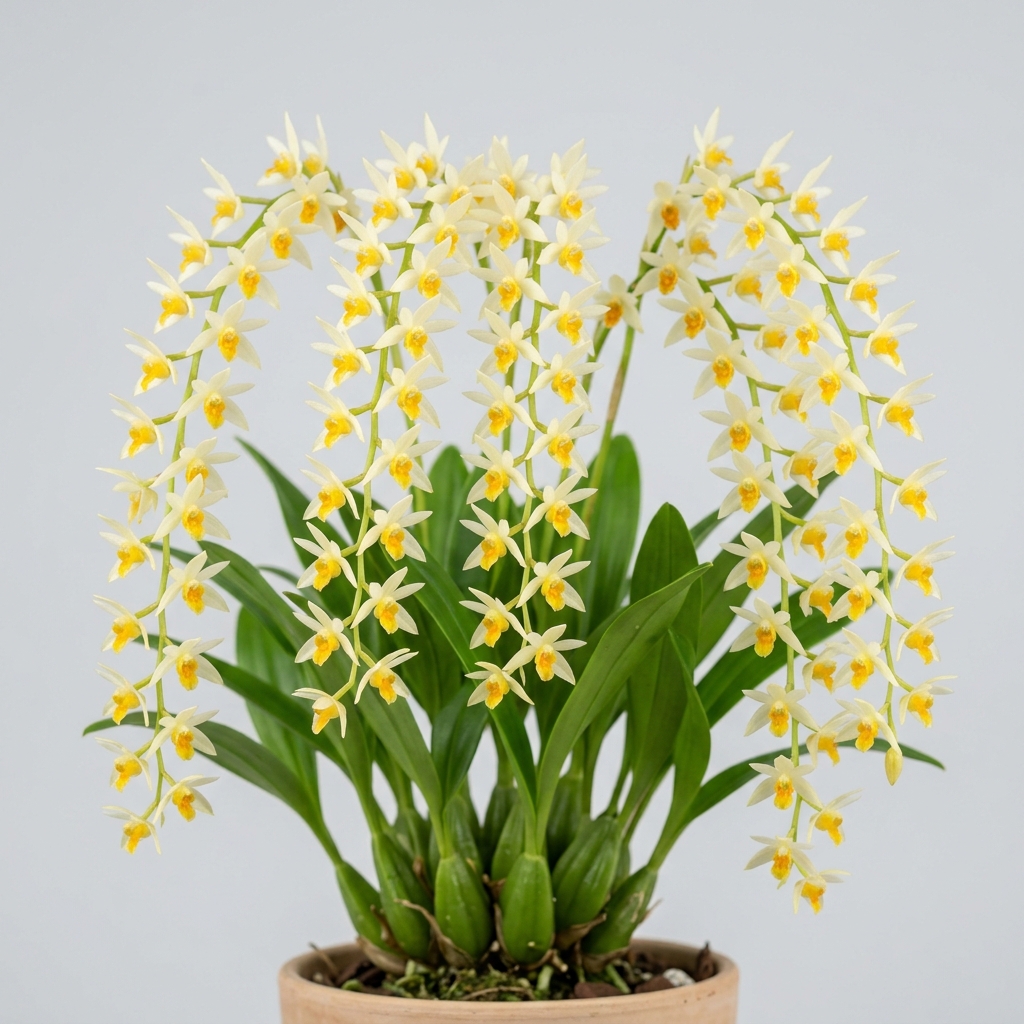
Coloration can be quite variable depending on the specific clone and growing temperatures. Most commonly, the flowers present a base color of pale yellow, cream, or greenish-white, heavily dotted with tiny purple or reddish-brown spots concentrated near the center. The inflorescences are relatively short, often carrying one to several flowers that open successively or simultaneously, creating a crowded, festive display beneath the foliage.
Fragrance & Bloom Profile
While many pleurothallids are grown strictly for their visual curiosity, Masdevallia Floribunda occasionally surprises growers with a subtle, faint fragrance. The scent is not universally present or strong, and is often described as slightly sweet or musky, typically becoming noticeable only during the warmest hours of midday. The blooms are remarkably long-lasting for such delicate structures, often remaining in pristine condition for several weeks if kept in cool, humid conditions. Because the plant is highly floriferous, a mature specimen can remain in some stage of bloom for months at a time.
Parentage & Hybrid Lineage
As a naturally occurring species rather than a man-made hybrid, Masdevallia Floribunda carries a pure genetic lineage shaped by natural selection in Central American cloud forests. However, its warmth tolerance and free-flowering nature have made it a valuable parent in hybridizing programs. Orchid breeders frequently use it to introduce vigor, compact growth, and temperature resilience into complex Masdevallia hybrids. When researching specific plants, growers should note that some specimens labeled as this species may represent distinct regional color forms or closely related sibling species, as taxonomic revisions within the genus are ongoing.
🌱 Growing Conditions
Successful cultivation of Masdevallia Floribunda requires replicating its shaded, humid forest home. It thrives in low to medium light conditions, similar to those preferred by jewel orchids or deep-shade ferns; direct sunlight will quickly scorch the thin leaves. An ideal location provides bright, filtered light or high-quality LED grow lights adjusted to a moderate intensity.
💡 Care Tip
Always use rainwater, distilled water, or reverse osmosis water for this orchid. Its fine, thread-like roots are highly sensitive to the dissolved minerals, chlorine, and fluoride commonly found in municipal tap water, which can cause rapid root dieback.
Temperature management is where this species shines compared to its cool-growing relatives. It comfortably tolerates intermediate conditions, with daytime temperatures ranging from 65°F to 78°F (18°C to 26°C) and a nighttime drop of about 10°F to 15°F. Constant, gentle air movement is absolutely vital to prevent stagnant air pockets, which can invite fungal pathogens in high-humidity environments. Aim to maintain relative humidity levels between 60% and 80%.
Watering, Feeding & Potting Media
Because Masdevallia Floribunda lacks pseudobulbs, its roots must never dry out completely. The potting medium should remain evenly moist—akin to a wrung-out sponge—but never waterlogged or muddy. Water the plant thoroughly with pure water, such as rainwater, reverse osmosis, or distilled water, as the fine roots are highly sensitive to dissolved salts and chlorine.
A potting mix of fine-grade New Zealand sphagnum moss or a blend of fine fir bark and perlite works exceptionally well to retain moisture while allowing oxygen to reach the roots. If grown in sphagnum, ensure it is packed loosely to maintain aeration. Fertilize very sparingly; a weak solution of a balanced orchid fertilizer applied at one-quarter strength every two to three weeks is sufficient. Flush the pot with pure water between feedings to prevent salt buildup.
Blooming Season & Care Notes
While Masdevallia Floribunda can produce flowers sporadically throughout the year, its primary blooming flushes typically occur in the spring and autumn. To encourage a heavy bud set, ensure the plant experiences a distinct day-to-night temperature drop during these transitional seasons. Once flower spikes begin to emerge from the base of the leaves, avoid changing the plant’s orientation or letting the humidity drop, as sudden environmental shifts can cause the delicate buds to blast. Repotting is best performed in late winter or early spring, just as new root growth initiates, minimizing transplant shock.
⚠️ Common Issues
⚠️ Common Mistake
The most common mistake is letting the potting medium dry out completely between waterings. Lacking pseudobulbs to store water, this orchid relies on constant, even moisture; even a brief period of complete dryness can cause severe leaf drop and root loss.
- Leaf Spotting: Dark spots on the leaves are often caused by fungal or bacterial pathogens, usually triggered by high humidity combined with inadequate air circulation.
- Root Rot:
Overwatering or using a compacted, decaying potting medium deprives the roots of oxygen, leading to rapid root decline and leaf drop. - Bud Blast:
Sudden drops in humidity, underwatering, or drastic temperature spikes can cause developing flower buds to yellow and wither before opening. - Pests:
Spider mites, aphids, and mealybugs can occasionally target the tender new growth; treat promptly with mild insecticidal soap or neem oil.
❓ Frequently Asked Questions
Can Masdevallia Floribunda be grown mounted on cork bark?
Yes, this species thrives when mounted on cork bark or tree fern plaques, provided you can maintain high humidity. When mounted, a pad of high-quality sphagnum moss must be secured around the roots to retain moisture, and the plant will require daily watering or misting to prevent desiccation.
Why are the leaf tips of my orchid turning black or brown?
Black or brown leaf tips are typically a sign of salt accumulation from tap water or over-fertilization. Because this orchid has highly sensitive roots, it is best to use pure water sources and flush the potting medium regularly to wash away residual minerals.
Does this orchid require a cold winter rest period?
No, this species does not require a dry or cold winter rest. It should be kept consistently moist and warm-to-intermediate year-round, though a slight reduction in watering frequency may be appropriate during the darkest winter months when growth naturally slows.
Is Masdevallia Floribunda suitable for a terrarium or vivarium?
This miniature orchid is an useful selection for terrariums and vivariums. Its compact size, love for high humidity, and tolerance of intermediate temperatures align perfectly with enclosed growing environments, provided there is adequate internal air circulation via a small fan.
⭐ Final Growing Notes
Masdevallia Floribunda represents a perfect bridge for orchid enthusiasts wishing to explore the captivating world of pleurothallids without the strict cooling requirements of high-altitude species. By providing consistent moisture, high humidity, gentle air movement, and pure water, growers will be rewarded with an incredibly charming, low-maintenance miniature that brings a touch of cloud-forest magic to any indoor collection.
⚕️ Health, Safety & Edibility
Understanding how a plant interacts with people, pets, and the surrounding environment is part of responsible cultivation. This section uses conservative, general guidance and does not replace professional medical or veterinary advice.
Human Safety: No published evidence currently identifies species-specific toxicity concerns for Masdevallia Floribunda during normal handling. As with most ornamental plants, it should not be intentionally consumed.
Pet Safety: Published information does not indicate that this orchid commonly poses a toxicity concern for cats or dogs. However, chewing leaves, flowers, roots, or potting media may still cause mild digestive upset.
Edibility: This orchid is cultivated for ornamental display rather than food. Ornamental plants may carry fertilizers, pesticides, or other horticultural treatments that make them unsuitable for consumption.
Skin Contact: Routine handling is not generally associated with skin irritation. Gardeners with sensitive skin may prefer wearing gloves when repotting, pruning, or handling potting media.
🌱 Propagation Tip
This orchid is best propagated by division during repotting in early spring. Ensure each division has at least five to eight healthy leaves and a robust root system, as smaller clumps can struggle to establish in the absence of pseudobulbs.
⭐ Expert Advice
To maximize the spectacular spring bloom flush, ensure the plant experiences a consistent 10 to 15 degree Fahrenheit drop in at night during the late winter. This natural diurnal shift acts as a powerful trigger for heavy bud initiation.

Leave A Comment