
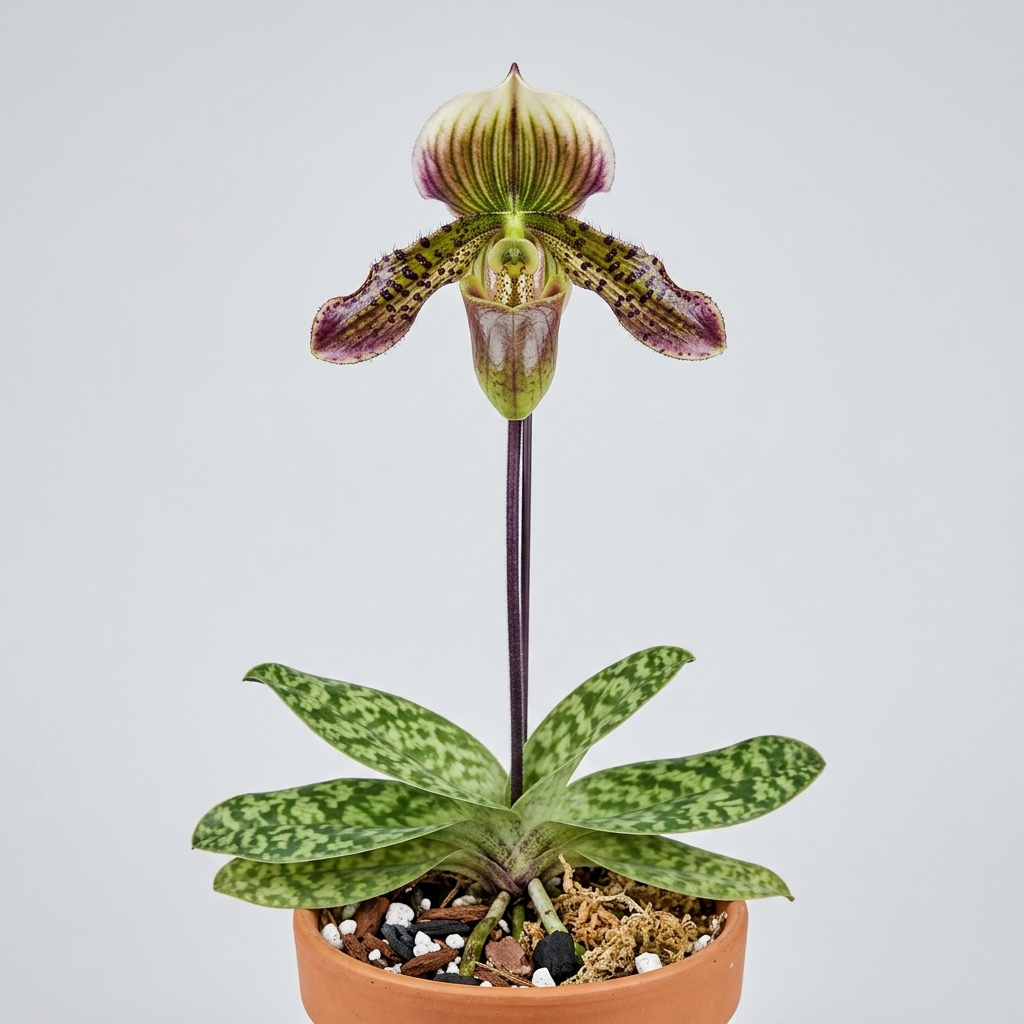
Paphiopedilum Bullenianum is a captivating terrestrial orchid species native to Southeast Asia, highly prized by collectors for its beautifully mottled foliage and elegant, pouch-shaped flowers. Belonging to the subgenus Sigmatopetalum, this slipper orchid showcases a distinctive botanical form that blends subtle forest tones with striking structural features. Its compact growth habit makes it an excellent choice for indoor growers and greenhouse enthusiasts who appreciate the intricate beauty of wild orchid species.
Cultivating this orchid offers a rewarding experience, as it bridges the gap between demanding tropical species and more resilient household plants. The striking contrast between its tessellated green leaves and its uniquely poised blossoms ensures that it remains a standout specimen even when not in bloom. By understanding its natural forest-floor habitat, growers can successfully replicate the moderate shade and consistent moisture required to help this exquisite slipper orchid thrive.
💡 Did You Know?
Paphiopedilum Bullenianum is part of the Paphiopedilum orchid group, a favorite among growers because its flowers, growth habit, and care needs make it useful for comparing cultivated orchids within the same . Observing its leaves, roots, and bloom spikes can help growers understand how this cultivar responds to indoor conditions.
🌿 Botanical Overview
Paphiopedilum Bullenianum is primarily found in the wild across Malaysia, Sumatra, and Borneo, where it typically grows as a terrestrial or lithophytic plant in the leaf litter of moist, shaded forests. It is found at elevations ranging from sea level up to moderate mountain slopes, which dictates its adaptable temperature preferences. The vegetative growth is characterized by a fan-shaped growth habit, with each growth consisting of several oblong, distichous leaves.
The foliage of this species is highly ornamental, featuring a distinct light and dark green mottled pattern on the upper surface, often with a purple-tinted underside near the base. This tessellation is an evolutionary adaptation to capture filtered light on the forest floor. The root system is typical of slipper orchids, consisting of thick, hairy, brownish roots that spread laterally through loose organic debris rather than penetrating deep into the soil.
🌸 Flower Characteristics
The inflorescence of Paphiopedilum Bullenianum emerges from the center of a mature leaf fan, producing a single, long, erect spike that can reach up to 30 to 40 centimeters in height. The flowers are moderately sized, typically measuring between 7 and 10 centimeters across, and are held well above the foliage. The dorsal sepal is usually ovate, featuring a pale green or whitish background with darker green vertical veining and sometimes a soft pinkish blush near the margins.
The petals are spreading, slightly reflexed, and decorated with dark spots or warts along the margins, ending in spatulate tips that often display a reddish-purple hue. The most prominent feature is the deeply pouched labellum, or slipper, which is typically dull green to brownish-yellow, sometimes flushed with bronze or purple. This specialized pouch serves as a pollination trap in nature, directing specific insect pollinators past the reproductive organs.
Fragrance & Bloom Profile
Unlike some of its highly fragrant orchid relatives, Paphiopedilum Bullenianum is generally considered to be unscented. While some growers occasionally report a very faint, earthy aroma under warm, humid conditions, a distinct fragrance profile is not consistently documented in horticultural literature. The primary appeal of this orchid lies entirely in its visual complexity, structural elegance, and the longevity of its individual blossoms.
A single flower can remain in pristine condition for six to eight weeks, and sometimes even longer if kept in a cool, stable environment. The long-lasting nature of the blooms makes it a highly satisfying plant to display. Because the spikes are single-flowered, the plant focuses its energy on maintaining one high-impact blossom per growth cycle rather than producing a succession of short-lived flowers.
Parentage & Hybrid Lineage
As a naturally occurring species rather than an artificial hybrid, Paphiopedilum Bullenianum carries a pure genetic lineage that has been used to introduce desirable traits into modern slipper orchid breeding. It belongs to a group of closely related species within the section Barbata, and its taxonomy has occasionally been subject to debate, with some botanists classifying closely related forms as varieties or distinct species.
In hybridization, this species is valued for imparting its mottled foliage, compact growth habit, and long, sturdy flower spikes to its offspring. When crossed with other Paphiopedilum species, it often contributes to hybrids with improved heat tolerance and unique petal spotting. However, because registration records can vary, specific hybrid parentage should be verified through official orchid registries for absolute certainty.
🌱 Growing Conditions
Replicating the understory environment of Southeast Asian rainforests is the key to successfully growing Paphiopedilum Bullenianum. It thrives in moderate to deep shade, requiring bright, indirect light but absolute protection from direct afternoon sunlight, which can easily scorch the sensitive mottled leaves. An east-facing window or a shaded south-facing window with sheer curtains provides ideal lighting conditions.
💡 Care Tip
For best results, grow Paphiopedilum Bullenianum in bright filtered with steady and gentle airflow. Avoid placing the plant in harsh midday sun, but do not keep it in a dark corner; weak is one of the most common reasons cultivated orchids refuse to rebloom.
Temperature: wise, this orchid is quite adaptable, preferring intermediate to warm conditions. Ideal daytime temperatures range from 21°C to 28°C (70°F to 82°F), with a slight drop at night to around 15°C to 18°C (60°F to 65°F) to stimulate healthy growth and blooming. High humidity levels between 50% and 70% are highly beneficial, accompanied by gentle, continuous air movement to prevent stagnant moisture from settling on the foliage.
Watering, Feeding & Potting Media
Unlike epiphytic orchids with pseudobulbs, Paphiopedilum Bullenianum does not store water and should never be allowed to dry out completely. The potting medium should remain consistently damp but never soggy or waterlogged. Watering frequency depends on environmental conditions, but typically involves thoroughly soaking the medium once or twice a week with rainwater, distilled water, or low-mineral tap water.
A well-draining, moisture-retentive potting mix is essential. A classic blend consists of fine to medium fir bark mixed with perlite, charcoal, and a small amount of chopped sphagnum moss to retain moisture. Feeding should be light and consistent; use a balanced, water-soluble orchid fertilizer diluted to one-quarter strength every two to three waterings during the active growing season, flushing the pot with pure water periodically to prevent salt buildup.
Blooming Season & Care Notes
The primary blooming season for Paphiopedilum Bullenianum typically occurs in the spring and summer, though flowers can occasionally appear at other times of the year depending on local growing conditions. As the new growth matures, a flower bud will slowly emerge from the center of the leaf fan. During this development phase, avoid changing the plant’s orientation to the light source to prevent the spike from twisting or growing crookedly.
Once the bloom fades, the flower spike can be cut back close to the base of the fan. The fan that produced the flower will not bloom again; instead, the plant will direct its energy into producing new vegetative leads from the base. Repotting is best performed every one to two years in the spring, immediately after flowering has finished, to refresh the decomposing medium and ensure the roots have access to fresh oxygen.
⚠️ Common Issues
⚠️ Common Mistake
The most common mistake is by calendar instead of root and potting-media condition. Paphiopedilum roots need moisture and air at the same time, so constantly wet bark or sphagnum can lead to root loss even when the leaves still look healthy.
- Root Rot:
Caused by overwatering or compacted, poorly draining media that deprives the roots of oxygen. - Leaf Scorch: Appears as bleached or brown patches on the foliage, indicating exposure to excessive direct sunlight.
- Bud Blast:
The premature drying and dropping of flower buds, often triggered by sudden temperature fluctuations, low humidity, or drafty conditions. - Mealybugs and Scale: Common pests that hide in the tight crevices of the leaf fans and under the flower bracts; treat promptly with insecticidal soap or horticultural oil.
- Bacterial Soft Rot: Fast-spreading brown, watery spots on the leaves, usually caused by water sitting in the crown of the plant overnight.
❓ Frequently Asked Questions
How often should I water my Paphiopedilum Bullenianum?
Watering should be frequent enough to keep the potting medium consistently moist but not saturated. Typically, this means watering once or twice a week, depending on your home’s temperature and humidity. Always check the moisture level of the mix just below the surface before watering, and never let the pot sit in standing water.
Does this orchid require a winter rest period to bloom?
No, Paphiopedilum Bullenianum does not require a dry or cold winter rest period. It prefers relatively consistent moisture and warm-to-intermediate temperatures year-round. However, a slight drop in nighttime temperatures during the autumn months can help stimulate the initiation of new flower spikes.
Can I grow Paphiopedilum Bullenianum under artificial LED lights?
Yes, this species adapts exceptionally well to artificial LED grow lights. Because it prefers moderate to low light levels, place the plant toward the edges of your light setup or keep the light fixture at a moderate distance (about 12 to 18 inches above the foliage) to avoid light stress or leaf bleaching.
Why are the tips of my orchid’s leaves turning brown?
Brown leaf tips are commonly caused by low humidity, underwatering, or a buildup of fertilizer salts in the potting medium. Ensure your humidity remains above 50%, water thoroughly until it drains freely from the bottom of the pot, and flush the medium with pure water once a month to remove excess salts.
⭐ Final Growing Notes
Paphiopedilum Bullenianum is a rewarding and visually striking orchid that brings the mysterious charm of Southeast Asian rainforests into the home. Its combination of beautifully patterned foliage and unique, long-lasting slipper flowers makes it a prized addition to any orchid collection. By maintaining consistent moisture, providing gentle filtered light, and ensuring adequate humidity, growers of all experience levels can enjoy the enduring beauty of this remarkable species.
⚕️ Health, Safety & Edibility
Understanding how a plant interacts with people, pets, and the surrounding environment is part of responsible cultivation. This section uses conservative, general guidance and does not replace professional medical or veterinary advice.
Human Safety: No published evidence currently identifies species-specific toxicity concerns for Paphiopedilum Bullenianum during normal handling. As with most ornamental plants, it should not be intentionally consumed.
Pet Safety: Published information does not indicate that this orchid commonly poses a toxicity concern for cats or dogs. However, chewing leaves, flowers, roots, or potting media may still cause mild digestive upset.
Edibility: This orchid is cultivated for ornamental display rather than food. Ornamental plants may carry fertilizers, pesticides, or other horticultural treatments that make them unsuitable for consumption.
Skin Contact: Routine handling is not generally associated with skin irritation. Gardeners with sensitive skin may prefer wearing gloves when repotting, pruning, or handling potting media.
🌱 Propagation Tip
Propagation should be approached patiently. Most home growers should wait for natural keikis or divide only mature, healthy plants when the orchid type allows it. Never remove a young growth until it has strong roots and enough leaves to support itself away from the parent plant.
⭐ Expert Advice
Repot after flowering when fresh root tips begin to appear. This timing helps the plant anchor quickly into new bark or sphagnum and reduces stress, especially for orchids grown indoors where airflow, , and drying speed can change from season to season.

Leave A Comment