
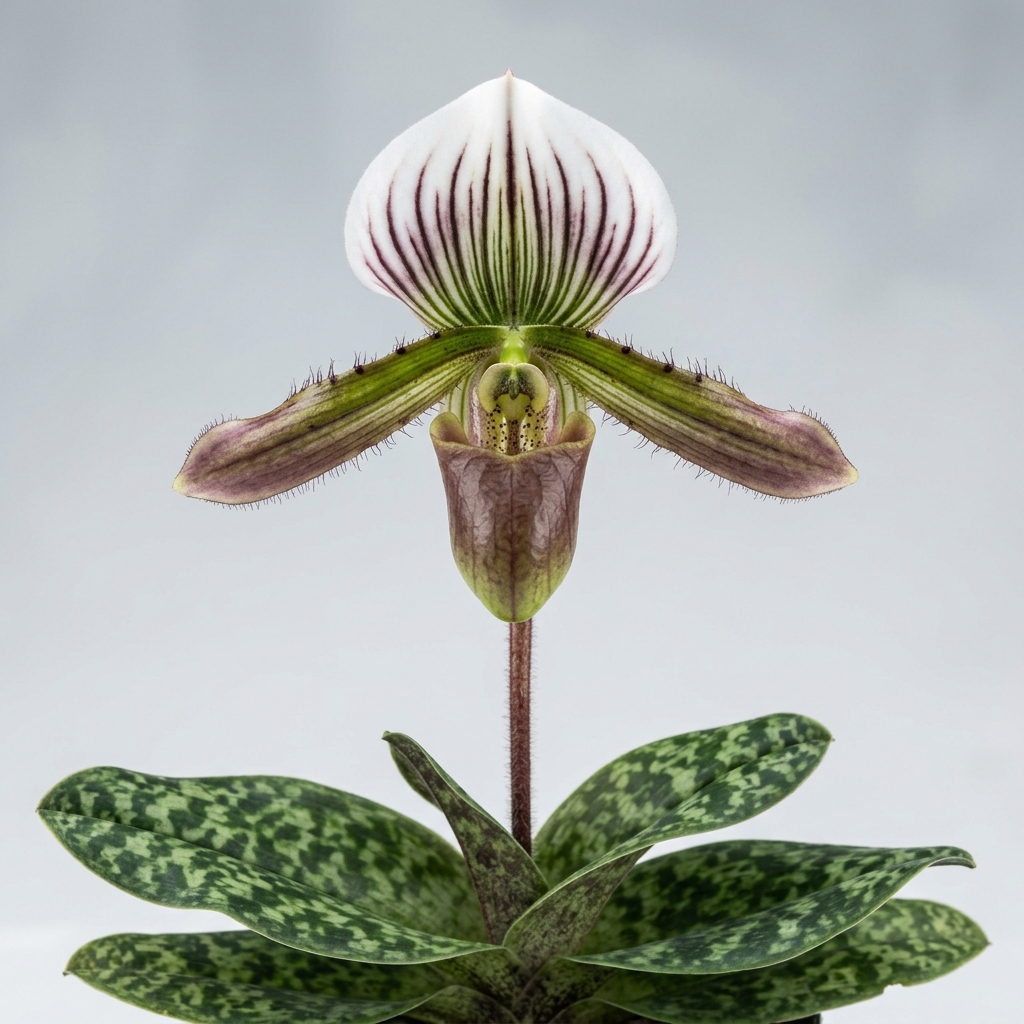
Paphiopedilum Dayanum is a highly sought-after terrestrial orchid prized for both its striking foliage and uniquely structured flowers. Often referred to as Day’s Paphiopedilum, this orchid belongs to the slipper orchid group, characterized by a pouch-like labellum that captures the attention of collectors and casual growers alike. Its distinctive growth habit and dramatic floral presentation make it a standout addition to indoor orchid collections.
Cultivators particularly value this orchid for its beautifully mottled, tessellated leaves, which provide year-round visual interest even when the plant is not in bloom. When it does flower, it produces a solitary, long-lasting blossom on an upright spike, showcasing a sophisticated palette of green, white, and purplish-brown tones. While it requires specific attention to humidity and moisture, mastering its care rewards growers with a classic display of slipper orchid elegance.
💡 Did You Know?
The striking mottled pattern on the leaves of Paphiopedilum Dayanum is a natural adaptation to life on the dim rainforest floor. This variegation helps the plant capture different wavelengths of filtered , allowing it to photosynthesize efficiently beneath the dense jungle canopy where direct sunlight rarely penetrates.
🌿 Botanical Overview
Paphiopedilum Dayanum is native to the understory of tropical rainforests, particularly in Borneo, where it grows in leaf litter and mossy crevices. This terrestrial or lithophytic growth habit dictates its preference for shady, humid, and well-aerated root environments. Unlike epiphytic orchids that grow high in tree canopies, this species thrives closer to the forest floor, receiving dappled, highly filtered sunlight.
The foliage is one of its most defining botanical features. The leaves are oblong-elliptic, presenting a striking variegated pattern of dark green and pale grayish-green patches. This tessellation is an adaptation to low-light environments, maximizing light absorption. The plant grows in a neat rosette pattern, with each growth producing a single inflorescence from the center before eventually producing new offsets at the base.
🌸 Flower Characteristics
The blossoms of Paphiopedilum Dayanum are celebrated for their dramatic, almost gothic architecture. Each flower features a prominent, pointed dorsal sepal that is typically white or pale green with dark green vertical veins. The petals are long, spreading horizontally or slightly drooping, and are fringed with dark, hair-like cilia along the margins. These petals often display a purplish-brown coloration toward the tips, contrasting beautifully with the green base.
The pouch, or labellum, is deeply cupped and helmet-shaped, usually showing a deep brownish-purple or olive-green hue with intricate veining. The entire flower is held aloft on a dark, pubescent stem that can reach up to 12 inches in height. This elevated presentation ensures the flower stands clear of the foliage, making it highly visible to potential pollinators in its natural habitat.
Fragrance & Bloom Profile
This orchid is generally considered to be non-fragrant. While some growers occasionally report a faint, earthy scent under specific temperature and humidity conditions, a distinct or sweet fragrance is not a documented characteristic of this species. Instead, its evolutionary strategy relies entirely on visual mimicry and structural design to attract pollinators.
The lack of scent is more than compensated for by the longevity of the blooms. A single flower can remain pristine on the plant for six to eight weeks, and sometimes longer if kept in cool, stable conditions. Because the flowers open slowly and hold their form exceptionally well, they provide a long-lasting focal point in any growing space.
Parentage & Hybrid Lineage
Paphiopedilum Dayanum is a naturally occurring species rather than a man-made hybrid. In orchid registration, it is recognized as a primary species within the subgenus Sigmatopetalum. Because of its striking leaf patterns and elongated, ciliated petals, it has been used extensively in hybridization programs to introduce dark veining, mottled foliage, and unique petal shapes to modern slipper orchid hybrids.
While pure species specimens are highly prized by purists, various line-bred cultivars exist within the trade, selected for larger flower size, more intense coloration, or stronger leaf variegation. When purchasing, growers should note that individual plants may exhibit slight variations in petal length and pouch color, reflecting the natural diversity of the species.
🌱 Growing Conditions
To cultivate Paphiopedilum Dayanum successfully, one must replicate the warm, shaded, and humid environment of its native rainforest floor. It thrives in low to medium indirect light, similar to the light levels preferred by Phalaenopsis orchids. Direct sunlight must be strictly avoided, as it will quickly scorch the delicate, variegated leaves and cause unsightly brown patches.
💡 Care Tip
To maintain the ideal for this orchid without risking root rot, place the pot on a tray filled with pebbles and water. Ensure the bottom of the pot rests on the dry pebbles above the water line to prevent water from wicking up into the media.
Temperature ranges should remain consistently warm to intermediate. Ideal daytime temperatures range between 75°F and 85°F (24°C to 29°C), with a slight drop at night to around 62°F to 68°F (17°C to 20°C). High humidity is crucial, ideally maintained between 60% and 80%. To prevent stagnant air from causing fungal issues in these humid conditions, gentle but continuous air movement using a small fan is highly recommended.
Watering, Feeding & Potting Media
Unlike many epiphytic orchids, Paphiopedilum Dayanum does not possess pseudobulbs for water storage. Consequently, it has a very low tolerance for drought and should never be allowed to dry out completely. The potting medium should be kept consistently damp but never soggy or waterlogged, which would quickly suffocate the thick, hairy roots. Watering once or twice a week is typical, depending on indoor humidity and temperature.
A well-draining, moisture-retentive potting mix is essential. A combination of fine-grade fir bark, chopped sphagnum moss, perlite, and a small amount of charcoal works exceptionally well. Feeding should be done conservatively; use a balanced, water-soluble orchid fertilizer diluted to one-quarter strength every two to three weeks during the active growing season, followed by a flush with pure water to prevent salt buildup.
Blooming Season & Care Notes
The primary blooming season for Paphiopedilum Dayanum typically occurs in the spring and early summer, though occasional autumn blooms are not uncommon. The emergence of a flower spike is preceded by the maturation of a new leaf rosette. Once the flower eventually fades, the spike should be cut down close to the base of the leaves using sterile cutting tools.
Repotting is best performed every one to two years, ideally just after the blooming cycle has finished and new root growth is visible. Slipper orchids prefer slightly snug pots, so only increase the pot size if the root system has completely outgrown the current container. When repotting, handle the brittle, hairy roots with extreme care to avoid damage.
⚠️ Common Issues
⚠️ Common Mistake
A frequent error is allowing water to collect and remain in the center of the leaf rosette or the flower bracts. This trapped moisture can quickly lead to crown rot, which is often fatal to the plant. Always water the potting medium directly, avoiding the foliage.
- Root Rot: Caused by overwatering or compacted, decomposing potting media that retains too much water and lacks aeration.
- Leaf Scorch: Bleached or dry brown patches on the leaves resulting from exposure to direct sunlight or excessively high light levels.
- Mealybugs and Scale: Common pests that hide in the tight crevices at the base of the leaves or under the flower bracts.
- Bud Blast: The premature drying and dropping of developing flower buds, often triggered by sudden changes in temperature, low humidity, or drafty locations.
- Fungal Leaf Spotting: Dark spots on the foliage caused by water sitting on the leaves overnight in stagnant, humid air.
❓ Frequently Asked Questions
How often should I water my Paphiopedilum Dayanum?
Watering frequency depends on your growing environment, but the potting medium should remain consistently moist. Typically, watering once or twice a week is sufficient. Always check the moisture level just below the surface of the media before watering, and never let the pot sit in standing water.
Why are the leaves on my orchid turning yellow?
Yellowing leaves can indicate several issues, including overwatering, underwatering, or excessive light. If the lower, older leaves yellow and drop slowly over time, it is likely a natural aging process. However, widespread yellowing accompanied by soft stems usually points to root rot from overwatering.
Does Paphiopedilum Dayanum require a winter chill to bloom?
No, this species is a warm-to-intermediate grower and does not require a cold period to initiate blooming. Instead, maintaining consistent temperatures with a slight, natural day-to-night temperature drop of about 10 degrees Fahrenheit is sufficient to encourage seasonal flower spikes.
Can I grow this orchid under artificial LED lights?
Yes, this orchid adapts very well to artificial LED grow lights. Because it prefers low-to-medium light levels, place the plant toward the edges of the light setup or keep the fixtures at a moderate distance to prevent leaf scorch. Aim for a photoperiod of about 12 to 14 hours daily.
⭐ Final Growing Notes
Paphiopedilum Dayanum is an exquisite representative of the slipper orchid genus, offering a rewarding cultivation experience for intermediate growers. By providing consistent moisture, shaded conditions, and high humidity, you can enjoy its spectacular, long-lasting blooms and striking variegated foliage for many years. It remains a timeless classic that brings a touch of tropical rainforest elegance to any indoor collection.
⚕️ Health, Safety & Edibility
Understanding how a plant interacts with people, pets, and the surrounding environment is part of responsible cultivation. This section uses conservative, general guidance and does not replace professional medical or veterinary advice.
Human Safety: No published evidence currently identifies species-specific toxicity concerns for Paphiopedilum Dayanum during normal handling. As with most ornamental plants, it should not be intentionally consumed.
Pet Safety: Published information does not indicate that this orchid commonly poses a toxicity concern for cats or dogs. However, chewing leaves, flowers, roots, or potting media may still cause mild digestive upset.
Edibility: This orchid is cultivated for ornamental display rather than food. Ornamental plants may carry fertilizers, pesticides, or other horticultural treatments that make them unsuitable for consumption.
Skin Contact: Routine handling is not generally associated with skin irritation. Gardeners with sensitive skin may prefer wearing gloves when repotting, pruning, or handling potting media.
🌱 Propagation Tip
Slipper orchids like this species are propagated by division rather than stem cuttings. Wait until the plant has formed a large clump with multiple mature rosettes, then gently separate them during repotting, ensuring each division has at least two or three healthy growths and an active root system.
⭐ Expert Advice
If your orchid is healthy but refuses to bloom, try slightly increasing the and ensuring there is a distinct day-to-night drop of about 10 degrees Fahrenheit. This natural fluctuation mimics its native habitat and is often the key trigger for flower spike development.

Leave A Comment