
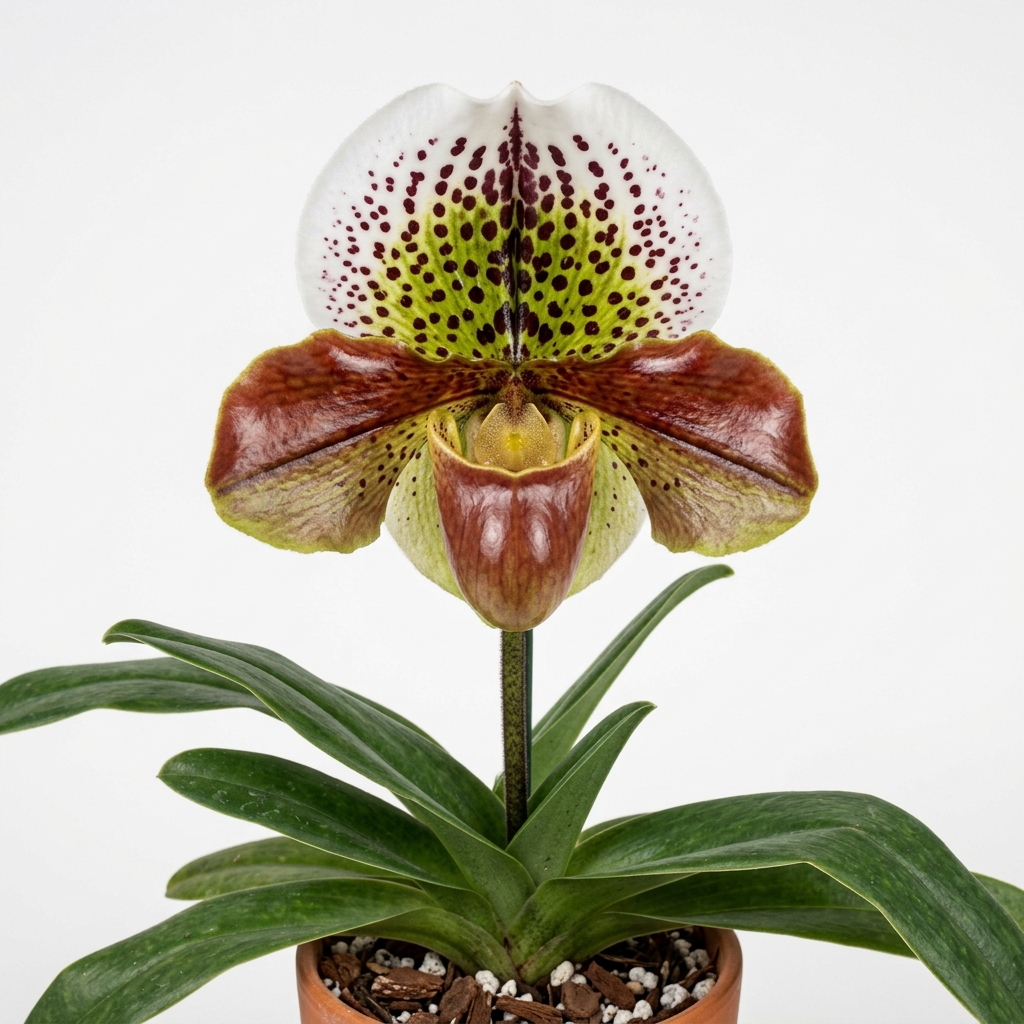
Paphiopedilum Winston Churchill is widely recognized as one of the most famous and influential complex slipper orchid hybrids in horticultural history. Noted for its massive, rounded “bulldog” flower form and robust growth habit, this classic orchid has been a cornerstone of modern slipper orchid breeding for decades. Its stately presence and long-lasting flowers make it a highly prized centerpiece in any orchid collection, appealing to both novice hobbyists and seasoned exhibitors.
Growers highly value this cultivar for its striking, glossy blooms that feature a prominent, heavily spotted dorsal sepal and rich mahogany-toned petals and pouch. Unlike many delicate wild species, this hybrid shows a vigorous growth habit, producing fans of leathery, strap-like green leaves that remain attractive even when the plant is not in bloom. With proper care, it rewards growers with spectacular, long-lasting winter displays.
💡 Did You Know?
Paphiopedilum Winston Churchill is widely regarded as one of the most influential parents in slipper orchid hybridizing history. Its genetics are present in thousands of modern 'bulldog' Paphiopedilum crosses, prized for passing down its exceptional round form, heavy substance, and distinctive spotted dorsal sepal to subsequent generations.
🌿 Botanical Overview
Paphiopedilum Winston Churchill belongs to the group of slipper orchids commonly referred to as “complex hybrids” or “bulldog” Paphiopedilums. These plants are the result of generations of selective breeding aimed at producing large, round, and symmetrical flowers with heavy substance. Unlike many other orchid genera, Paphiopedilums do not possess pseudobulbs, meaning they rely on their thick, fleshy roots and leathery leaves to store moisture and nutrients.
The growth habit of this cultivar is sympodial, characterized by a series of leafy fans that emerge from a creeping rhizome. Each fan grows to maturity, produces a single flower spike from its center, and then slowly declines over several years while producing new offset fans at its base. The foliage is solid green, lacking the mottled patterns found on warmer-growing slipper orchid species, which indicates its preference for slightly cooler growing conditions.
🌸 Flower Characteristics
The defining feature of Paphiopedilum Winston Churchill is its magnificent, waxy flower. The bloom is exceptionally flat and round, often reaching up to four or five inches in diameter. The dominant feature is the large, upright dorsal sepal, which typically displays a clean white border surrounding a green or yellow center that is heavily brushed or spotted with deep maroon or chocolate brown.
The lateral petals are broad, horizontal, and slightly glossy, featuring a rich mahogany-red coloration with a distinct horizontal line dividing the upper and lower halves. The pouch, or labellum, is shaped like a rounded slipper or helmet, showing off a highly polished, deep reddish-brown hue. This heavy-textured flower is supported by a sturdy, upright spike that holds the bloom well above the foliage for an elegant presentation.
Fragrance & Bloom Profile
Fragrance is not consistently documented for Paphiopedilum Winston Churchill, and like the vast majority of complex slipper orchid hybrids, it is generally considered unscented. Instead of relying on scent to attract pollinators, the plant focuses its evolutionary energy on creating highly durable, visually striking flowers designed to last for an extended period.
The blooming profile of this cultivar is highly rewarding. A single flower can remain in pristine condition on the plant for six to eight weeks, and sometimes even longer if kept in cool, stable conditions. The flowers open slowly, taking several days to fully expand and flatten, allowing growers to enjoy the gradual unfurling of the impressive bloom.
Parentage & Hybrid Lineage
Registered in the mid-20th century, Paphiopedilum Winston Churchill is a classic hybrid whose lineage traces back to foundational species such as Paphiopedilum insigne, Paphiopedilum villosum, and Paphiopedilum spicerianum. While historical registration records attribute its direct parentage to the cross between Paphiopedilum Eridge and Paphiopedilum Hampden, its exact genetic influence is best appreciated through its extensive legacy as a parent plant.
This cultivar revolutionized slipper orchid breeding by consistently passing on its desirable traits of roundness, flat presentation, and heavy flower substance to its offspring. It has been used in thousands of later crosses, making it one of the most decorated and influential grexes in the history of the Royal Horticultural Society and the American Orchid Society.
🌱 Growing Conditions
To grow Paphiopedilum Winston Churchill successfully, intermediate to cool temperatures are ideal. Daytime temperatures should ideally range between 68°F and 75°F, with a night drop to around 55°F to 60°F. This temperature differential is particularly important in the autumn, as it helps stimulate the initiation of flower buds within the mature leaf fans.
💡 Care Tip
To prevent crown rot, always water this orchid early in the day and avoid getting water trapped in the center of the leaf fan. If water does pool in the crown, gently absorb it with a paper towel and ensure adequate air circulation.
Light requirements are modest compared to other orchid genera. This plant thrives in bright, filtered light, such as that provided by an east-facing window or a shaded south-facing window. Direct, intense sunlight will quickly scorch the leaves, turning them pale yellow or brown. Adequate air movement is also crucial; a gentle breeze from a nearby fan helps prevent stagnant air around the foliage, reducing the risk of fungal infections.
Watering, Feeding & Potting Media
Because Paphiopedilum Winston Churchill lacks pseudobulbs, it has no capacity to store water for long periods. Consequently, the potting medium should be kept evenly moist but never waterlogged. Water the plant thoroughly when the top half-inch of the media begins to feel slightly dry. Avoid letting the pot sit in standing water, as this will quickly suffocate the thick, hairy roots and lead to root rot.
A well-draining, moisture-retentive potting mix is essential. A fine-grade fir bark mixed with perlite, charcoal, and a small amount of chopped sphagnum moss works exceptionally well. Feed the orchid weekly with a highly diluted, balanced orchid fertilizer, often referred to as “weakly, weekly.” It is highly recommended to flush the pot with pure, unfertilized water once a month to wash away any accumulated mineral salts.
Blooming Season & Care Notes
The primary blooming season for Paphiopedilum Winston Churchill spans from late autumn through the winter months, though occasional blooms can occur in early spring. As the flower spike emerges from the center of the leaf fan, it may require gentle staking to support the heavy bloom and ensure it faces forward for optimal display.
Once the flower finally fades and drops, cut the spike off as close to the base of the fan as possible. The fan that produced the flower will not bloom again; instead, it will direct its energy into growing new vegetative leads from the base. Repotting should be performed every one to two years, preferably in the spring after flowering has finished, to refresh the decomposing bark and ensure the roots remain healthy.
⚠️ Common Issues
⚠️ Common Mistake
A frequent error is letting the potting medium dry out completely between waterings. Unlike Cattleyas, Paphiopedilums lack water-storing pseudobulbs and require consistent, even moisture to prevent root loss and leaf shriveling.
- Root Rot:
Caused by overwatering or compacted potting media that prevents oxygen from reaching the roots. - Crown Rot:
Occurs when water is allowed to sit in the center of the leaf fan, especially in cool or stagnant conditions. - Bud Blast:
The premature drying and dropping of flower buds, often triggered by sudden temperature fluctuations, low humidity, or drafts. - Leaf Scorch: Yellowing or bleached patches on the leaves caused by exposure to direct, intense sunlight.
- Pests:
Mealybugs and scale insects can occasionally hide in the tight crevices of the leaf bases and must be treated promptly.
❓ Frequently Asked Questions
How often should I water my Paphiopedilum Winston Churchill?
Watering frequency depends on your home’s environment, but typically ranges from once to twice a week. The goal is to keep the potting medium evenly damp, never allowing it to dry out completely or remain soggy.
Does this orchid require a winter chill to bloom?
While it does not require freezing temperatures, a subtle drop in night temperatures to around 55°F to 60°F during the autumn months is highly beneficial for triggering the development of flower spikes.
Can I grow Paphiopedilum Winston Churchill under artificial LED lights?
Yes, this cultivar adapts very well to indoor growing under LED lights. Keep the lights at a moderate distance to mimic filtered shade, ensuring the leaves maintain a healthy, medium-green color.
What should I do if the leaves start turning yellow?
Yellowing leaves can indicate either excessive light or root damage from overwatering. Move the plant to a slightly shadier location and check the root system to ensure it is firm, healthy, and not rotting.
⭐ Final Growing Notes
Paphiopedilum Winston Churchill remains an enduring classic for good reason. Its magnificent, heavy-textured “bulldog” blooms and relatively forgiving nature make it an exceptionally rewarding orchid to cultivate. By providing consistent moisture, moderate light, and cool to intermediate temperatures, growers can enjoy the timeless beauty of this legendary slipper orchid hybrid year after year.
⚕️ Health, Safety & Edibility
Understanding how a plant interacts with people, pets, and the surrounding environment is part of responsible cultivation. This section uses conservative, general guidance and does not replace professional medical or veterinary advice.
Human Safety: No published evidence currently identifies species-specific toxicity concerns for Paphiopedilum Winston Churchill during normal handling. As with most ornamental plants, it should not be intentionally consumed.
Pet Safety: Published information does not indicate that this orchid commonly poses a toxicity concern for cats or dogs. However, chewing leaves, flowers, roots, or potting media may still cause mild digestive upset.
Edibility: This orchid is cultivated for ornamental display rather than food. Ornamental plants may carry fertilizers, pesticides, or other horticultural treatments that make them unsuitable for consumption.
Skin Contact: Routine handling is not generally associated with skin irritation. Gardeners with sensitive skin may prefer wearing gloves when repotting, pruning, or handling potting media.
🌱 Propagation Tip
Slipper orchids do not produce pseudobulbs or keikis, so propagation is achieved by division. Only divide mature plants during repotting, ensuring each new division has at least three healthy, leafy fans with active root systems to ensure survival.
⭐ Expert Advice
For optimal blooming, provide a slight drop in night temperatures (around 10 to 15 degrees Fahrenheit) during the early autumn months. This natural fluctuation helps trigger the development of the flower spike deep within the leaf fan.

Leave A Comment