
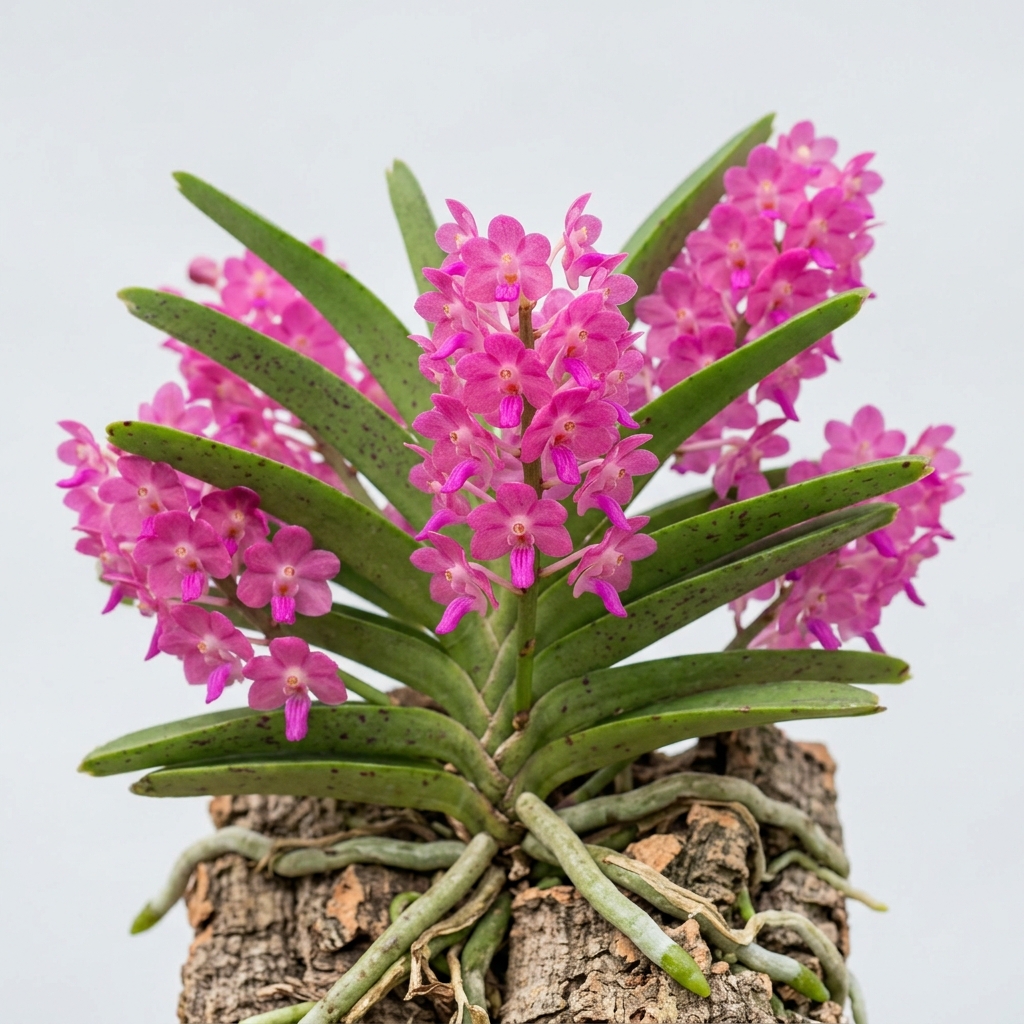
Vanda Ampullacea, historically known and loved by collectors as Ascocentrum ampullaceum, is a delightful miniature monopodial orchid species celebrated for its vibrant floral displays. Native to the seasonally dry forest regions of the Himalayas and Southeast Asia, this compact epiphyte produces dense, upright clusters of vivid rose-pink to magenta blossoms that contrast beautifully with its stiff, fan-like foliage. Its small stature makes it an exceptional choice for indoor growers and greenhouse hobbyists who appreciate the dramatic impact of Vanda-type orchids but have limited growing space.
Unlike its larger Vanda relatives, Vanda Ampullacea maintains a highly manageable growth habit, rarely exceeding a few inches in height. Despite its diminutive size, a mature specimen can put on a spectacular show, pushing multiple flower spikes simultaneously from the leaf axils. This species is highly valued for its resilience, adaptability to basket culture, and its reliable spring blooming cycle, making it a rewarding addition to any diverse orchid collection.
💡 Did You Know?
Vanda Ampullacea is part of the Vanda orchid group, a favorite among growers because its flowers, growth habit, and care needs make it useful for comparing cultivated orchids within the same . Observing its leaves, roots, and bloom spikes can help growers understand how this cultivar responds to indoor conditions.
🌿 Botanical Overview
Vanda Ampullacea is a classic miniature monopodial epiphyte, meaning it grows vertically from a single stem rather than spreading via pseudobulbs. The plant features distichous, strap-like leaves that are thick, leathery, and arranged in a neat, V-shaped fan. Under high-light conditions, the foliage often develops attractive purple or reddish speckling, which is a natural protective pigmentation response and a sign of adequate light levels.
The root system of this species is robust and fleshy, typical of epiphytic Vandas. These aerial roots are covered in a thick layer of velamen, which rapidly absorbs moisture and nutrients from the air and rain before drying out quickly. In its native habitat, Vanda Ampullacea clings to the branches of deciduous trees, experiencing distinct wet and dry seasons that dictate its growth and flowering cycles.
🌸 Flower Characteristics
The defining feature of Vanda Ampullacea is its dense, cylindrical inflorescence. The flower spikes emerge from the leaf axils, growing upright to a height of three to eight inches. Each spike can carry anywhere from ten to over thirty tightly packed, long-lasting flowers. The individual blossoms are relatively small, typically measuring about half an inch to three-quarters of an inch in diameter.
The sepals and petals are similarly sized, presenting a flat, open face in shades ranging from deep rose-pink to intense magenta-red. The lip, or labellum, is narrow and features a small spur at the back, characteristic of the former Ascocentrum genus. The overall effect of multiple spikes blooming simultaneously is a brilliant, fiery torch-like display that stands out despite the plant’s small footprint.
Fragrance & Bloom Profile
While many Vanda species are highly prized for their intense perfumes, Vanda Ampullacea is generally considered to be unscented or to possess only a very faint, clean floral fragrance that is difficult to detect. Growers choose this orchid primarily for its visual impact rather than its scent. The blooms are remarkably long-lasting, often remaining pristine for four to six weeks if kept in a cool, draft-free environment.
Because the flowers open nearly simultaneously along the spike, the plant achieves its peak display quickly. To maximize the lifespan of the blooms, growers should avoid getting water directly on the petals during routine misting or watering, as standing water can encourage fungal spotting or premature petal drop.
Parentage & Hybrid Lineage
Vanda Ampullacea is a distinct, naturally occurring species rather than a man-made hybrid. Historically classified under the genus Ascocentrum, taxonomists recently transferred it to the genus Vanda based on molecular and phylogenetic data. This reclassification explains why older reference materials and plant labels still frequently list it as Ascocentrum ampullaceum.
In orchid breeding, this species has played a significant role in creating compact, colorful intergeneric hybrids, often referred to as Ascocendas (Vanda x Ascocentrum). Hybridizers value Vanda Ampullacea for its ability to pass down its miniature growth habit, upright spike presentation, and intense pink-red coloration to its offspring, allowing growers to enjoy Vanda-like flowers on much smaller, space-saving plants.
🌱 Growing Conditions
To thrive, Vanda Ampullacea requires bright, indirect light. It can tolerate some direct morning sun, but hot afternoon sunlight will scorch the leaves. A south- or east-facing window is ideal for indoor cultivation. If the leaves remain a dark, uniform green, the plant is likely not receiving enough light to trigger blooming; a light green color with subtle purple speckling indicates optimal light levels.
💡 Care Tip
For best results, grow Vanda Ampullacea in bright filtered with steady and gentle airflow. Avoid placing the plant in harsh midday sun, but do not keep it in a dark corner; weak is one of the most common reasons cultivated orchids refuse to rebloom.
This orchid prefers warm to intermediate temperatures, ideally ranging from 70°F to 85°F (21°C to 29°C) during the day, with a slight drop of 10°F to 15°F at night to mimic its natural montane habitat. High humidity between 60% and 80% is essential, especially if the plant is grown bare-root. Strong air movement must be maintained at all times to prevent stagnant moisture from causing rot.
Watering, Feeding & Potting Media
Watering Vanda Ampullacea depends heavily on how it is potted. Because its roots require rapid wet-dry cycles, the most popular method is growing it bare-root in a slatted wooden or plastic basket, or mounted on cork bark. Bare-root plants require daily watering—sometimes twice a day during hot summer months—by thoroughly soaking the roots until they turn bright green.
If grown in a pot, a highly porous, fast-draining medium such as extra-large fir bark chunks, charcoal, and perlite must be used. Feed the plant weekly during the active spring and summer growing season with a balanced, water-soluble orchid fertilizer diluted to one-quarter strength. Flush the root system with pure water once a month to prevent harmful fertilizer salt buildup.
Blooming Season & Care Notes
Vanda Ampullacea typically blooms in the spring, with spikes initiating as temperatures begin to rise and day lengths increase. To encourage reliable blooming, provide a slightly cooler, drier rest period during the late autumn and winter months. During this winter rest, reduce watering frequency to every few days and withhold fertilizer, but maintain high light levels.
Once the flower spikes begin to emerge from the leaf joints, avoid changing the plant’s orientation relative to its light source, as this can cause the developing buds to twist or blast. After the flowers have completely faded, cut the spent spike off near the base of the stem using a sterile cutting tool to keep the plant tidy and prevent disease.
⚠️ Common Issues
⚠️ Common Mistake
The most common mistake is by calendar instead of root and potting-media condition. Vanda roots need moisture and air at the same time, so constantly wet bark or sphagnum can lead to root loss even when the leaves still look healthy.
- Root Rot:
Caused by stagnant water or compacted potting media. Roots should dry completely within a few hours of watering. - Bud Blast:
The sudden yellowing and dropping of flower buds before they open, usually triggered by low humidity, cold drafts, or sudden environmental changes. - Leaf Spotting: Fungal or bacterial spots can develop if water sits on the leaves overnight or if air circulation is inadequate.
- Dehydration:
Shriveled, wrinkled leaves and dry, silvery roots indicate insufficient watering or low ambient humidity. - Pests:
Mealybugs and scale insects can occasionally hide in the tight crevices between the fan-shaped leaves. Treat promptly with insecticidal soap or neem oil.
❓ Frequently Asked Questions
How often should I water Vanda Ampullacea?
If grown bare-root in a basket, Vanda Ampullacea should be watered daily, or even twice daily during hot summer weather. If grown in a coarse bark mix, water every two to three days, allowing the medium to dry completely between waterings.
Can Vanda Ampullacea be grown under LED lights?
Yes, Vanda Ampullacea adapts well to indoor growing under high-output LED grow lights. Position the plant about 12 to 18 inches below the light source, ensuring it receives 12 to 14 hours of light daily to simulate its natural environment.
Why are the leaves on my Vanda Ampullacea turning purple?
A light purple or reddish speckling on the leaves is a natural response to high light levels, acting like sunscreen for the orchid. It is generally a positive sign that the plant is receiving sufficient light to produce flowers, provided the leaves are not burning.
Does Vanda Ampullacea require a winter rest?
Yes, a mild winter rest helps trigger spring blooming. During late autumn and winter, reduce watering so the roots dry out thoroughly between light mistings, withhold fertilizer, and keep the plant in slightly cooler temperatures while maintaining bright light.
⭐ Final Growing Notes
Vanda Ampullacea is a rewarding and visually stunning miniature orchid that brings the vibrant beauty of the Vanda alliance into small growing spaces. By mimicking its natural epiphytic habitat with bright light, high humidity, excellent air movement, and rapid wet-dry cycles, growers can enjoy its spectacular, torch-like magenta blooms year after year. Its compact size and resilient nature make it an absolute must-have for both novice orchid enthusiasts looking to try their hand at Vandas and seasoned collectors seeking to maximize their greenhouse space.
⚕️ Health, Safety & Edibility
Understanding how a plant interacts with people, pets, and the surrounding environment is part of responsible cultivation. This section uses conservative, general guidance and does not replace professional medical or veterinary advice.
Human Safety: No published evidence currently identifies species-specific toxicity concerns for Vanda Ampullacea during normal handling. As with most ornamental plants, it should not be intentionally consumed.
Pet Safety: Published information does not indicate that this orchid commonly poses a toxicity concern for cats or dogs. However, chewing leaves, flowers, roots, or potting media may still cause mild digestive upset.
Edibility: This orchid is cultivated for ornamental display rather than food. Ornamental plants may carry fertilizers, pesticides, or other horticultural treatments that make them unsuitable for consumption.
Skin Contact: Routine handling is not generally associated with skin irritation. Gardeners with sensitive skin may prefer wearing gloves when repotting, pruning, or handling potting media.
🌱 Propagation Tip
Propagation should be approached patiently. Most home growers should wait for natural keikis or divide only mature, healthy plants when the orchid type allows it. Never remove a young growth until it has strong roots and enough leaves to support itself away from the parent plant.
⭐ Expert Advice
Repot after flowering when fresh root tips begin to appear. This timing helps the plant anchor quickly into new bark or sphagnum and reduces stress, especially for orchids grown indoors where airflow, , and drying speed can change from season to season.

Leave A Comment